Clear Sky Science · en
A global dataset of impact forces from submarine landslides on pipelines and cables
Hidden Risks Beneath the Waves
Every video call, international bank transfer, and offshore wind farm relies on a vast, unseen network of pipes and cables laid across the seafloor. Yet this critical infrastructure is exposed to powerful underwater landslides that can snap cables and deform pipelines in an instant. This study gathers, cleans, and standardizes data from decades of experiments and computer simulations to build the most comprehensive global dataset yet on how such underwater landslides push and pull on these lifelines of the modern world.
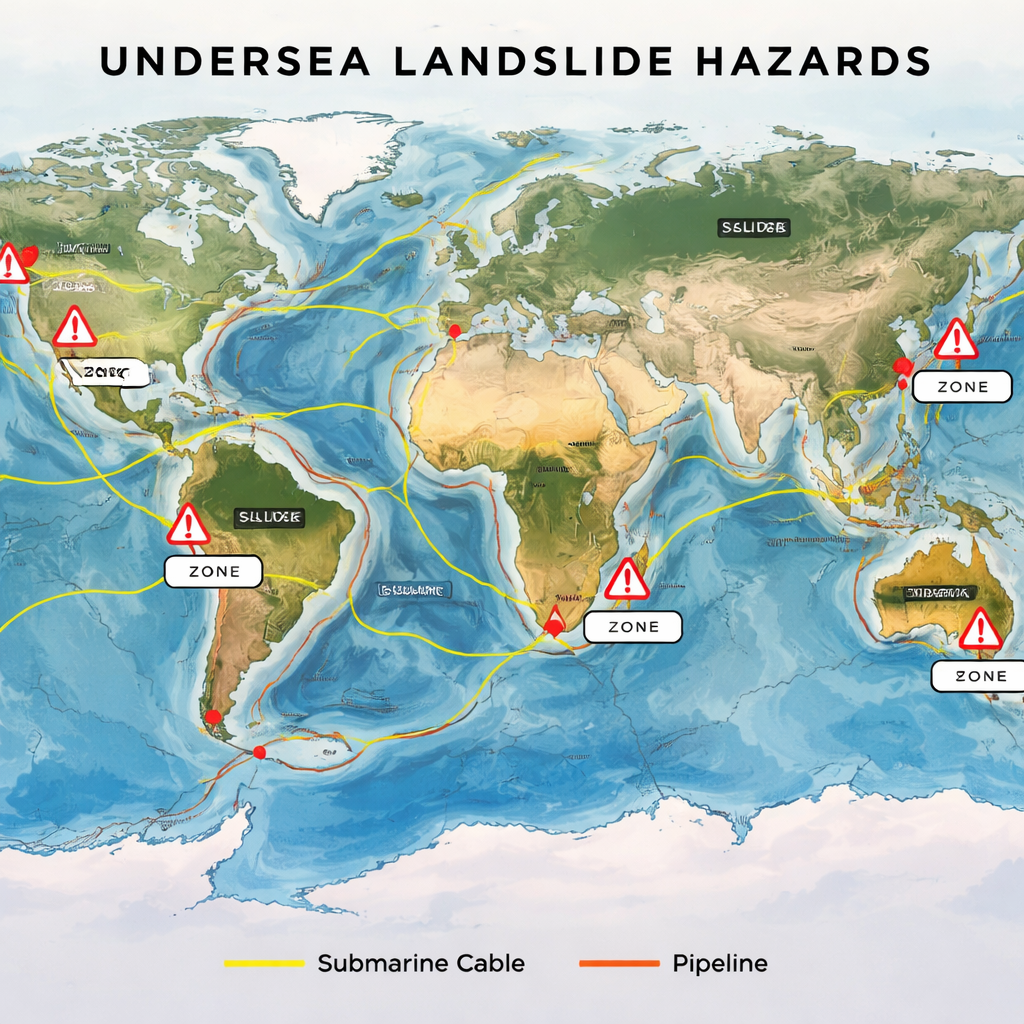
The Undersea Highway System
Oil and gas pipelines and fiber-optic cables form a global circulation system for energy and information. Oil and gas lines already stretch more than 100,000 kilometers, while communication cables exceed 1.4 million kilometers and continue to expand with new offshore energy projects and ever-growing data traffic. In shallow water, many of these lines are buried for protection, but in deeper seas they often lie directly on the seabed or hang slightly above it. There, they must endure strong currents and a shifting seafloor shaped by earthquakes, floods, and sediment movements.
When the Seafloor Starts to Move
Among the many hazards that threaten this infrastructure, underwater landslides stand out as both widespread and destructive. These events range from slow mudflows to fast, sediment-laden currents that can travel for hundreds of kilometers. Historical disasters have severed multiple communication cables, spilled oil, and caused major economic losses. When a slide sweeps past a pipeline or cable, it exerts complex forces: pushing along its length (drag), lifting or pressing it vertically (lift), and sometimes pulling along the cable’s axis. These forces change rapidly over time as swirling flows form, break down, and reorganize around the structure.
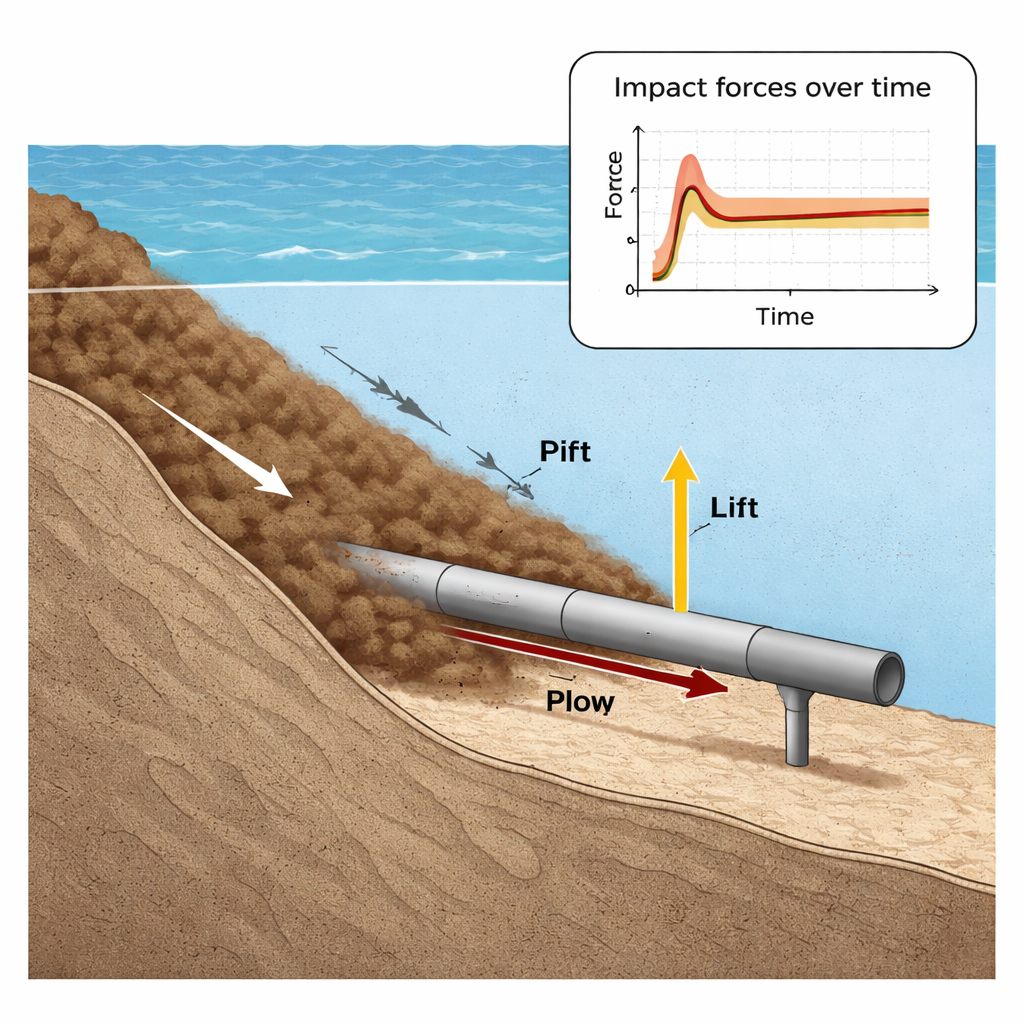
Bringing Scattered Results into One Picture
Until now, research on slide impacts has been spread across many fields, using different methods and definitions. Some teams rely on flume experiments or centrifuge models; others use advanced computer tools such as computational fluid dynamics or particle-based methods. Each study tends to frame the problem in its own way, making it hard to compare results or build broadly applicable design rules. To overcome this, the authors combed the Web of Science database for all studies linking underwater landslides and pipelines or cables, ultimately screening 868 papers and selecting 24 that reported detailed, quantitative load data.
Standardizing How Forces Are Measured
From these 24 studies, the team extracted 864 separate records of how strongly underwater slides push and lift pipelines and cables. Data originally appeared as tables or as curves plotted in figures; for the latter, the authors carefully digitized the curves without smoothing or altering them, keeping four decimal places to preserve detail. They then created a consistent set of definitions for key parameters, including flow type, slide speed, fluid properties, and geometric details such as pipeline diameter, distance above the seabed, and thickness of the slide layer above the pipe. Crucially, they unified how “peak” and “steady” forces are defined along a force–time curve so that engineers can compare results across experiments and simulations.
Making Complex Flows Easier to Compare
The dataset also sorts different conditions into simple categories based on a measure of flow behavior known as the Reynolds number, which reflects how smoothly or turbulently the slide material moves. By grouping cases into low, medium, and high flow regimes, the authors highlight how force patterns change: from smoother, more predictable loads at low values to highly fluctuating lift and drag at high values, where vortices shed from the pipeline. All records are linked back to their original references, and the dataset—organized into parameter lists, a glossary of flow types, the main data table, and a reference sheet—is openly available in spreadsheet form so others can explore, check, and reuse it.
Why This Matters for Everyday Life
For non-specialists, the value of this work lies in making our invisible infrastructure safer and more reliable. By pulling scattered measurements into a single, transparent, and carefully standardized resource, the dataset gives engineers a stronger footing to design pipelines and cables that can better withstand underwater landslides. In turn, that helps reduce the risk of oil spills, internet outages, and power disruptions that could ripple across countries and continents when the seafloor suddenly shifts.
Citation: Liu, X., Wei, S., Meng, X. et al. A global dataset of impact forces from submarine landslides on pipelines and cables. Sci Data 13, 285 (2026). https://doi.org/10.1038/s41597-026-06629-1
Keywords: submarine landslides, undersea cables, offshore pipelines, marine hazards, seafloor engineering