Clear Sky Science · en
Chromatin accessibility and transcriptome in human neuronal model exposed to Parkinson’s environmental toxins
Why everyday toxins matter for brain health
Parkinson’s disease is best known for its impact on movement, but behind the tremors and stiffness lies a complex story about how our environment can quietly reshape the brain. This study looks at two common research chemicals that mimic pesticide-like damage in nerve cells and asks a deeper question: not just whether they harm cells, but how they may subtly rewrite the way our DNA is used—without changing the DNA code itself. By mapping these invisible changes, the authors provide a publicly available resource that could help scientists uncover new clues about why so many Parkinson’s cases arise without a clear genetic cause.
Recreating Parkinson-like stress in a dish
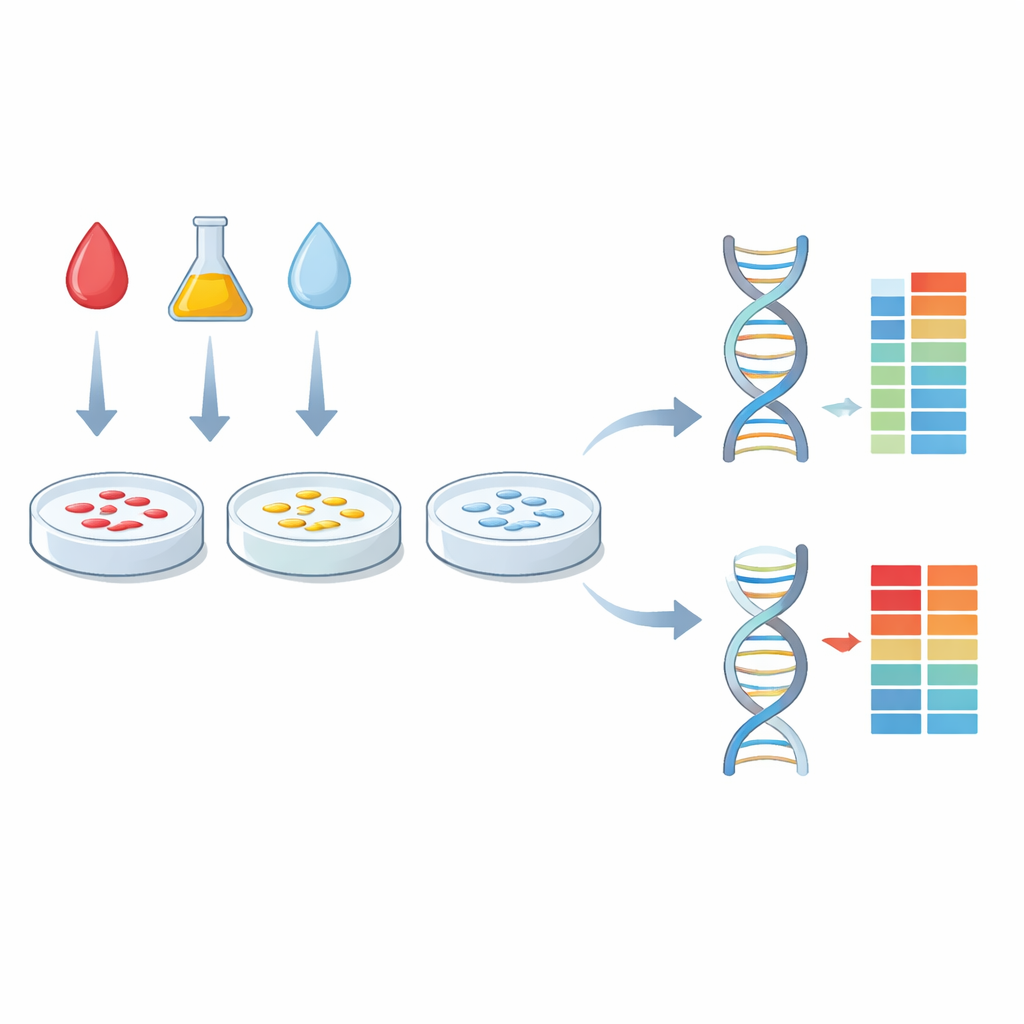
To explore this question, the researchers used a well-established human cell line called SH-SY5Y, which behaves much like immature dopamine-producing brain cells—the very type that die off in Parkinson’s disease. They exposed these cells to two Parkinson-linked toxins, MPP⁺ (a breakdown product of the street drug contaminant MPTP) and the pesticide rotenone, both known to injure energy-producing structures in cells. A third group of cells received only a harmless solvent and served as the control. After 24 hours, the team harvested the cells and prepared them for two complementary high-throughput assays that can capture, in great detail, how genes are turned on or off and how the DNA’s packaging changes under toxic stress.
Listening in on gene activity
One arm of the study focused on the transcriptome—the collection of all RNA messages that reflect which genes are active at a given moment. Using RNA sequencing, the authors measured these messages across tens of thousands of genes in treated and untreated cells. They applied rigorous quality checks to ensure clean, accurate data, such as filtering out low-quality reads and verifying that most sequences aligned correctly to the human genome. Statistical analysis then flagged genes whose activity rose or fell significantly after exposure to each toxin. These shifts in gene activity reveal how cells attempt to cope with damage, for example by ramping up stress-response pathways or dialing down functions they can no longer maintain.
Opening and closing the book of DNA
The other arm of the study examined chromatin accessibility—the way DNA is wound around proteins and either exposed or hidden from the cell’s machinery. Think of the genome as a vast library: some pages are spread open and easy to read, while others are tightly shut. The team used a technique called ATAC-seq, in which an enzyme preferentially cuts and tags open regions of DNA, allowing them to be sequenced and mapped back to the genome. Again, they confirmed high data quality, checked that biological replicates agreed with one another, and identified thousands of regions that became more or less accessible after toxin exposure. Many of these regions sit near gene start sites, suggesting that the toxins directly influence how easily key genes can be switched on.
Connecting DNA packaging to gene behavior
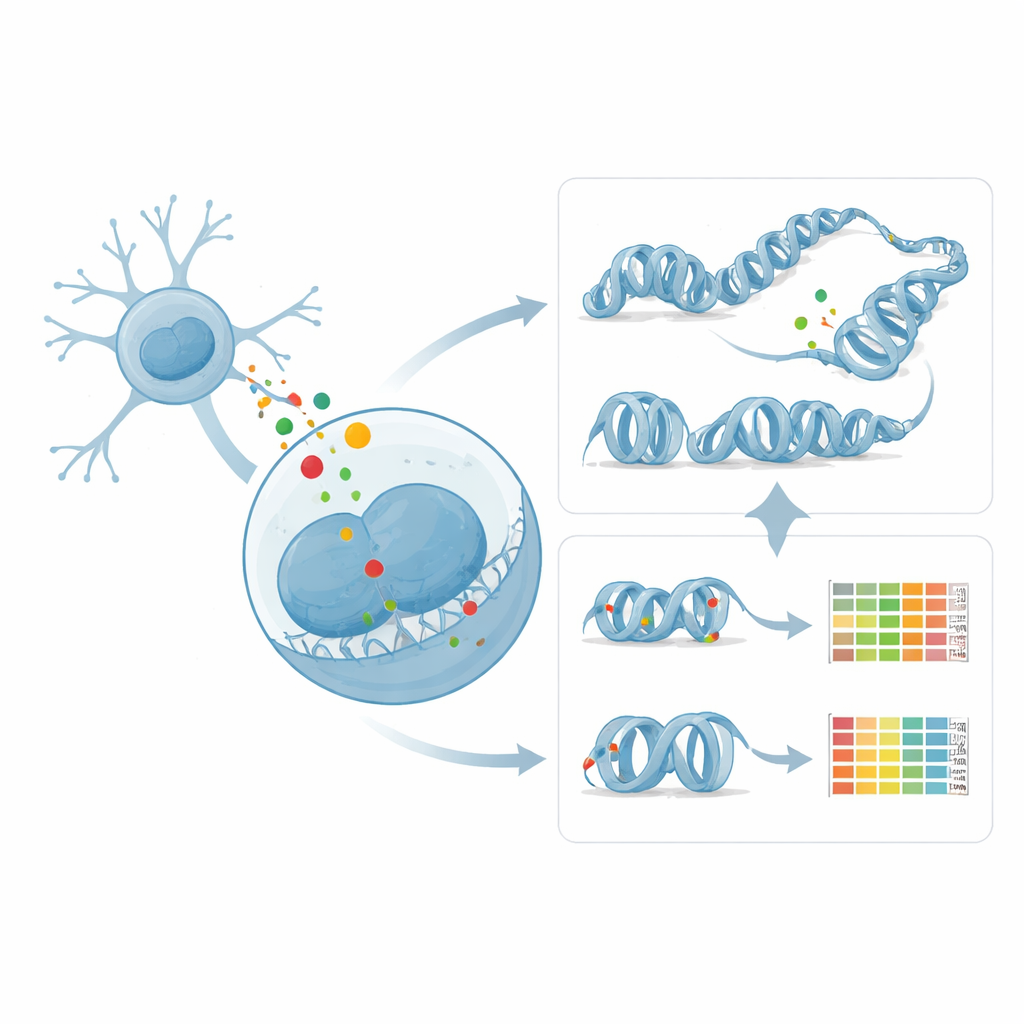
The real power of this work comes from merging the two datasets. By overlaying changes in chromatin accessibility with changes in gene activity, the authors pinpointed a set of high-confidence genes that not only altered their expression levels but also showed coordinated shifts in how their surrounding DNA was packaged. These genes are enriched in biological pathways already suspected to be important in Parkinson’s disease, such as cellular stress responses and signaling routes that control survival or death decisions in neurons. Because both toxins produced overlapping patterns of change, the findings support the idea that different environmental insults may converge on shared molecular routes to damage dopamine-producing cells.
What this means for understanding Parkinson’s
Rather than proposing a new drug on its own, this study delivers a detailed map—a reference atlas of how Parkinson-related toxins reshape both gene activity and the accessibility of the genome in human nerve-like cells. For non-specialists, the key message is that environmental chemicals may contribute to Parkinson’s disease not only by killing cells outright, but also by subtly reprogramming which genes are read and when. By making all raw and processed data publicly available, the authors give researchers worldwide a tool to hunt for early warning markers of disease, to test new protective compounds, and to deepen our understanding of how everyday exposures might tip vulnerable brains toward degeneration.
Citation: Hong, J., Huang, J. Chromatin accessibility and transcriptome in human neuronal model exposed to Parkinson’s environmental toxins. Sci Data 13, 360 (2026). https://doi.org/10.1038/s41597-026-06626-4
Keywords: Parkinson’s disease, environmental toxins, epigenetics, chromatin accessibility, RNA sequencing