Clear Sky Science · en
A phased, near-telomere-to-telomere chromosome-scale reference genome of the Moroccan argan tree
A desert tree with a global story
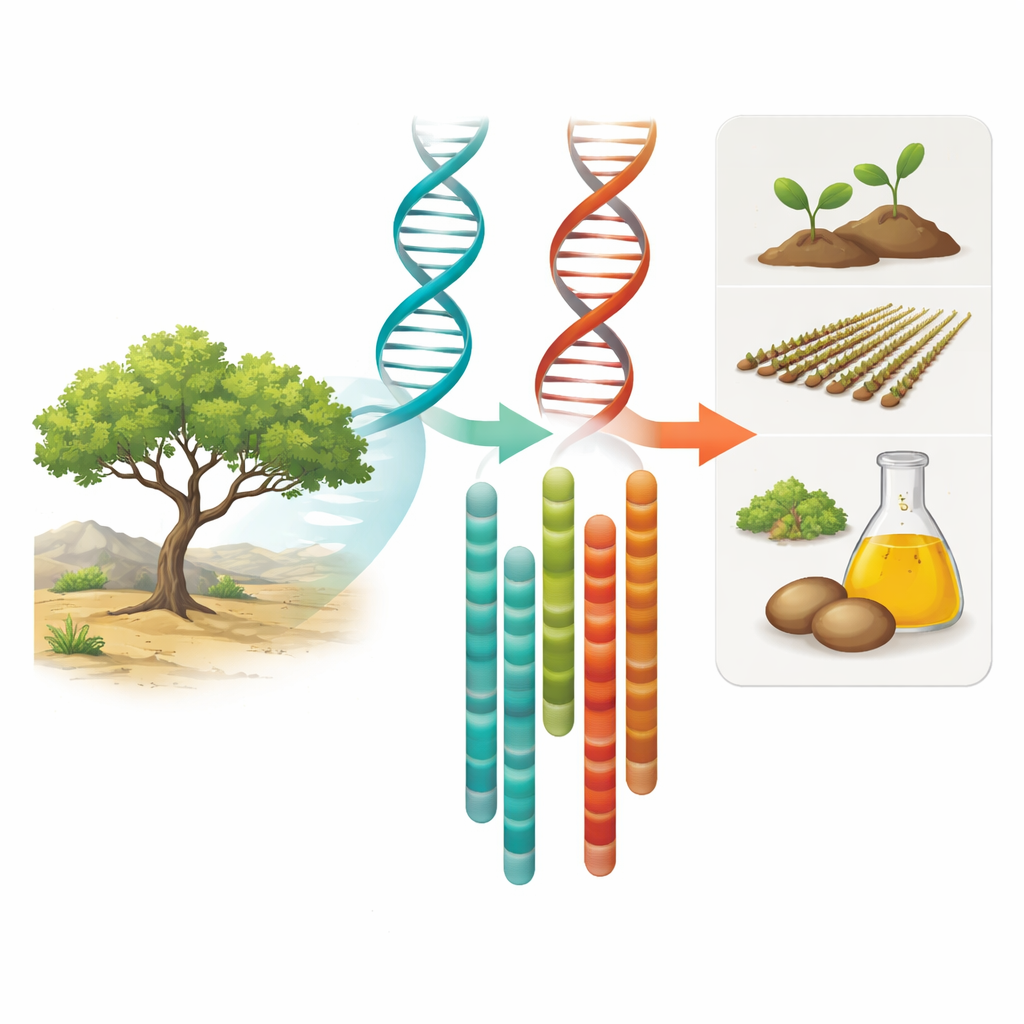
The Moroccan argan tree is famous for the rich oil pressed from its seeds, now found in kitchens and cosmetics around the world. Yet this rugged tree does far more than fill bottles: it feeds people and livestock, slows desert expansion, and supports rural livelihoods. Despite its importance, argan forests have been shrinking under pressure from climate change and overuse. This study delivers a powerful new tool for protecting and improving this iconic species: the most complete genetic blueprint of the argan tree produced to date.
Why map the argan tree’s blueprint?
Argan trees grow naturally only in parts of Morocco, where they help anchor soils and sustain local economies, earning their forest a UNESCO Biosphere Reserve designation. Government programs now aim to restore degraded stands and expand modern orchards to boost oil production. To do this wisely, researchers need to know which trees are best suited to heat, drought, and disease, and which carry traits for higher, more stable oil yields. A detailed reference genome acts like a master map, allowing scientists to spot useful variants, track diversity across regions, and design better conservation and breeding strategies.
Building a near-complete genome
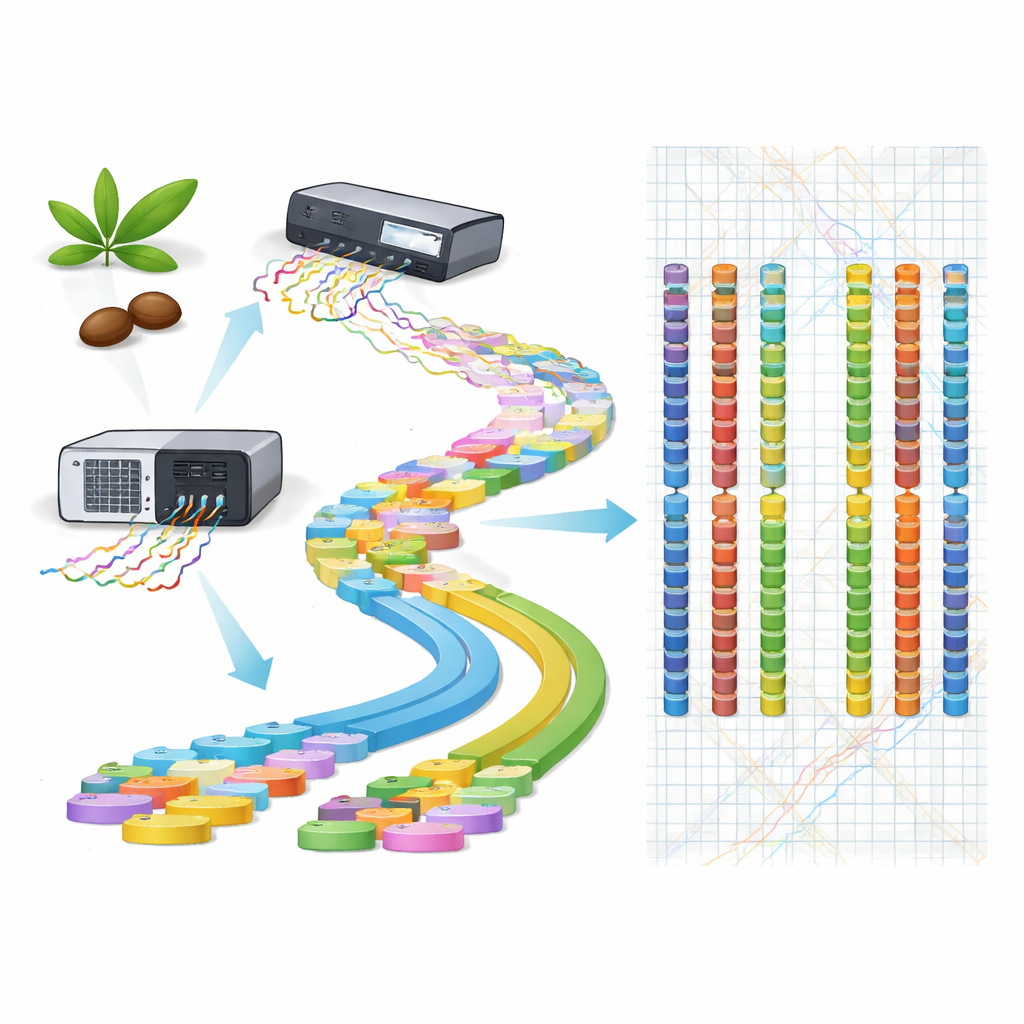
The team focused on a single argan tree, selected from Morocco’s Souss Valley for its representative features. They collected young leaves to extract very long, high-quality DNA, then used an advanced sequencing technology that reads long stretches of genetic code with great accuracy. To understand how these stretches are arranged along chromosomes, they paired this with a method that captures how distant pieces of DNA sit near each other inside the cell nucleus. Combining these approaches, and running them through state-of-the-art assembly software, allowed the researchers to reconstruct both copies of the tree’s genome, one inherited from each parent.
Two full sets of chromosomes
Every argan tree carries two versions of its genome, and this study disentangled them into two separate but matching sets, called haplotypes. Each set is organized into eleven long DNA strands, corresponding to the tree’s eleven chromosome pairs. The assembled sequences are remarkably continuous, with most chromosomes stretching almost from one end to the other and only tiny gaps remaining. Special repeated sequences were found at the tips of nearly all chromosomes, signaling that the team had reached the natural ends. Tests that compare the assembly against thousands of known plant genes showed that nearly all expected genes are present, and quality checks suggested very few reading errors in the final sequences.
What the genes and repeats reveal
Once the basic structure was in place, the researchers turned the genome from a raw sequence into a readable catalog of genetic elements. They identified more than 35,000 gene locations and nearly 40,000 different gene transcripts, many of which were supported by direct measurements of RNA from argan roots, leaves, and seeds. Roughly three quarters of these genes could be linked to known functions, offering clues to processes such as stress tolerance and oil production. The team also mapped the vast stretches of repetitive DNA that fill much of the argan genome. Over 60% of its DNA consists of repeats, dominated by mobile genetic elements that have copied and pasted themselves throughout the chromosomes over evolutionary time.
A foundation for saving and improving argan
All of the raw data, assembled genomes, and gene annotations have been made publicly available so that other researchers, breeders, and conservationists can build on this work. With a high-quality, near end-to-end genetic reference now in hand, it becomes possible to pinpoint variants linked to drought resilience, disease resistance, or superior oil traits, and to monitor how genetic diversity is changing as forests shrink or new orchards are planted. In practical terms, this genome opens the door to more informed restoration projects and smarter selection of planting material, helping ensure that the argan tree—and the communities and landscapes that depend on it—can thrive in a warming, drying world.
Citation: El Idrissi, H., Gkanogiannis, A., Iraqi, D. et al. A phased, near-telomere-to-telomere chromosome-scale reference genome of the Moroccan argan tree. Sci Data 13, 412 (2026). https://doi.org/10.1038/s41597-026-06615-7
Keywords: argan tree, genome assembly, Morocco, conservation genetics, argan oil