Clear Sky Science · en
FlareDB: A Database of Significant Flares in Solar Cycles 24 and 25 with SDO/HMI and SDO/AIA Observations
Why sudden solar outbursts matter on Earth
Solar flares are immense explosions on the surface of the Sun that can disrupt satellites, knock out radio communications, and even threaten power grids on Earth. Yet scientists still struggle to predict exactly when and where the largest flares will erupt. This article introduces FlareDB, a new open database that gathers detailed observations of the Sun’s most powerful flares over the past decade and a half. By organizing these data in a way that both human researchers and machine-learning systems can easily use, FlareDB aims to accelerate our understanding—and forecasting—of dangerous space weather.
A new library of the Sun’s biggest tempers
FlareDB focuses on 151 of the most energetic solar flares, all classified as at least M5.0 or X-class, recorded between 2010 and 2025. These events come from 82 active regions—magnetically intense patches on the Sun’s surface where flares tend to originate. Only flares whose source regions were reasonably close to the center of the solar disk were included, because measurements near the edge of the Sun’s visible face are less reliable. Together, these criteria create a clean, well-defined sample of the kinds of eruptions most likely to disturb Earth’s space environment.
Seeing the Sun in many colors
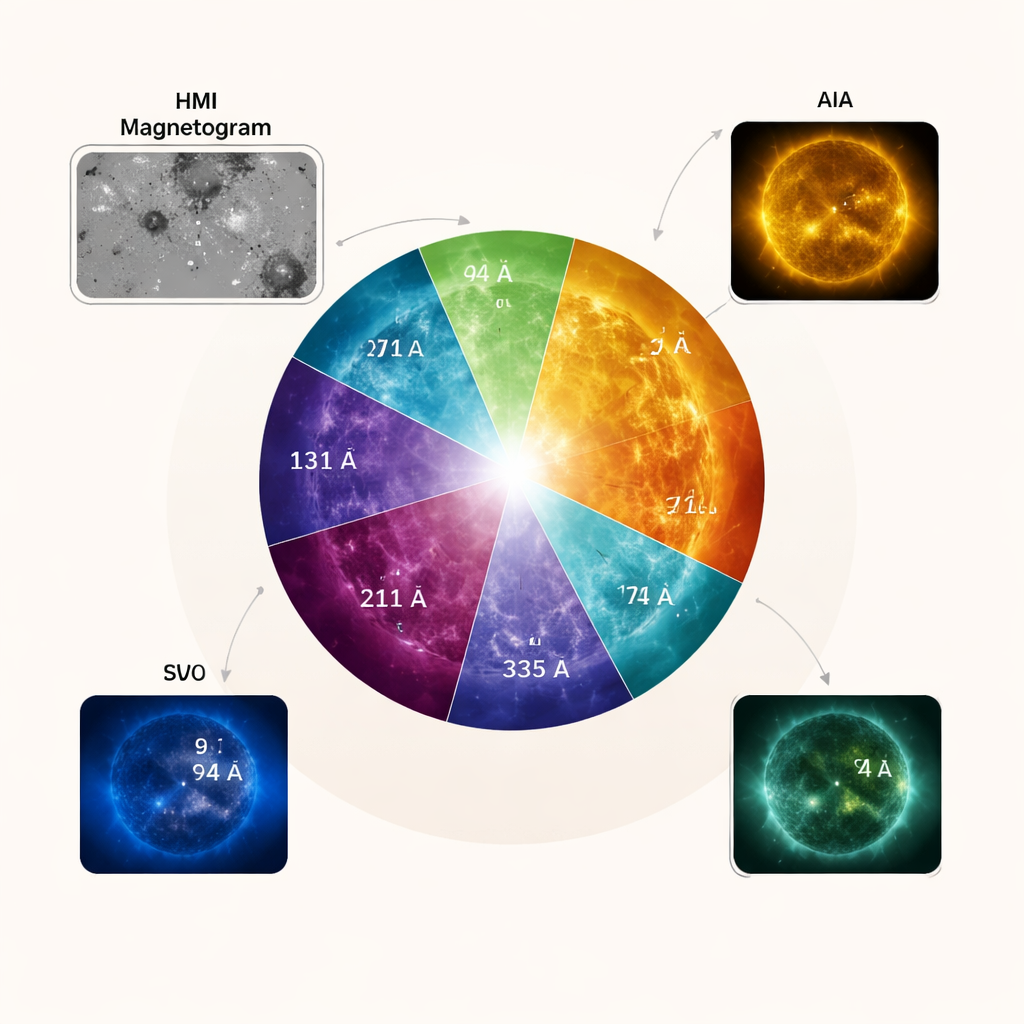
The database is built from two instruments on NASA’s Solar Dynamics Observatory (SDO). One, the Helioseismic and Magnetic Imager (HMI), maps the Sun’s magnetic field and records white-light images of sunspots. The other, the Atmospheric Imaging Assembly (AIA), takes rapid-fire pictures in ultraviolet and extreme-ultraviolet light at several wavelengths, each highlighting gas at different temperatures in the solar atmosphere. For every flare, FlareDB extracts just the region around the active area instead of storing the full solar disk, and it does this in two different map projections. This approach keeps the focus on where the action is, while still preserving information about how the magnetic field and hot plasma are arranged.
From raw images to ready-to-use data
Turning a flood of raw spacecraft images into a coherent database required careful processing. The team standardized the way magnetic field components are calculated, aligned AIA images with HMI magnetograms despite their slightly different resolutions, and ensured that each active region stays centered even as the Sun rotates. For wavelengths that capture emission from thick, three-dimensional layers of the solar atmosphere, they applied special care in how the images are re-mapped so they can still be meaningfully compared with surface magnetic maps. In total, more than 218,000 AIA images were reprojected and cropped so that each flare event has a consistent set of views across many temperatures and heights above the solar surface.
Fast, standardized movies for human eyes and algorithms
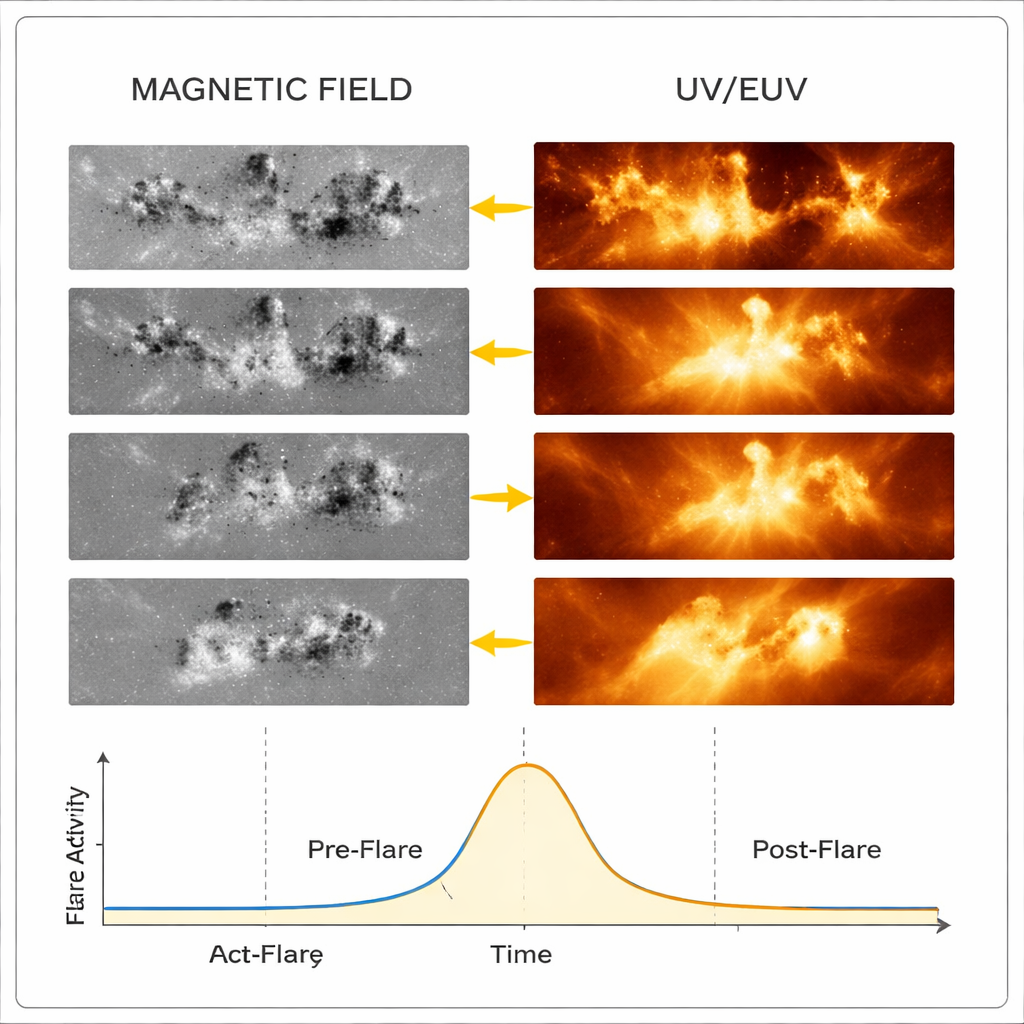
One of FlareDB’s most practical products is a set of 5,285 short “quick look” movies—35 movies for each flare—showing how the active region evolves from 24 hours before the flare to 8 hours afterward. Each movie uses fixed brightness scales so that different events can be compared directly, even if some extreme details are muted. This standardization makes it much easier to scan many events by eye, but it is especially valuable for training machine-learning models, which work best when data are uniform in format and scale. Researchers who need full detail can download the underlying image files in a standard scientific format from an associated online service.
Building a foundation for better space-weather forecasts
To ensure reliability, the creators of FlareDB checked how their processing steps affect data quality and documented where the coverage is strongest—about 95 percent of the dataset sits in the most reliable viewing zone near the solar disk center. The result is a public resource that combines magnetic maps, ultraviolet images, and compact overview movies for the Sun’s biggest flares over two solar cycles. For a layperson, the key outcome is this: by giving scientists and AI tools a consistent, rich record of how active regions behave before and during major eruptions, FlareDB lays the groundwork for more accurate and timely forecasts of solar storms that can influence our technology-dependent lives.
Citation: Liu, N., Abduallah, Y., Kapure, T.S. et al. FlareDB: A Database of Significant Flares in Solar Cycles 24 and 25 with SDO/HMI and SDO/AIA Observations. Sci Data 13, 279 (2026). https://doi.org/10.1038/s41597-026-06607-7
Keywords: solar flares, space weather, Sun observations, magnetic fields, machine learning