Clear Sky Science · en
Dataset about Warming Effects on Carbon Cycling and Greenhouse Gas Fluxes in Permafrost Ecosystems
Why Thawing Frozen Ground Matters to Everyone
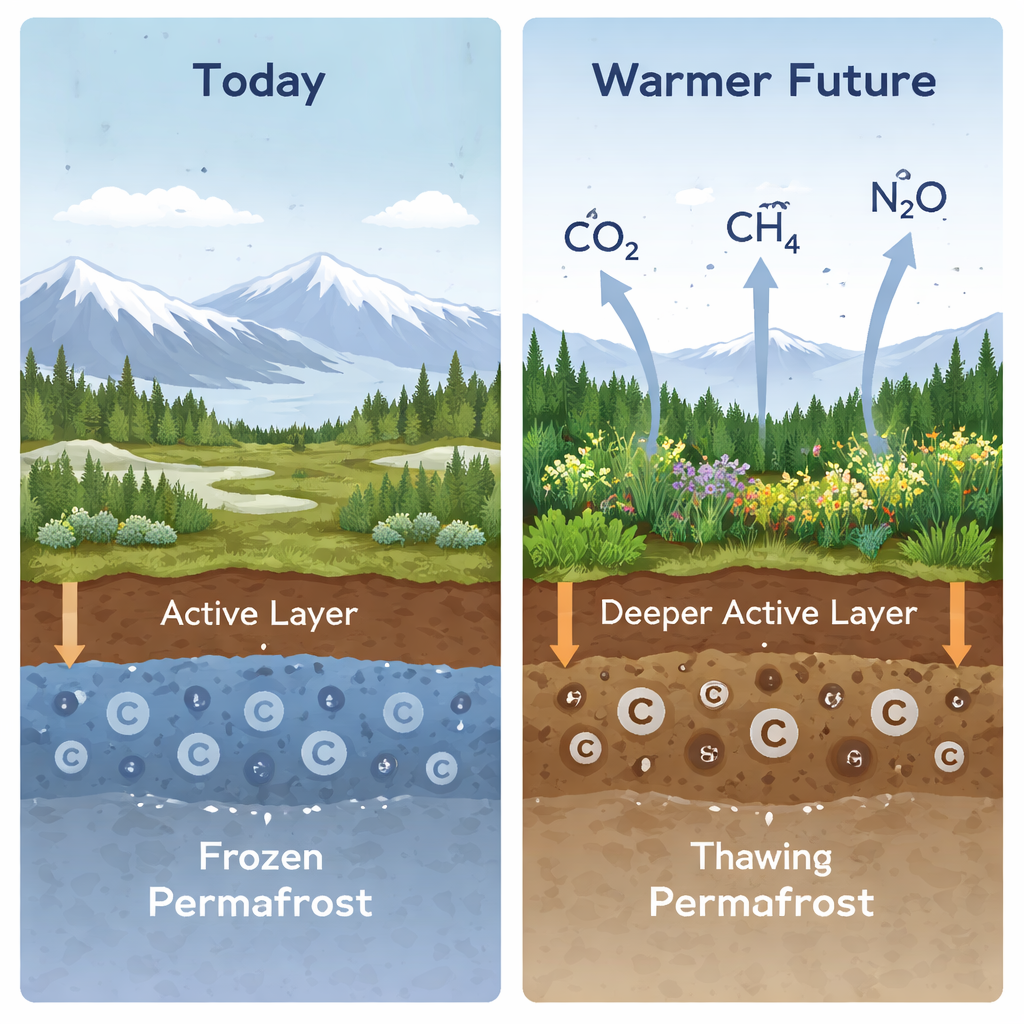
Far beneath the mosses and shrubs of the Arctic and high mountains lies permafrost—ground that stays frozen year-round and locks away enormous amounts of ancient plant material. As the planet warms, this frozen storehouse of carbon is at risk of waking up, potentially releasing powerful greenhouse gases that can speed up climate change. The article describes a new, open dataset that pulls together results from field experiments across the Northern Hemisphere to understand how warmer conditions are already changing carbon flows and greenhouse gas emissions from these vulnerable landscapes.
A Hidden Giant of the Global Carbon Vault
Permafrost underlies roughly one-fifth of the land in the Northern Hemisphere and holds about a third of the world’s soil carbon. For millennia this organic matter has been preserved like food in a deep-freeze. But Arctic and high-altitude regions are now warming two to four times faster than the global average. Even if humanity meets the Paris Agreement’s goal of limiting global warming to 2 °C, large swaths of permafrost are expected to thaw. When that happens, ice-rich ground can slump and collapse, exposing buried material to microbes that break it down and release carbon dioxide and methane—two greenhouse gases that further heat the planet in a reinforcing feedback loop.
Bringing Together Hundreds of Warming Experiments
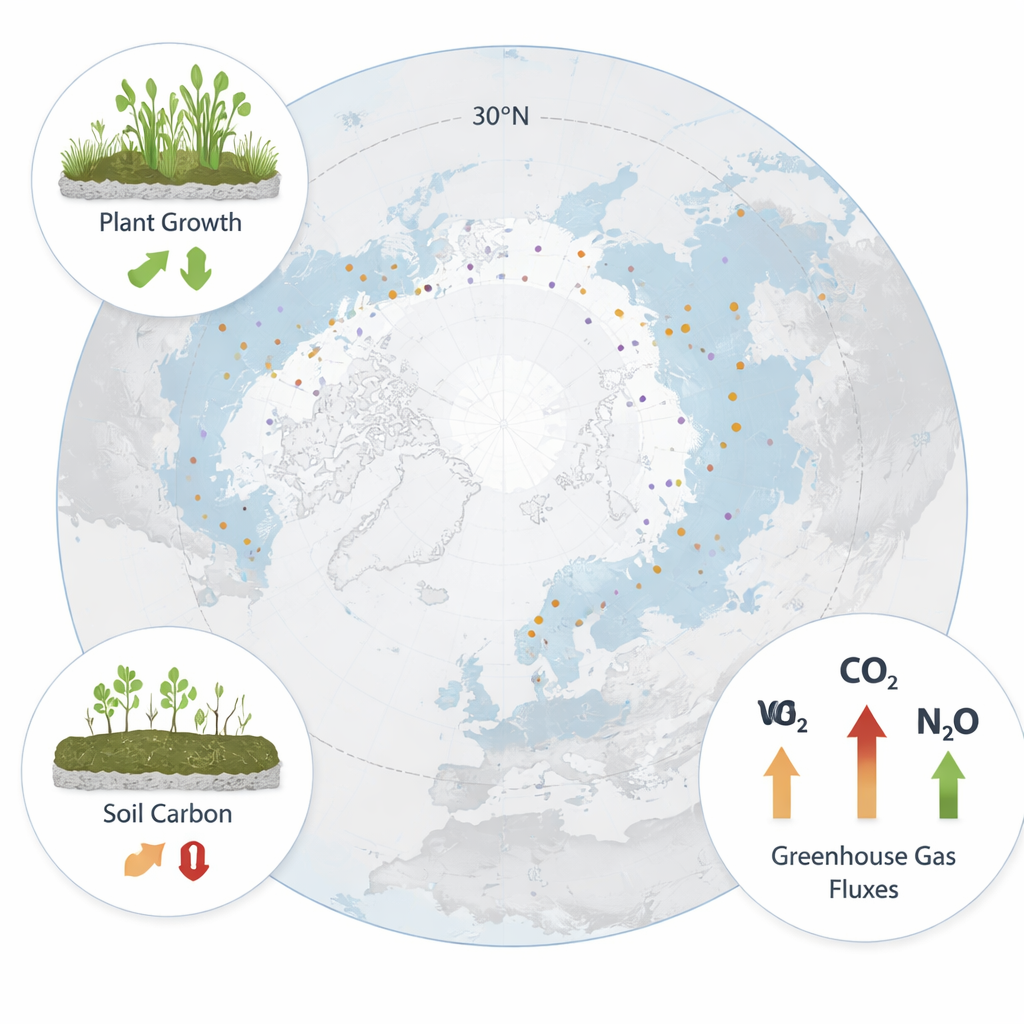
Scientists have been running outdoor warming experiments for decades to see how real ecosystems respond to higher temperatures. They use simple open-top chambers that passively trap heat, infrared heaters that warm soil and plants, and greenhouse-like structures that raise air temperature. The new dataset gathers results from 132 peer-reviewed studies carried out between 1990 and 2024 across Arctic, subarctic, and alpine regions. Altogether, it includes 1,430 pairs of measurements comparing plots left at normal temperatures with nearby plots that were artificially warmed during the growing season.
Tracking Plants, Soils, and Escaping Gases
Each experimental site in the dataset captures multiple pieces of the carbon puzzle. Scientists measured how much new plant material is produced above and below ground, how much carbon is stored in soils, how moist and warm the soil becomes, and how fast carbon dioxide, methane, and nitrous oxide move between land and air. In total, 17 different variables are included, such as plant height and abundance, soil organic carbon, soil nitrogen, and key processes like photosynthesis and respiration. The dataset also records the details that shape those responses: where each site is located, what kind of vegetation dominates (herbs, shrubs, mosses, lichens), what the climate is like, how long the warming lasted, and how strong the temperature increase was.
Turning Diverse Studies into Comparable Signals
Because each research group used its own methods and scales, the authors carefully re-processed the numbers so they can be compared fairly. For each site and variable, they calculated how much warming changed the outcome relative to the control plot, using a standard "effect size" that expresses the percent change. They double-checked units, corrected inconsistencies, and statistically examined the data to catch odd values or errors. They also tested for "publication bias"—the tendency for studies with eye-catching results to be published more often—and found no signs that the dataset is skewed in this way. The result is a harmonized, quality-checked resource that reflects a broad range of real-world conditions, from wet Arctic tundra to high mountain meadows.
How This Helps Us See the Climate Future
Although this article does not promote a single headline number for future emissions, its message is clear: warming is already reshaping how frozen landscapes store and release carbon, and the direction and strength of those changes vary by region and ecosystem type. By making decades of experiments directly comparable and publicly available, the dataset gives climate modelers, remote-sensing experts, and policy analysts a powerful tool to reduce uncertainty about permafrost’s role in future climate change. For a lay reader, the takeaway is that scientists are no longer guessing blindly about this "sleeping giant" of the carbon cycle—they now have a detailed, evolving map of how permafrost ecosystems respond to warming, which can improve forecasts and inform better choices to limit further climate risks.
Citation: Bao, T., Xu, X., Jia, G. et al. Dataset about Warming Effects on Carbon Cycling and Greenhouse Gas Fluxes in Permafrost Ecosystems. Sci Data 13, 272 (2026). https://doi.org/10.1038/s41597-026-06600-0
Keywords: permafrost, greenhouse gases, carbon cycle, climate warming, Arctic ecosystems