Clear Sky Science · en
A Large and Precise All-Sky Photometric Standard Star Dataset Across More Than 200 Passbands
Why Measuring Starlight So Precisely Matters
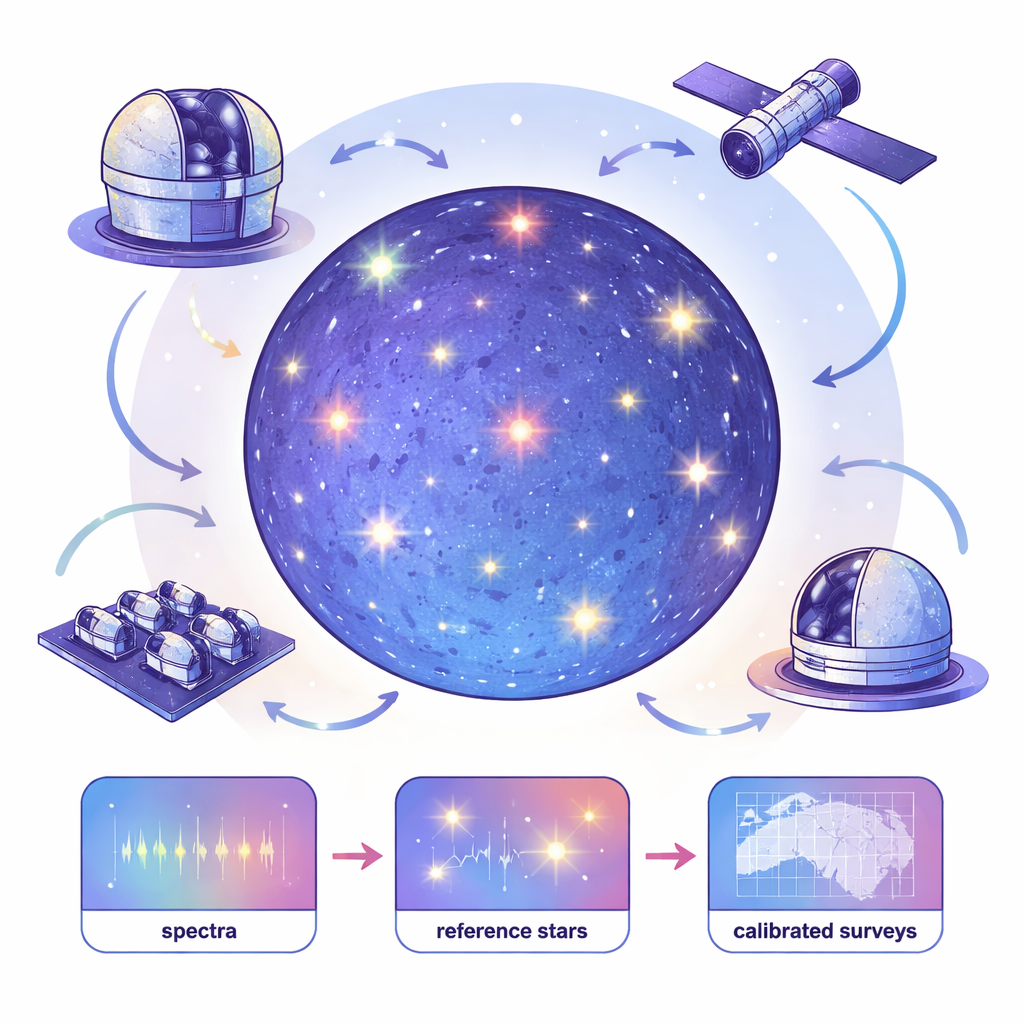
Modern astronomy depends on measuring how bright stars and galaxies appear in the sky. These brightness measurements, taken in different colors of light, underpin everything from mapping our Milky Way to probing dark energy. But like a bathroom scale that is a little off, even tiny mistakes in these measurements can mislead scientists. This paper presents the BEst STars Database (BEST), a new, ultra-precise, all-sky set of reference stars—hundreds of millions of them—that acts as a universal "standard ruler" for starlight across more than 200 different color filters used by today’s telescopes.
A New Cosmic Reference Grid
Astronomers have long relied on special “standard stars” with well-known brightness to calibrate their instruments. Classic sets, such as the Landolt standards, contain only tens of thousands of stars, are located mainly near the celestial equator, and reach a precision of about 1% in brightness. Newer all-sky catalogs cover the whole sky but still carry systematic errors of 2–3%. With the explosion of wide-field surveys—like Pan-STARRS, the SkyMapper Southern Survey, and upcoming projects such as LSST and the Chinese Space Station Telescope—these limitations have become a serious bottleneck. BEST aims to remove that bottleneck by offering an all-sky grid of over 200 million standard stars, each measured in hundreds of color bands with errors typically smaller than one hundredth of a percent in many filters.
Turning Raw Spectra into Trusted Standards
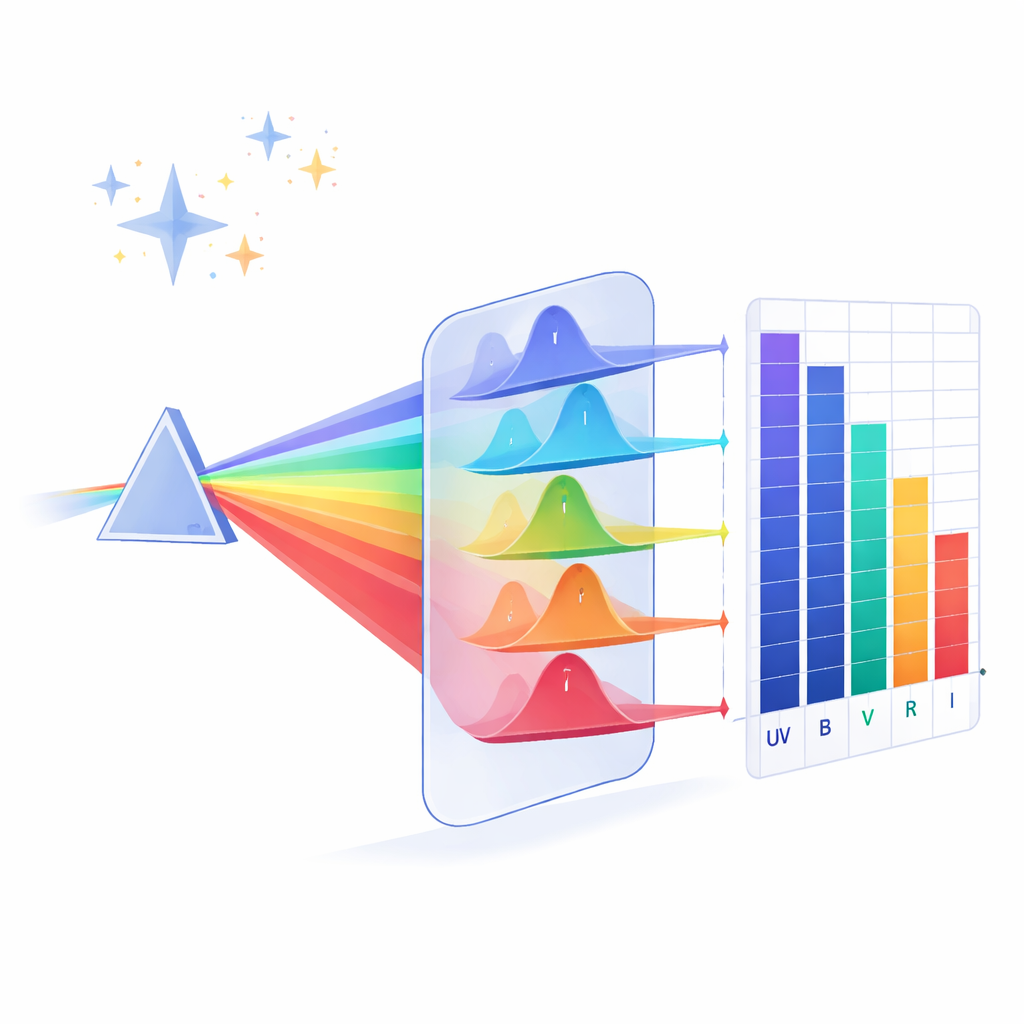
The heart of BEST is a clever use of data from the European Space Agency’s Gaia mission, which has collected low-resolution spectra—rainbow-like fingerprints—of more than 200 million stars. By carefully correcting known color-, brightness-, and dust-related quirks in these spectra, the team can mathematically “observe” each star through the filters of many different telescope systems. This process, called synthetic photometry, converts each Gaia spectrum into predicted brightnesses in over 200 passbands, from near-ultraviolet to near-infrared. The authors refine an earlier method known as Gaia XP synthetic photometry (XPSP), improving its accuracy especially in blue light, where previous errors could exceed one hundredth of a magnitude.
Cross-Checking with Independent Methods
To make sure these synthetic measurements are not just precise but also trustworthy, the researchers combine them with an entirely different approach called Stellar Color Regression (SCR). Instead of starting from spectra, SCR uses physical properties of stars—such as temperature and chemical composition—measured by large spectroscopic surveys like LAMOST and GALAH. Stars with similar physical properties should have the same true colors; any difference observed on the sky mainly comes from dust and calibration issues. By comparing how the XPSP and SCR methods predict colors across many stars and filters, the team can spot and correct subtle biases. The two methods typically agree within 0.01–0.02 magnitudes in the bluest bands and within 0.001–0.005 magnitudes in the redder bands, giving strong confidence in the final standards.
Recalibrating Today’s Big Sky Surveys
With this massive pool of trusted reference stars in hand, the authors systematically revisit several major survey datasets. They fine-tune Gaia’s own brightness scale, ironing out small trends at very bright and faint levels. They correct Pan-STARRS measurements in five main filters, reducing spatial and brightness-dependent errors and providing detailed correction maps and software tools for other astronomers. They also recalibrate the J-PLUS, S-PLUS, and SkyMapper Southern Survey (SMSS) data, uncovering and fixing position-dependent offsets and other small systematics. In each case, using BEST shrinks typical zero-point errors—the overall brightness scale for a given image—to just a few thousandths of a magnitude, representing an improvement by factors of two to six over earlier work.
Building a Universal Photometric Backbone
The finished BEST database contains hundreds of millions of well-characterized standard stars spread over the whole sky, with precise brightness measurements in over 200 filter bands. This makes it the largest and most accurate photometric standard set ever assembled, and it already powers high-precision studies, from reprocessing old photographic plates to calibrating cutting-edge telescope arrays. For non-specialists, the key takeaway is that astronomers now have something like an ultra-accurate global time standard—but for starlight. As future surveys push to measure ever fainter objects and smaller variations in brightness, the BEST catalog will help ensure that those measurements rest on a solid, uniform foundation, sharpening our view of the Universe’s structure, history, and fate.
Citation: Xiao, K., Huang, Y., Yuan, H. et al. A Large and Precise All-Sky Photometric Standard Star Dataset Across More Than 200 Passbands. Sci Data 13, 265 (2026). https://doi.org/10.1038/s41597-026-06590-z
Keywords: photometric calibration, standard stars, Gaia mission, sky surveys, astronomical catalogs