Clear Sky Science · en
Telomere-to-telomere gap-free genome assembly of the Opsariichthys evolans (Cypriniformes: Cyprinidae)
A Stream Fish With a Genomic Story
Rushing mountain streams in southeastern China and Taiwan are home to a small, colorful fish called Opsariichthys evolans. Though little known outside the region, this species is an ecological linchpin and a natural work of art, with bright stripes and striking breeding colors. For more than a century, scientists have argued about how to classify it and how it fits into the freshwater fish family tree. This study delivers a key piece of that puzzle: the first complete, gap-free genome of O. evolans, read from one chromosome end to the other.
Why This Fish Matters
O. evolans lives in clear, flowing streams, where it helps keep food webs in balance and serves as a sensitive indicator of water quality. Males develop vivid lateral stripes and granular bumps on the head and around the eyes during the breeding season, along with a dark, blackish-purple snout. These eye-catching traits, combined with the fish’s preference for fast-running water, make it an ideal species for studying how animals adapt to their environments. At the same time, human-driven changes—pollution, habitat fragmentation, and invasive species—are shrinking its populations, making it important to understand its biology for conservation.
A Long-Running Name Confusion
For decades, biologists struggled to decide whether O. evolans belonged in the genus Opsariichthys or Zacco. Early taxonomists described the species as Zacco evolans, basing their decision largely on external features such as fin shape and body stripes. Later, more detailed studies showed that its stripe pattern and breeding tubercles differ from those of the similar-looking Zacco platypus. Mitochondrial DNA studies suggested that O. evolans fits best within Opsariichthys, but some nuclear gene data hinted at a closer tie to Zacco. Without a complete genome, the evolutionary picture remained blurry, and the debate over its proper place on the fish family tree continued.
Reading Every Letter of the Genome
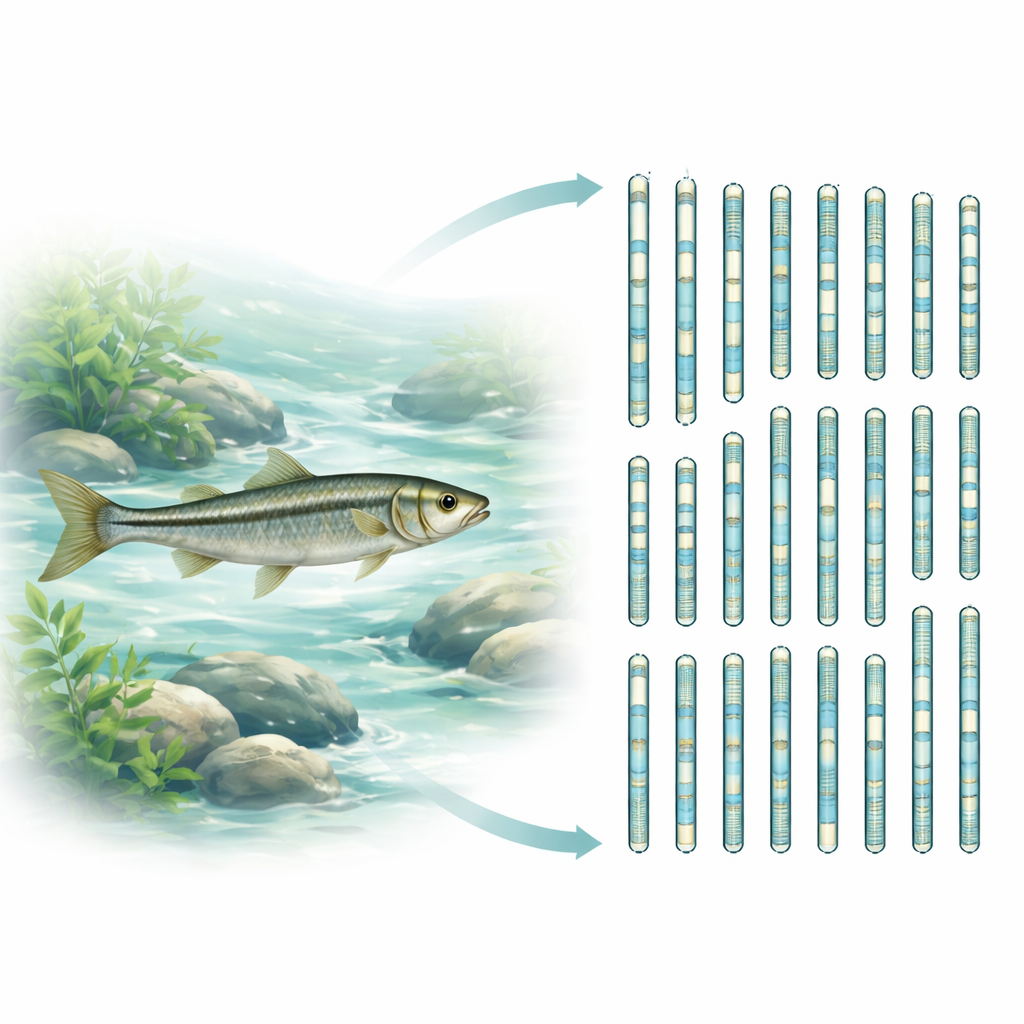
To settle these questions, the researchers collected a wild male fish from a river in Anhui Province, China, and carefully preserved nine different tissues. They then combined several cutting-edge DNA sequencing technologies, each with its own strengths, to read the animal’s genetic code. Short, highly accurate fragments helped polish the sequence, while long and ultra-long reads from PacBio and Oxford Nanopore platforms spanned difficult regions and stitched chromosomes together from end to end. Hi-C technology, which captures how DNA folds inside the cell, was used to arrange the pieces into full-length chromosomes. The final result is a telomere-to-telomere, gap-free genome of about 0.89 billion base pairs, neatly organized into 39 chromosomes with one continuous piece of DNA for each.
What the Genome Reveals
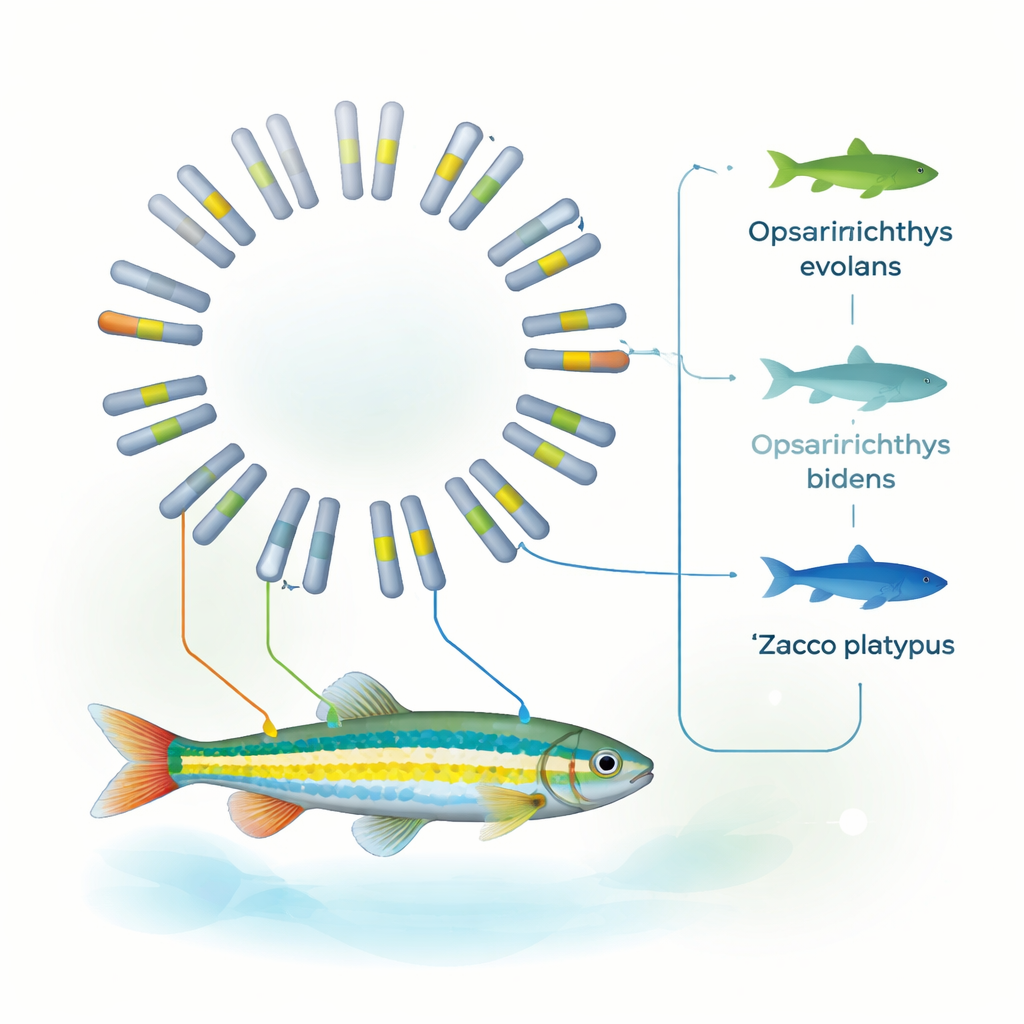
The finished genome passed strict quality checks, capturing more than 99% of expected conserved genes and aligning closely with known DNA sequences from related fishes. Nearly half of the genome consists of repeated sequences, many of them “jumping genes” that can move around and reshape the genome over evolutionary time. The team identified almost 30,000 protein-coding genes and thousands of non-coding RNAs, most of which could be linked to known functions using major biological databases. By comparing this new genome with those of two close relatives—Opsariichthys bidens and Zacco platypus—the scientists found that the overall chromosome structure is highly similar, confirming tight evolutionary ties. Within this framework, they pinpointed candidate genes and pathways likely involved in the fish’s body stripe coloration and adaptations to living in swift currents, offering clues to how its distinctive look and lifestyle evolved.
Clarifying Its Place in the Fish Family Tree
Using gene families shared across ten different fish species, the team reconstructed a detailed evolutionary tree. Their analysis indicates that O. evolans diverged from Z. platypus roughly 8 to 19 million years ago and that its genome structure is especially close to that of O. bidens. Together with earlier mitochondrial evidence, these patterns support placing O. evolans firmly in the genus Opsariichthys, not Zacco. In other words, the full genome now backs up what careful observation of stripes, snout color, and breeding structures had suggested: appearances may be deceiving, but when morphology and a complete genome agree, taxonomic lines become much clearer.
Why a Complete Genome Changes the Game
For non-specialists, the achievement here is like going from a blurry, torn map to a crisp, full-resolution atlas of a species. With a complete, gap-free genome, scientists can now trace the origins of O. evolans’s striking colors, its streamlined shape for life in fast water, and its relationships to other East Asian minnows with unprecedented precision. This resource will help refine fish classification, guide conservation efforts for vulnerable stream ecosystems, and deepen our understanding of how small differences in DNA can generate the rich diversity seen in freshwater fishes.
Citation: Wang, P., Wang, X., Yin, D. et al. Telomere-to-telomere gap-free genome assembly of the Opsariichthys evolans (Cypriniformes: Cyprinidae). Sci Data 13, 263 (2026). https://doi.org/10.1038/s41597-026-06588-7
Keywords: genome assembly, freshwater fish, telomere-to-telomere, fish evolution, comparative genomics