Clear Sky Science · en
A multi-Omic resource for exploring microbial eukaryotes in the meromictic freshwater Lake Pavin
A Hidden World in a Mountain Lake
Far below the surface of many lakes lies a largely invisible world of tiny, single-celled organisms that quietly help drive Earth’s cycles of carbon and nutrients. In a small volcanic crater lake in central France, scientists have now taken one of the most detailed looks yet at these little-known freshwater microbes, building a genetic “atlas” that anyone can use to explore who they are and what they do.
The Lake with Two Different Worlds
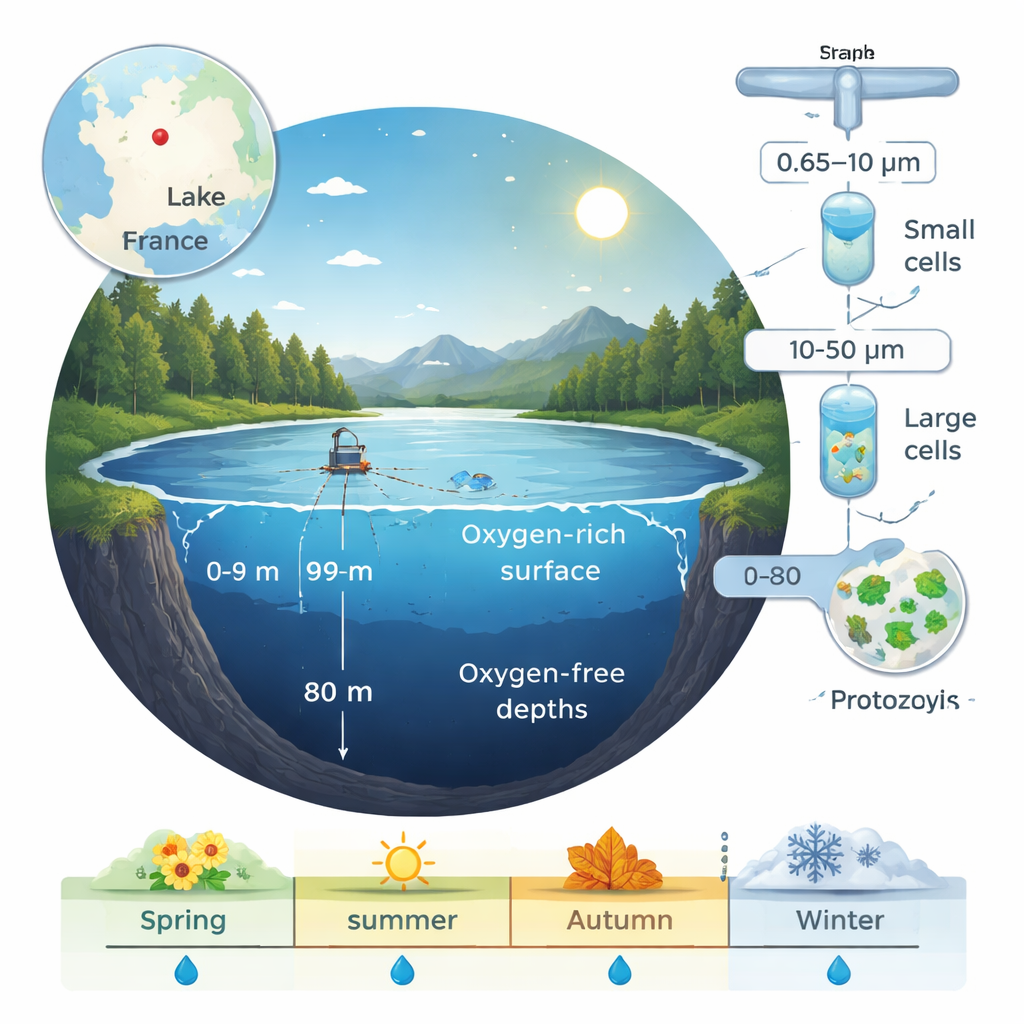
Lake Pavin is unusual: its upper waters are rich in oxygen, while the deep layers remain permanently oxygen-free. This sharp divide means that organisms living near the surface experience very different conditions from those in the dark depths. Throughout 2018, researchers sampled both layers of the lake in every season, during the day and at night. They also separated small microbes from larger ones, allowing them to compare who lives where, when, and at what size. This design turned the lake into a natural laboratory for watching how microscopic life responds to changing light, temperature, and mixing events over the year.
Reading the Lake’s Genetic Library
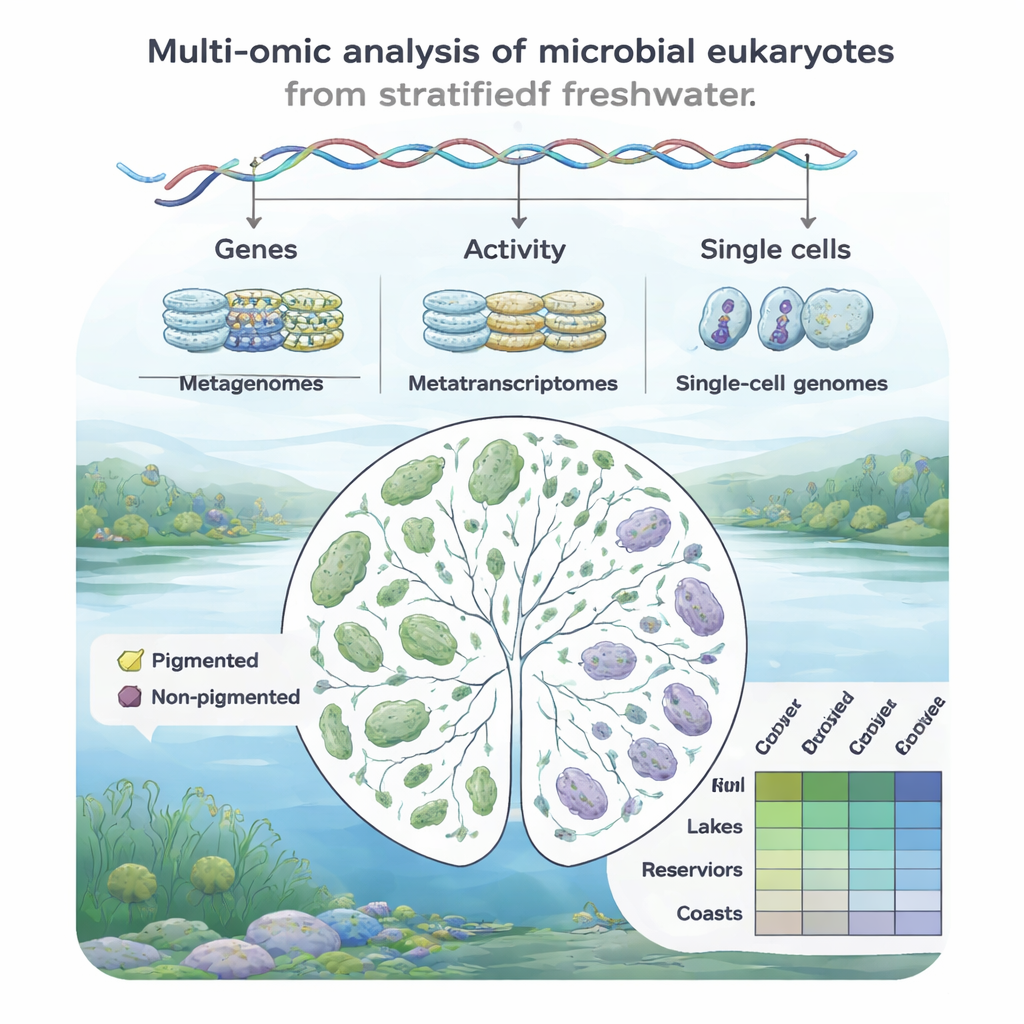
Instead of trying to grow these organisms in the lab, the team read the genetic material directly from the water. They combined several powerful approaches: short “barcodes” used to identify species, full community DNA to reveal genetic potential, RNA to capture which genes are actively being used, and genomes from individual cells sorted one by one. From this, they reconstructed 106 draft genomes assembled from mixed samples and 11 genomes from single cells. These genomes include many groups that are poorly represented in existing databases, such as certain parasites and algae-like organisms. In total, the work produced more than nine million distinct gene sequences, creating a rich resource for future studies.
Life in Light and in Darkness
The genetic patterns show that the lake’s tiny residents are finely tuned to their environment. Pigmented microbes that harvest light, such as various algae, are most common and diverse in the oxygen-rich surface layer, and many of their genes are geared toward photosynthesis. In contrast, the darker, oxygen-free depths harbor a surprising variety of organisms that feed on others or on decaying material, including parasites that attack algae and other hosts. The researchers also used RNA data to see which genes switch on as conditions change. They found that different lifestyles—purely plant-like, purely animal-like, or “mixotrophic” cells that both photosynthesise and eat—become more or less active with the seasons and with events like spring and autumn mixing of the water.
Freshwater Specialists with a Wider Reach
To test how unique Lake Pavin’s microbes are, the team compared their genomes with genetic data from about 3,000 water samples collected worldwide. Most of the lake’s genomes showed up primarily in calm inland waters such as lakes and reservoirs, suggesting that many of these organisms are freshwater specialists. However, some of the light-harvesting groups appeared in rivers, ponds, and even near coasts, indicating that certain lineages can thrive across a broader range of habitats. This comparison helps place a single small lake into a global context, showing how its microscopic communities fit into larger patterns of biodiversity.
A Reference Map for Future Explorers
For non-specialists, the most important result is not a single discovery but the creation of a detailed reference map of freshwater microbial life. By making all sequences, genomes, and analysis tools publicly available, the authors provide a backbone that other scientists can use to investigate questions about water quality, climate change, and the evolution of complex cells. In simple terms, this study turns Lake Pavin into an open textbook on how tiny eukaryotic microbes live, interact, and adapt in layered lake environments, and offers a template for exploring similar hidden worlds in freshwaters around the globe.
Citation: Courtine, D., Lepère, C., Wawrzyniak, I. et al. A multi-Omic resource for exploring microbial eukaryotes in the meromictic freshwater Lake Pavin. Sci Data 13, 252 (2026). https://doi.org/10.1038/s41597-026-06573-0
Keywords: freshwater microbiology, protist diversity, lake ecosystems, metagenomics, microbial eukaryotes