Clear Sky Science · en
The Tervuren xylarium Wood Density Database (TWDD)
Why the weight of wood matters for the planet
How heavy is a tree, really? That simple-sounding question lies at the heart of big issues like climate change, forest conservation, and even the global economy of timber. To know how much carbon forests store and how they respond to a warming world, scientists must estimate the mass of billions of trees they will never cut down. This paper introduces a major new dataset from the Tervuren xylarium in Belgium that greatly improves those estimates, especially for African tropical forests that have long been a blind spot in global data.
A global library of wooden clues
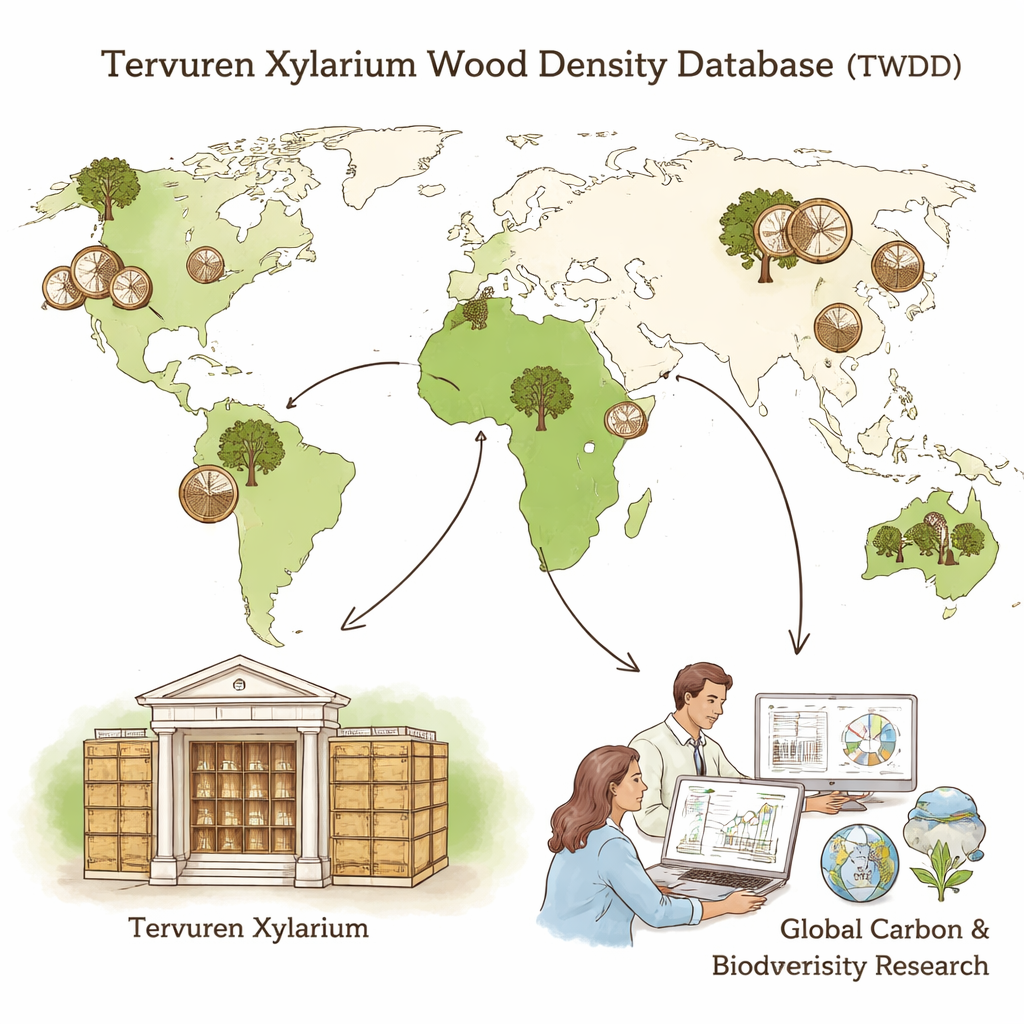
The Tervuren xylarium is a scientific “library” of more than 83,000 wood specimens gathered since 1898 from across the tropics and beyond. Drawing on this collection, the authors created the Tervuren xylarium Wood Density Database (TWDD), which provides detailed measurements for 13,332 wood samples from 2,994 species, 1,022 genera and 156 plant families spanning six continents. About 72% of the samples come from Africa, and more than half from the Democratic Republic of the Congo alone. Compared with two major existing datasets (CIRAD and the Global Wood Density Database), TWDD adds 1,164 tree species, 160 genera and 8 plant families that were previously missing, sharply improving coverage of African trees.
How scientists weigh trees without cutting them down
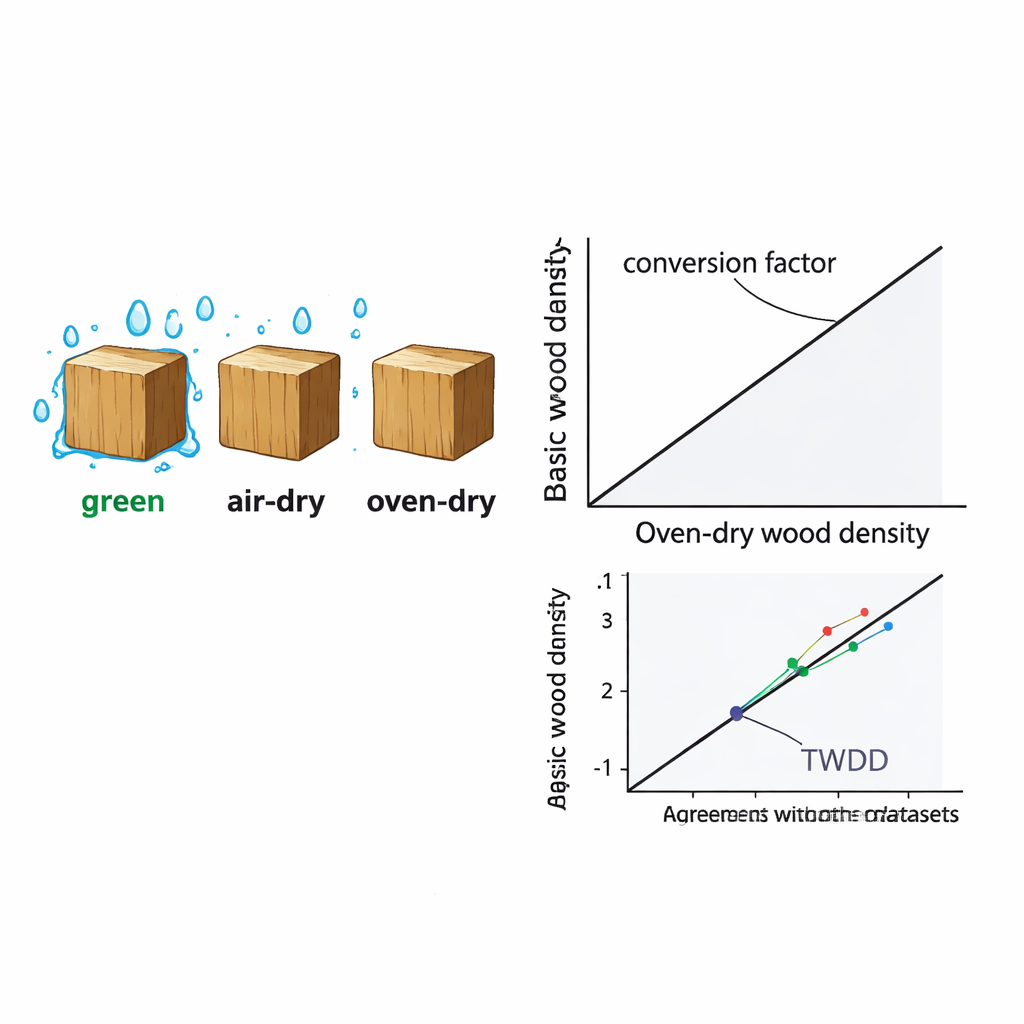
To estimate forest biomass, researchers measure a tree’s volume in the field, then multiply by a property called “basic wood density”, which is essentially the dry mass of wood divided by its fresh (green) volume. Getting that number right is tricky because wood holds water and changes as it dries. The team measured three key states for thousands of samples: green (freshly taken from living trees), air-dry (equilibrated with room air), and oven-dry (dried at 103 °C until almost all water is removed). They used careful protocols in the xylarium, including precise balances and water-displacement setups for both small and large pieces, to standardize how mass and volume were recorded and to avoid hidden biases from inconsistent drying methods.
Finding the sweet spot for drying and conversion
One concern is how long wood needs to stay in the oven to reach a truly dry state without being damaged. The authors ran an experiment with 40 samples spanning low and high density and volume, comparing drying for 24 versus 48 hours. They found no meaningful differences in final mass, volume, or density, showing that 24 hours at 103 °C is enough for samples that have already air-dried for at least a year. This supports a practical standard many labs can follow. The team then focused on a core problem: most existing databases do not have green volume, so basic density is estimated from air-dry or oven-dry measurements using “conversion factors”. By measuring all three states in 1,686 samples from Central African forests, they derived highly precise factors that translate air-dry or oven-dry density into basic density for African tree species.
Putting African forests on the global carbon map
The new conversion factors agreed remarkably well with those from earlier global studies, differing by less than a quarter of one percent—evidence that the relationship between dry and basic density is a robust physical rule, not something that changes much from one region to another. Using these factors, the authors computed basic wood density for every TWDD sample and compared species averages to values in the CIRAD and Global Wood Density databases. The patterns matched closely, with only small differences on average, but TWDD noticeably expands the taxonomic and geographic coverage of African trees. The dataset and analysis also highlight the pitfalls of relying on air-dry measurements, which can vary widely with local storage conditions, and argue that oven-dry measurements plus well-tested conversion factors give more reliable global numbers.
What this means for climate and conservation
For non-specialists, the takeaway is clear: knowing exactly how heavy different kinds of wood are lets scientists better estimate how much carbon is locked up in forests, how that stock is changing, and which regions or species are most important for climate mitigation. By filling a major gap in data for African tropical trees and by clarifying how to measure and convert wood densities in a consistent way, the Tervuren xylarium Wood Density Database provides a stronger foundation for global carbon accounting, biodiversity studies, and sustainable forest management.
Citation: Verbiest, W.W.M., Hicter, P., Beeckman, H. et al. The Tervuren xylarium Wood Density Database (TWDD). Sci Data 13, 243 (2026). https://doi.org/10.1038/s41597-026-06563-2
Keywords: wood density, tropical forests, carbon storage, African trees, forest biomass