Clear Sky Science · en
Hyperspectral imaging dataset for non-destructive fertility and structural evaluation of chicken eggs
Why Looking Inside Eggs Matters
Eggs are among the most common foods on the planet, but farmers and food companies still struggle with basic questions: Is an egg fertile before it goes into an incubator? Will its shell break during transport? How much nutritious yolk does it contain? Today, many of these questions are answered by cracking eggs open or waiting days to see if they develop—methods that are slow, wasteful, and costly. This study introduces a new, openly available imaging dataset that lets researchers "see" inside thousands of intact chicken eggs using light, helping pave the way for smarter, non-destructive egg screening.
Shining Light Through Whole Eggs
Instead of breaking eggs to inspect them, the researchers used a technique called hyperspectral imaging, which captures not just a color picture but hundreds of wavelengths of light passing through the egg. Each wavelength carries subtle information about what’s inside, such as water, fat, and proteins. The team scanned 1,228 white-shelled chicken eggs using a specialized camera system in a dark room, with a strong lamp shining from below and the camera looking down from above. The setup allowed them to record how light traveled through each egg, pixel by pixel, across the visible and near-infrared range from 374 to 1,015 nanometers. 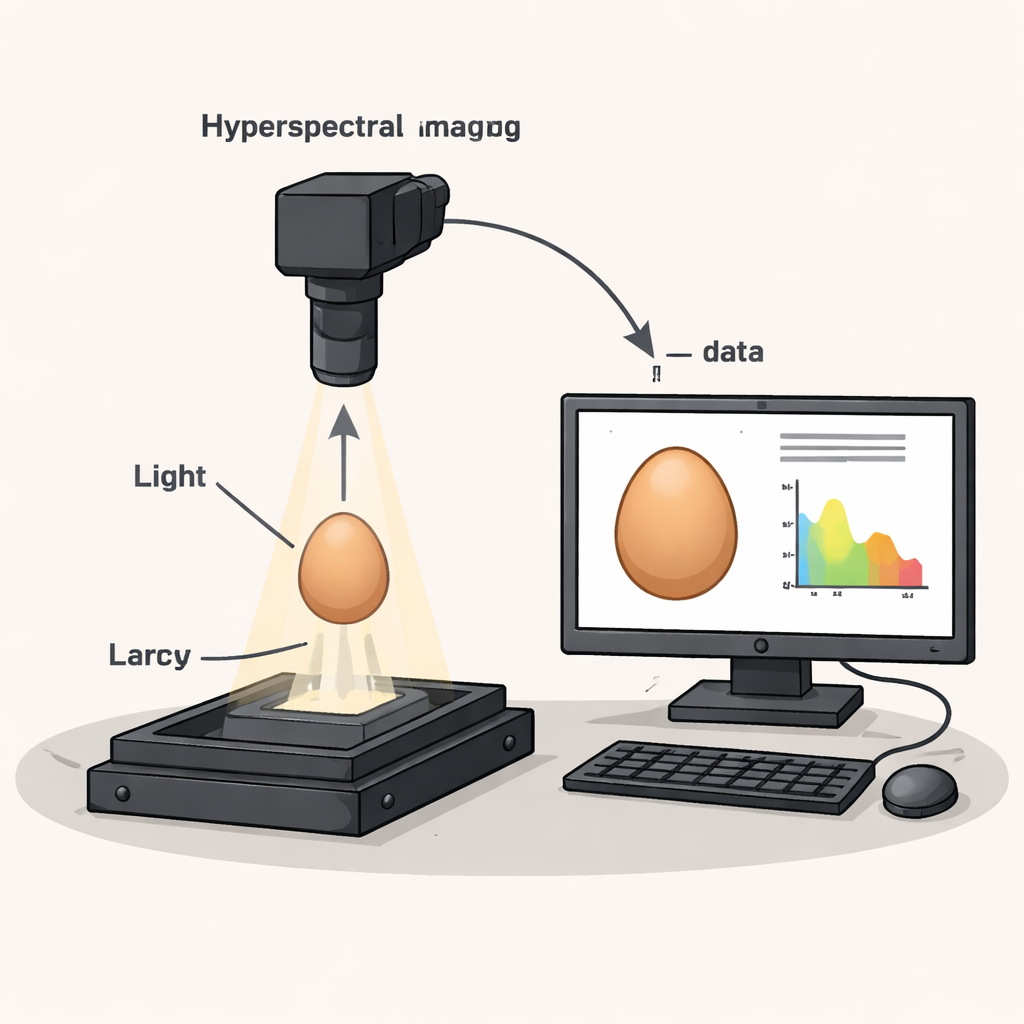
Building a Rich Library of Egg Traits
To make the imaging data truly useful, the authors paired every egg scan with careful physical measurements. They recorded basic size and weight, but also key traits that matter to hatcheries and the food industry: whether the egg was fertile before incubation, how thick and strong the shell was, and how heavy the yolk was once the egg was finally opened. This combination turns each egg into a well-documented case: a three-dimensional data cube of light information plus a set of real-world labels. The eggs came from controlled flocks where fertility was known in advance, and the instruments used for thickness, strength, and mass were regularly calibrated, helping ensure that the reference values are trustworthy.
Patterns Hidden in Light
When the team examined the light signatures from all the eggs, clear patterns emerged. Certain wavelengths were strongly linked to pigments that color the yolk, to water content, and to protein- or fat-rich regions—features that relate to both nutrition and shell quality. The eggs also showed a natural spread in weight, size, shell thickness, yolk mass, and shell strength, reflecting the diversity found in real farms rather than idealized laboratory samples. That diversity is valuable: it challenges computer models to work reliably across many types of eggs instead of excelling only on a narrow, uniform set.
Teaching Machines to Read Eggs
To test how useful the dataset is, the researchers trained relatively simple machine learning models on the hyperspectral data. One model tried to predict yolk mass, while another classified eggs as fertile or infertile before incubation. Even without discarding outliers or using advanced artificial intelligence, the fertility model correctly labeled around 90% or more of eggs in independent test sets, and the yolk prediction model produced reasonably accurate estimates. These results suggest that more sophisticated algorithms—such as deep learning—could push performance even higher, and that the dataset is consistent and robust enough to support such efforts. 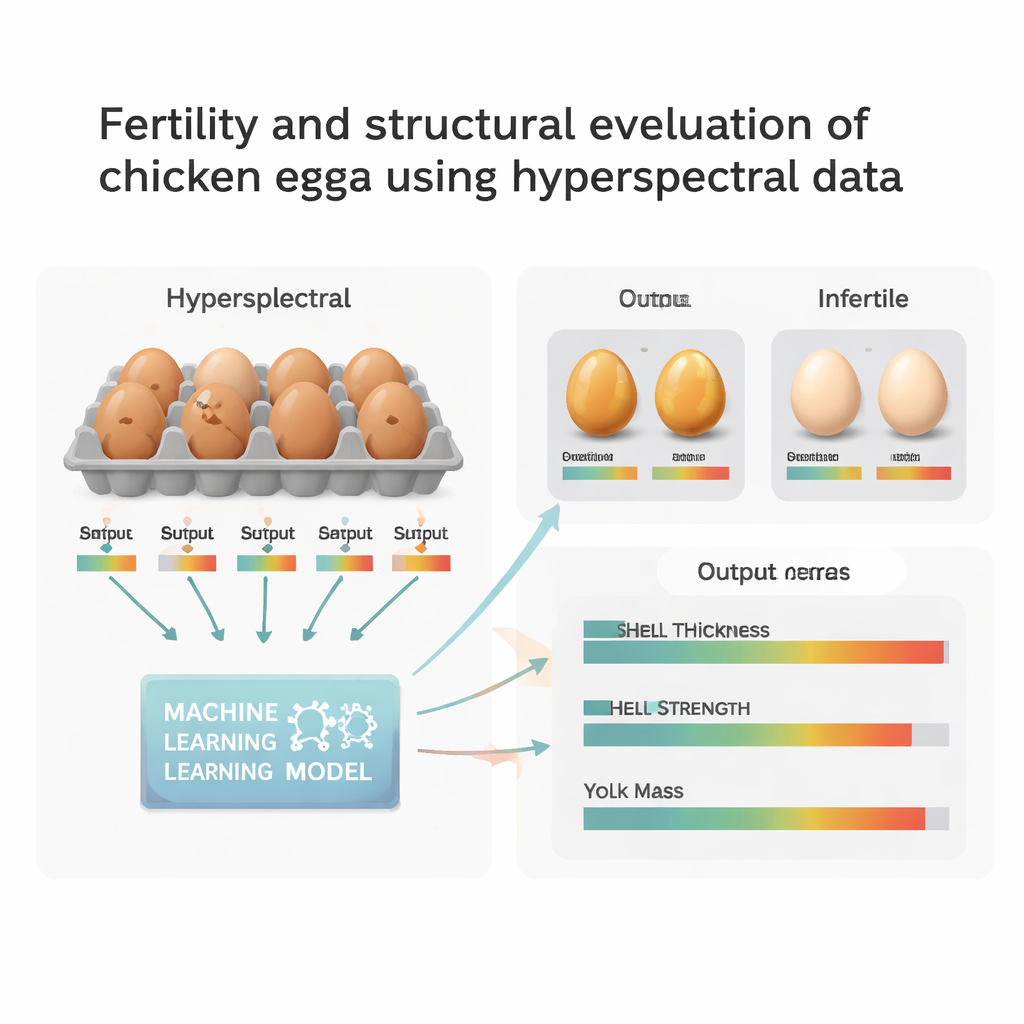
Opening the Door to Smarter Egg Handling
For non-specialists, the main message is straightforward: this open dataset is a foundation for machines that can look through eggs without breaking them. By sharing both the raw hyperspectral images and easy-to-use tables of spectra and measurements, the authors give researchers, engineers, and industry partners a common starting point to develop new tools. In the future, such tools could automatically sort infertile eggs before they ever enter an incubator, reduce waste and contamination, and help guarantee consistent shell strength and yolk content—making egg production safer, more efficient, and less resource-intensive.
Citation: Ahmed, M.W., Song, D., Ahmed, M.T. et al. Hyperspectral imaging dataset for non-destructive fertility and structural evaluation of chicken eggs. Sci Data 13, 237 (2026). https://doi.org/10.1038/s41597-026-06556-1
Keywords: hyperspectral imaging, egg quality, fertility detection, non-destructive testing, poultry science