Clear Sky Science · en
Reconstruction of Holocene Northern Hemisphere precipitation fields using paleoclimate data assimilation
Why Looking Back at Ancient Rainfall Matters Today
Rain may seem like everyday weather, but over thousands of years it has shaped where people could farm, build cities, and survive droughts. To understand how human‑driven climate change may alter future water supplies, scientists need to know how Earth’s rainfall has naturally shifted in the past. This study reconstructs how annual precipitation over most of the Northern Hemisphere changed over the last 12,000 years of the Holocene, giving a long‑term backdrop against which we can judge modern and future hydroclimate change. 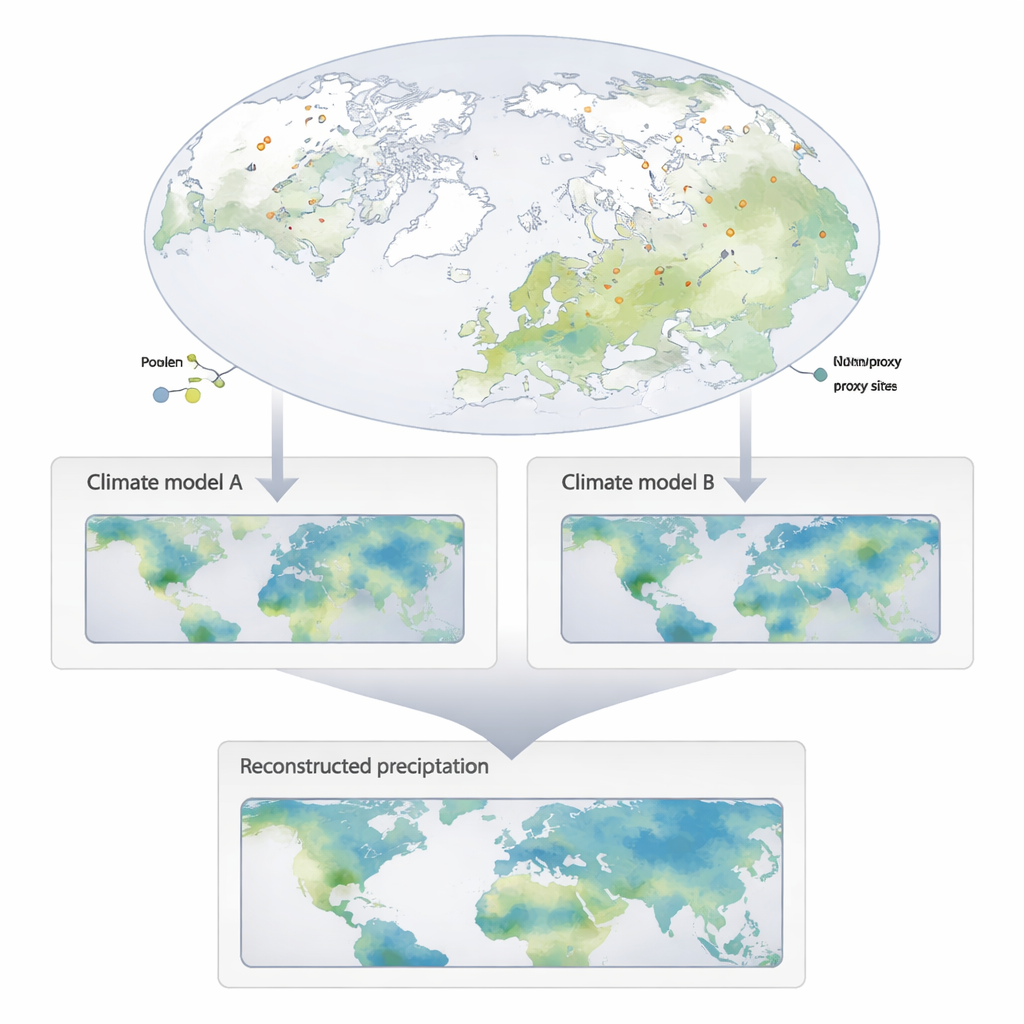
Rebuilding a 12,000‑Year Picture of Rain
The Holocene is the warm period since the last ice age, covering roughly the past 11,700 years. It includes major transitions in human history, from early farming to modern industrial societies. While scientists have already built fairly detailed maps of past temperatures for this period, reconstructing rainfall has been much harder. Rainfall is patchy in space and time, and most existing records are local or regional, leaving big gaps. This study tackles that problem by generating a continuous, hemisphere‑wide reconstruction of annual precipitation, with maps every 100 years and grid cells about a few hundred kilometers across, from 12,000 years ago to the present.
Blending Models and Ancient Clues
To fill in the missing pieces, the authors use an approach called paleoclimate data assimilation. In simple terms, this method fuses two ingredients: climate model simulations of past conditions and “proxy” records—natural archives such as fossil pollen that preserve clues about past climate. Here, the team uses 2,421 pollen‑based records of annual precipitation from across the Northern Hemisphere, all drawn from a carefully screened public database. They combine these with two long, detailed simulations of Holocene climate run by different global climate models. The key is an algorithm (a variant of the Ensemble Kalman Filter) that adjusts the model’s precipitation fields so they are statistically consistent with the proxy evidence, while also accounting for uncertainties in both. 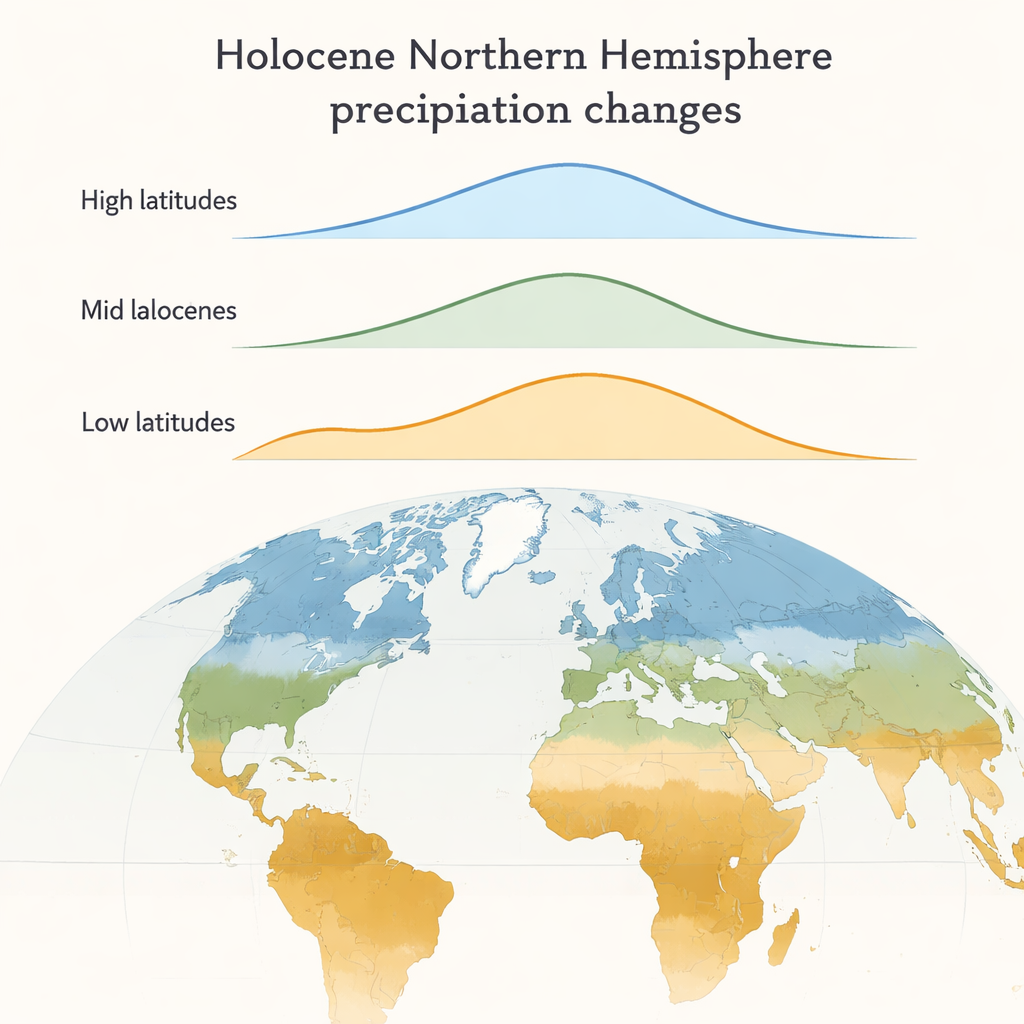
How the Reconstruction Was Built
The researchers first convert the uneven, age‑uncertain pollen records into 100‑year averages, matching the timescale of the reconstructed maps. They then prepare the model side by averaging simulated precipitation into the same 100‑year windows and correcting simple long‑term biases against a 20th‑century reanalysis dataset. In a series of sensitivity tests, they tune two important settings: how far information from each data point can influence surrounding grid cells, and how much weight to give the proxy errors. After choosing the best‑performing settings, they run hundreds of Monte Carlo realizations, each time sampling slightly different prior model states and subsets of proxy records. This ensemble approach allows them to quantify not only a best estimate of precipitation, but also uncertainty at each grid point and time slice.
Checking How Well It Works
Because rain maps averaged over 100‑year intervals cannot be directly compared to short instrumental records, the team relies on several indirect tests. In each experiment, they deliberately hold back a quarter of the pollen records and use them only for validation. They also compare the reconstructed precipitation against 70 additional independent records from caves, ice cores, and other sources that were not used in the assimilation. Across these tests, the reconstructions reproduce local trends and variability better than the original model simulations alone, particularly in mid‑ and high‑latitude regions. A probabilistic skill score based on 20th‑century data shows that the combined‑model reconstruction improves on the raw models across nearly 90% of grid cells, including over many ocean areas where no proxy data exist.
What We Learn About Holocene Rainfall
When averaged over the Northern Hemisphere’s land, the new reconstruction shows a coherent long‑term pattern: precipitation generally increases from the early Holocene into a mid‑Holocene peak around 6,000 years ago, followed by a gradual decline toward modern times. This behavior is consistent with previous, more limited studies and with the influence of slow shifts in Earth’s orbit on monsoons and storm tracks. The reconstruction also reveals latitude‑dependent differences: mid‑ and high‑latitude bands show particularly strong agreement between the new dataset, existing proxy compilations, and climate models, while low‑latitude regions are more challenging but still improved when multi‑model information is used. These broad patterns help scientists test how well climate models capture long‑term water‑cycle responses to natural forcing.
Why This Dataset Matters for the Future
For non‑specialists, the key takeaway is that scientists now have the most complete, time‑resolved picture to date of how Northern Hemisphere rainfall has changed over the entire Holocene. It does not predict next year’s drought, but it does provide a powerful benchmark: we can now ask whether recent and future changes in regional precipitation fall within the range of natural variability over many millennia or push beyond it. The dataset also offers a rigorous testbed for improving climate models’ treatment of rainfall, which is crucial for planning water management, agriculture, and infrastructure in a warming world.
Citation: Fang, M., Wang, J. & Chang, H. Reconstruction of Holocene Northern Hemisphere precipitation fields using paleoclimate data assimilation. Sci Data 13, 235 (2026). https://doi.org/10.1038/s41597-026-06551-6
Keywords: Holocene precipitation, paleoclimate data assimilation, Northern Hemisphere climate, hydroclimate variability, climate proxies