Clear Sky Science · en
Chromosome-level genome assembly of the dwarf cattail Typha minima
A tiny plant with a big genetic story
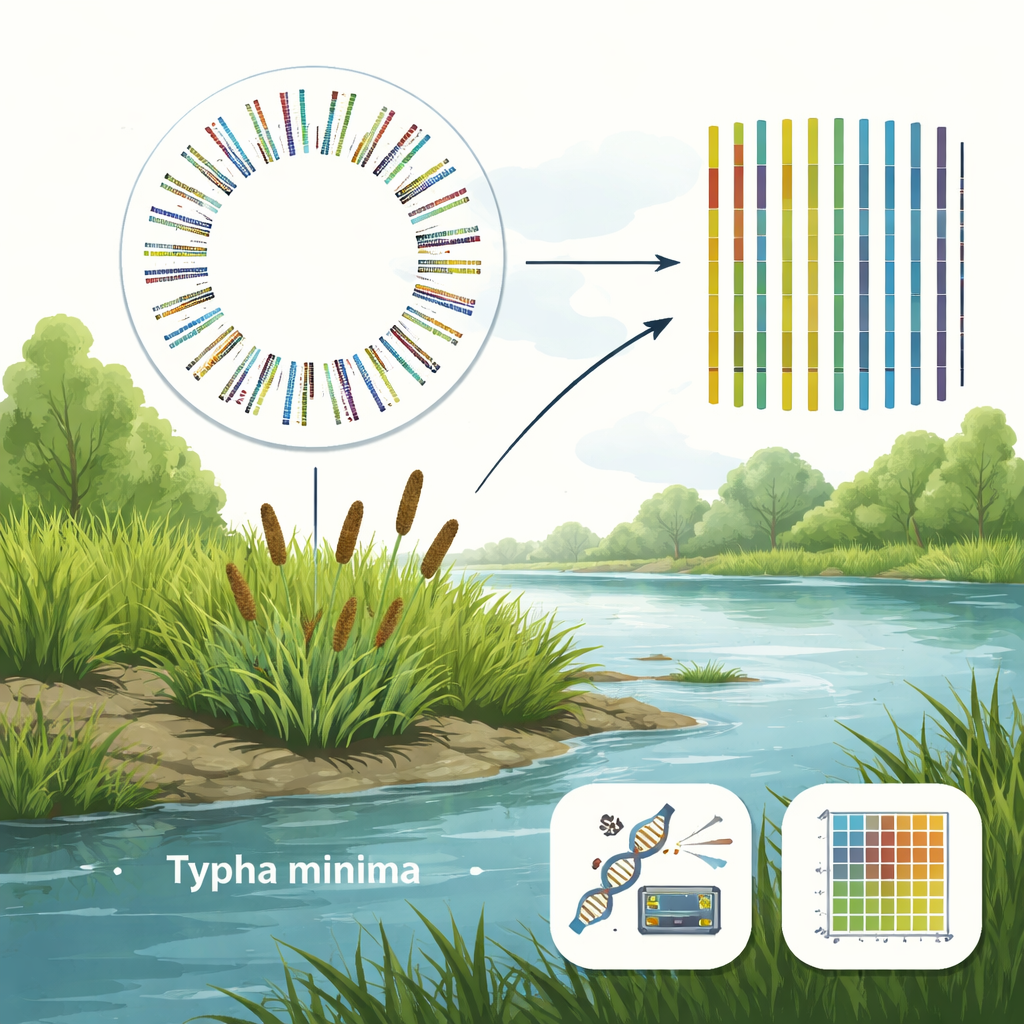
The dwarf cattail, Typha minima, is a small wetland plant with outsized importance for clean water, wildlife habitat, and traditional medicine. Yet this species is now critically endangered in parts of Europe, surviving only in scattered pockets. In this study, scientists have decoded its DNA at chromosome-level detail for the first time, creating a genetic blueprint that can help explain how the plant works, why it is at risk, and how best to protect it.
Why this little cattail matters
Cattails are among the architectural engineers of wetlands. They create shelter for animals, stabilize shorelines, and help control the chemistry of water. Their roots can trap harmful microbes and pollutants, acting like a living filter. On top of this, cattail pollen has long been used in traditional medicine for its blood-clotting and diuretic effects. Typha minima is a more delicate cousin of the common cattail, native to temperate Eurasia and now endangered in several European countries. Understanding its biology at the DNA level offers a way to safeguard not just one species, but the health and services of entire wetland ecosystems.
Building a complete genetic blueprint
To capture the full genetic makeup of Typha minima, the researchers collected fresh leaves from plants growing in a river valley in Xinjiang, China. They extracted high-quality DNA and used state-of-the-art sequencing methods that read long stretches of the genetic code with great accuracy. Another technique, called Hi-C, allowed them to see how pieces of DNA are physically arranged and folded inside the cell, helping to assemble the genome into full-length chromosomes rather than scattered fragments. The final result is a compact genome of about 325 million DNA letters neatly organized into 30 chromosome-like units with exceptional continuity and accuracy.
Peering inside the genome’s structure
With the basic assembly in hand, the team checked its quality in several ways. They compared the plant’s DNA back to the assembly and found that almost all the original data mapped correctly, suggesting very few gaps or errors. A standard test that looks for thousands of core plant genes showed that more than 99 percent were present and intact, confirming that almost nothing important was missed. The scientists also cataloged repeated stretches of DNA, which can shape how genomes evolve. About one-third of the dwarf cattail genome is made of such repeats, including mobile genetic elements known as retrotransposons, many of which appear to be specific to this lineage.

From raw sequence to working genes
Beyond just assembling chromosomes, the researchers wanted to know what the genes actually do. They sequenced RNA from roots, stems, leaves, and fruits—snapshots of which genes are active in different tissues. Combining this information with comparisons to other plants and several prediction programs, they identified 34,541 protein-coding genes. Remarkably, over 96 percent of these genes could be linked to known or predicted functions using major biological databases. Many genes had support from multiple independent sources, giving high confidence that the genome is not only structurally complete but also biologically well described.
A foundation for conservation and evolution studies
Typha minima forms a key branch of the cattail family tree, closely related to another species and together set apart from the rest of the group. By providing a high-resolution genome, this work opens the door to tracing how cattails diversified, how they adapted to wetlands, and which genetic changes might be tied to rarity or resilience. For conservationists, this genome is like a detailed manual: it can help pinpoint genetic diversity within and between populations, identify vulnerabilities, and design smarter strategies to preserve this threatened plant and the ecosystems it supports.
What this means in everyday terms
For a non-specialist, the message is simple: scientists have turned the entire DNA of a rare wetland plant into a readable, searchable reference book. This resource shows where its genes sit on each chromosome, what many of them likely do, and how stable and complete the genetic picture is. With this blueprint in hand, future studies can better explain why dwarf cattail is struggling in the wild, how it helps keep water clean, and how we might protect both the species and the wetlands that depend on it.
Citation: Du, J., Huang, L. & Xu, X. Chromosome-level genome assembly of the dwarf cattail Typha minima. Sci Data 13, 231 (2026). https://doi.org/10.1038/s41597-026-06547-2
Keywords: wetland plants, genome assembly, cattail, endangered species, conservation genomics