Clear Sky Science · en
A dataset on occupant satisfaction with the indoor environmental quality in Belgian classrooms
Why the feel of a classroom matters
Anyone who has tried to follow a lesson in a stuffy, noisy or overly warm classroom knows that the room itself can make learning harder. Yet most building standards still assume that if temperature and air flows are set “about right” for an average adult, everyone inside will feel fine. This paper introduces a rich new dataset from Belgian classrooms that challenges that assumption, showing in detail how children, teenagers and university students actually feel about their indoor environment over time.
Listening to students, not just to sensors
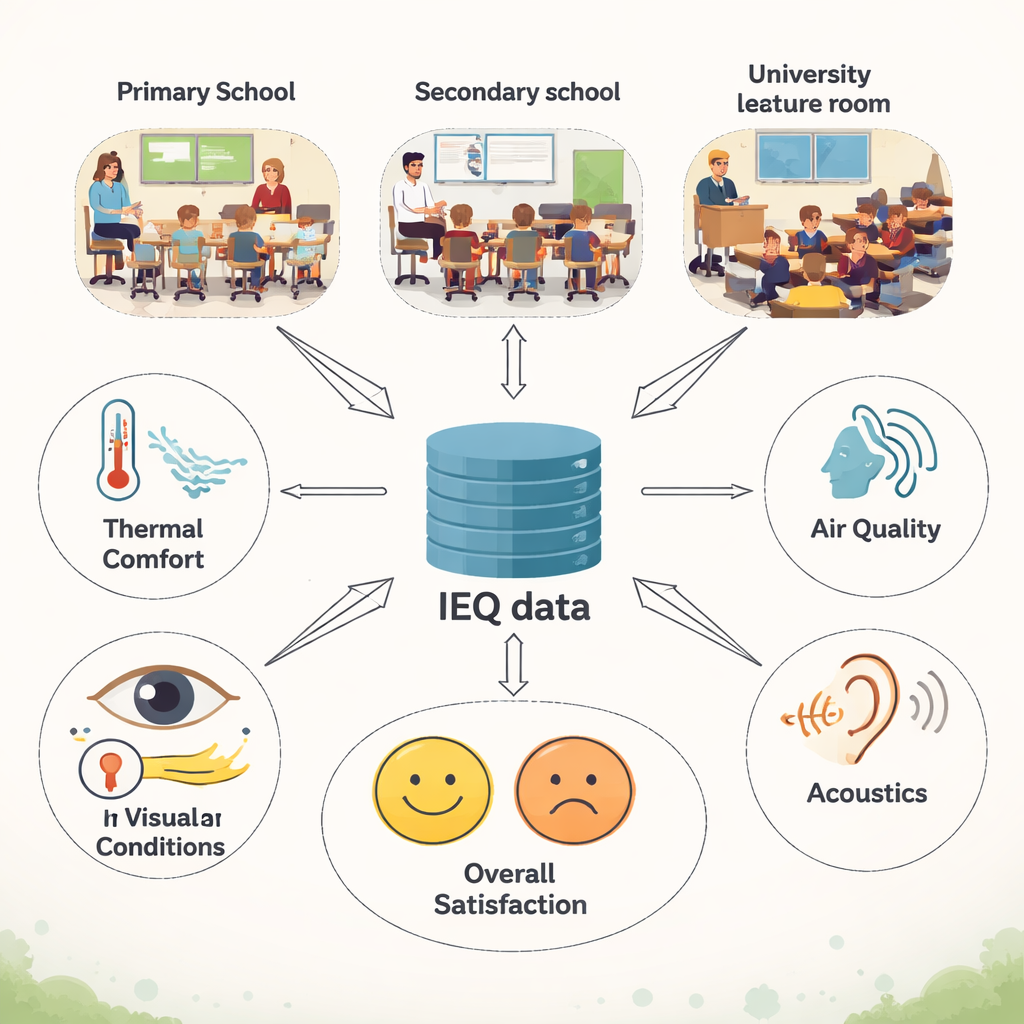
The researchers followed three types of educational spaces in Flanders, Belgium: secondary school classrooms, primary school classrooms and a university lecture room. In each setting, they repeatedly asked occupants how satisfied they were with five aspects of the indoor environment: temperature, air quality, lighting, noise and the overall feel of the room. Instead of long technical questionnaires, they used a simple five‑star style scale, familiar from online reviews, to make it easy for pupils and students to respond quickly on their phones or school devices, sometimes 10–20 times over the study period.
Measuring the invisible classroom climate
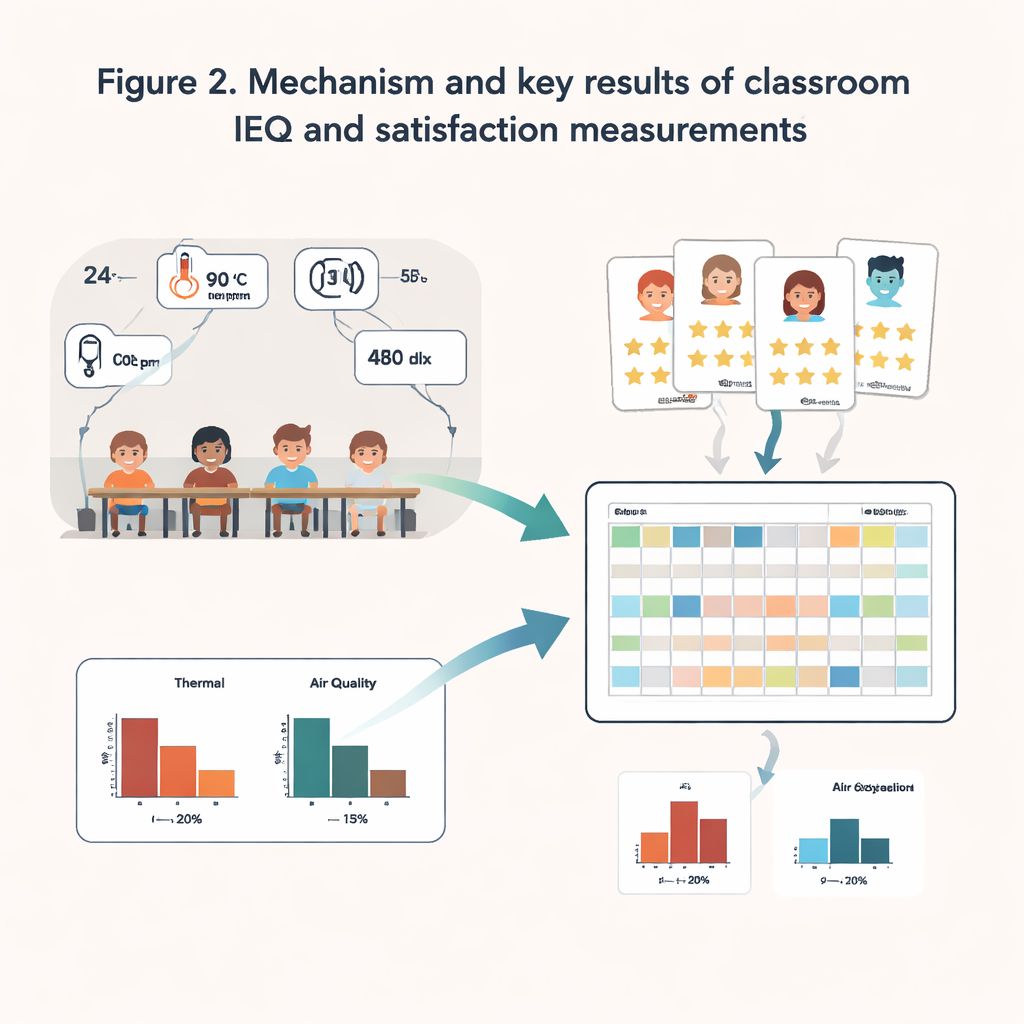
At the same time, the team continuously measured what the rooms were actually like. Sensors recorded temperature, humidity, carbon dioxide (as a marker of how fresh the air was), noise levels and light levels in all three case studies, and in the university lecture room they also tracked air speed and tiny particles and gases in the air. These measurements were taken every few minutes. Each survey response was then matched to the nearest sensor readings in time, so that every opinion about comfort could be linked to the physical conditions at that moment and to contextual details such as where in the room a pupil was sitting, what they were wearing, whether windows were open and what kind of lesson was taking place.
A rare long‑term picture of classroom comfort
Across all sites, the dataset contains 6,834 satisfaction assessments from 321 different occupants, ranging from children under 12 to young adults. This makes it one of the largest public, long‑term collections of classroom comfort data, and unusual in several ways. First, it covers all four main comfort domains—thermal, air quality, visual and acoustic—rather than temperature alone. Second, because each person answered multiple times, the data can be used to explore how an individual’s preferences change over days, weeks and seasons, instead of treating all occupants as interchangeable. Third, it highlights an under‑represented region: mixed‑humid Belgian classrooms, for which almost no high‑quality comfort data previously existed.
What the data already reveal
Even before building complex models, the merged data paint a telling picture. In many classrooms, a substantial minority of votes expressed dissatisfaction, particularly with temperature and air quality. In the secondary school, about one in five ratings for these two aspects were negative, hinting at overheating and stuffiness at times. Primary school pupils were especially unhappy with noise levels, while university students in the test lecture room often criticised temperature and lighting. The sensor data back up these impressions: some classrooms showed brief periods of high temperatures, very low or high humidity, or carbon dioxide levels that spiked when ventilation systems were not working optimally. Because the studies took place during COVID‑19, with mask use and extra window opening, the dataset also captures how pandemic practices may have altered the usual balance between fresh air, warmth and quiet.
From averages to truly comfortable classrooms
Traditional comfort standards are built on averages from adults and often fail to capture what a specific child or student actually prefers. This dataset is designed to help change that. By providing repeated feedback from the same people, paired with detailed measurements of their surroundings, it offers a foundation for new “personal comfort models” and smarter heating and ventilation controls that can respond to real occupants instead of an imaginary average. For teachers, school designers and policy‑makers, the core message is simple: if we want healthier, more effective learning environments, we need to measure what students feel—systematically and over time—and use that evidence to fine‑tune how we design and operate classrooms.
Citation: Carton, Q., Kolarik, J. & Breesch, H. A dataset on occupant satisfaction with the indoor environmental quality in Belgian classrooms. Sci Data 13, 229 (2026). https://doi.org/10.1038/s41597-026-06545-4
Keywords: classroom environment, student comfort, indoor air quality, school buildings, learning conditions