Clear Sky Science · en
A prefrontal cortex map based on single-neuron activity
How the Brain’s Control Center Keeps Thoughts in Order
The front part of the brain, called the prefrontal cortex, helps us plan, decide, and keep track of goals. Yet scientists still debate how this region is organized: is it carved into tidy sections with fixed jobs, or does it work more like a flexible network? This study tackles that question by listening in on more than 24,000 individual brain cells in mice, revealing a new kind of map based not on tissue appearance, but on how single neurons fire over time.
Listening to Thousands of Tiny Electrical Voices
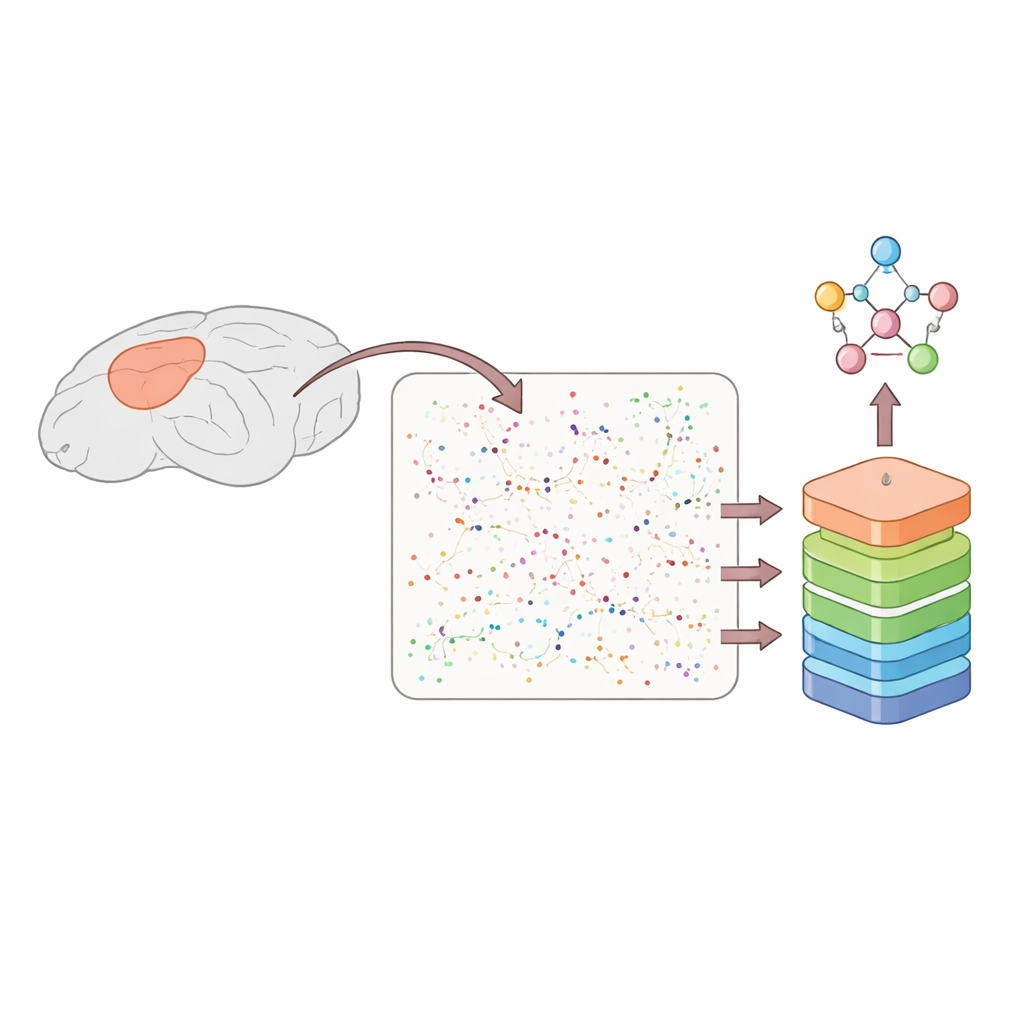
To build this functional map, the researchers used ultra-dense recording probes to measure electrical spikes from individual neurons across the mouse prefrontal cortex and neighboring regions while the animals were awake. They examined how often each neuron fired, whether its spikes came in steady rhythms or in bursts, and whether the timing of one spike influenced the next. These three simple features captured how “regular” or “bursty” each neuron’s activity was. Instead of relying on traditional anatomical borders, they grouped neurons with similar firing styles and asked where these groups appeared in the brain.
A Signature Firing Style for Higher-Order Brain Areas
The analysis showed that brain areas do not all “sound” the same. Subregions of the prefrontal cortex were especially rich in neurons that fired slowly and with striking regularity, like well-spaced ticks of a metronome. In contrast, regions such as the thalamus and hippocampus tended to host more neurons that fired in bursts with irregular gaps. When the team compared these patterns to an independent measure of how high each cortical area sits in a brain-wide processing hierarchy, an intriguing link emerged: higher-order regions consistently showed more of these low-rate, regular-firing neurons, whereas lower-level sensory areas contained more bursty cells.
A Map That Ignores Classical Borders
Within the prefrontal cortex itself, the team carved the tissue into many small patches containing similar numbers of recorded neurons. They found that patches sharing similar firing profiles often spilled across classical textbook boundaries between named subregions. Some clusters of patches formed coherent “modules” of low-rate, regular activity that aligned only partly with known anatomical labels. When the authors compared their firing-based map with a detailed wiring diagram of connections inside the prefrontal cortex, they saw that regions higher in this internal hierarchy were also those enriched in the regular-firing neurons. This suggests that how areas are wired together, rather than how their cells look under a microscope, is what shapes the landscape of ongoing activity.
From Quiet Background Firing to Decisions and Feedback
The study also asked how these spontaneous patterns relate to what neurons do during specific events. In one set of experiments, the mice simply heard tones, and neurons were grouped by how quickly and strongly they responded. Tone-responsive cells were scattered in patches across the prefrontal cortex and did not respect anatomical borders. In a separate, more complex task, mice saw a visual cue, turned a wheel to choose a side, and then received reward or noise. Neurons that carried information about the animal’s choice clustered in a previously undefined swath of prefrontal cortex that overlapped with regions rich in regular-firing neurons. Yet, on a cell-by-cell level, the units that actually signaled choice, tone, or feedback tended to be those with higher spontaneous firing rates, not the slow, regular ones.
Two Interlocking Populations Behind Flexible Thought
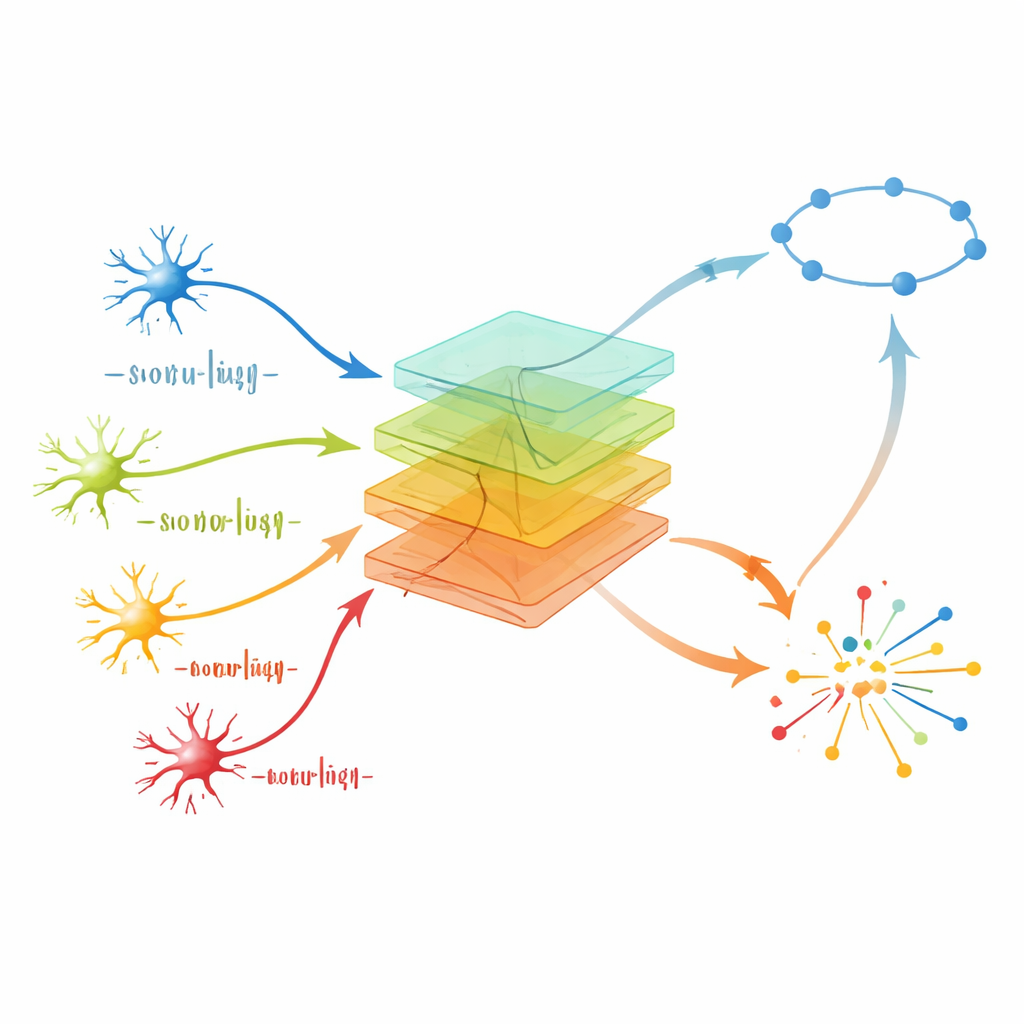
Taken together, the results point to a division of labor. Slow, regular-firing neurons appear to mark and support high-level, highly connected parts of the cortex, providing a stable background that may favor long-lasting representations and integration of information. Faster, more excitable neurons sitting in the same neighborhoods are the ones that light up for specific sounds, choices, and outcomes. This work argues that the true organizing principle of the brain’s control center is not how its layers and cell types look, but how they are connected and how their activity is patterned in time. By showing how fine-grained maps based on single-neuron firing can reveal hidden structure, the study offers a roadmap for uncovering similar functional maps throughout the brain.
Citation: Le Merre, P., Heining, K., Slashcheva, M. et al. A prefrontal cortex map based on single-neuron activity. Nat Neurosci 29, 673–681 (2026). https://doi.org/10.1038/s41593-025-02190-z
Keywords: prefrontal cortex, neuronal firing patterns, brain hierarchy, neural connectivity, decision making