Clear Sky Science · en
Infants have rich visual categories in ventrotemporal cortex at 2 months of age
Babies Seeing the World in Groups
When adults look around, we effortlessly sort what we see into meaningful groups: people, animals, tools, furniture, and so on. This study shows that even very young babies, just 2 months old, already have surprisingly rich category structure in their brains. Long before they can talk, point, or even see perfectly clearly, their visual system is organizing the world into groups that resemble those found in adults and even in modern artificial intelligence systems.
Peeking Inside the Newborn Brain
To uncover how early this mental sorting begins, the researchers used functional MRI to measure brain activity in more than 100 awake infants at about 2 months of age, and in a subset of them again at 9 months, alongside a comparison group of adults. While in the scanner, participants viewed a series of simple pictures: animals such as cats and birds, small everyday objects like cups and toys, and large objects like trees or shopping carts. By carefully tracking patterns of activity across many tiny patches of brain tissue, the team could ask not just whether the brain responded, but whether it responded in systematically different ways to different kinds of things. 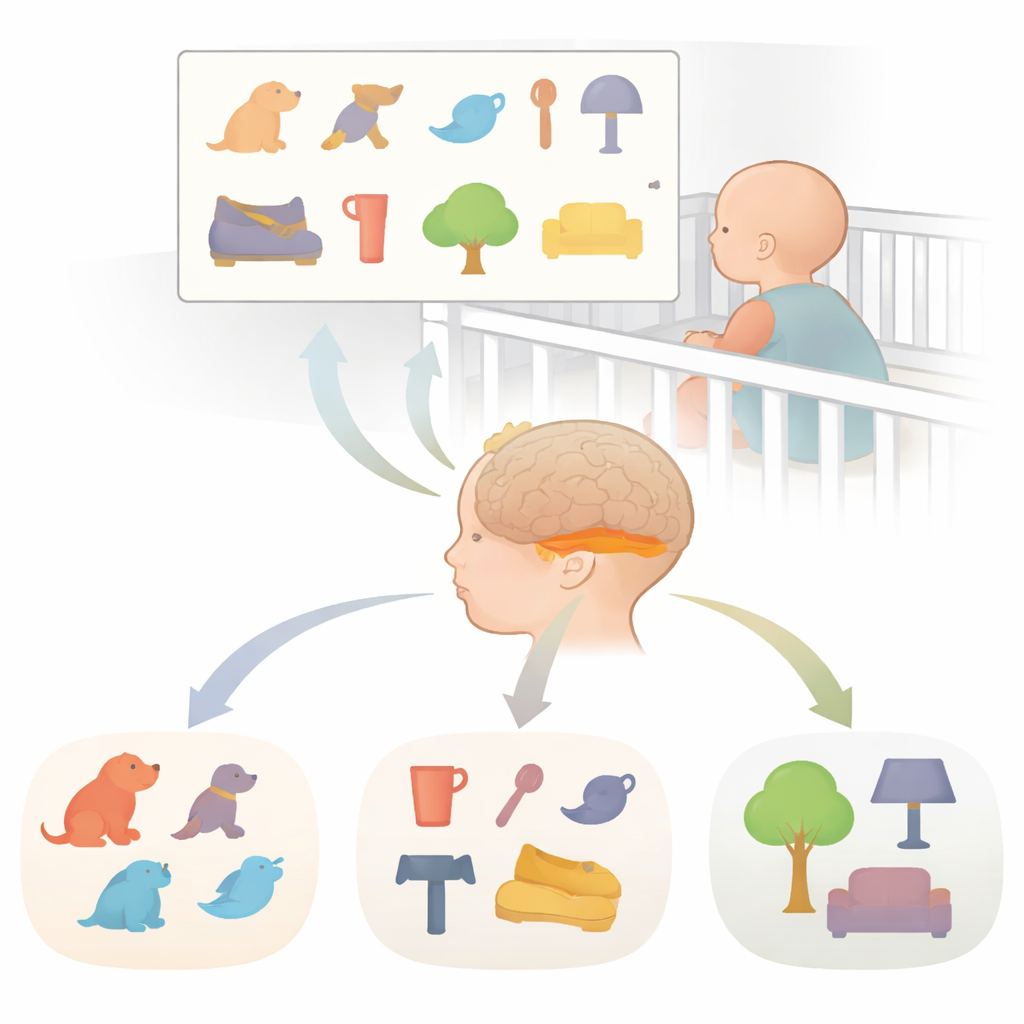
Early Brain Areas Already Know “What’s What”
The focus was on the ventral visual pathway, a set of regions on the underside of the brain that in adults supports recognizing what we are looking at. The scientists examined how similar or different the brain’s activity patterns were for each pair of images, building a kind of “map” of visual relationships. Shockingly, at just 2 months old, babies already showed distinct patterns for individual objects and for broad categories in high-level ventral regions. Their maps resembled those of adults far more than expected, even though infant eyesight and experience with the world are still very limited. The babies’ brains were already grouping images by whether they were animate or inanimate, and by whether inanimate objects were small hand-held items or large things you move around or sit in.
Not a Simple Bottom-Up Build
One long-standing idea is that visual development proceeds from simple to complex: early brain regions would first tune to basic features like size or color, and only later would higher regions build categories on top of these building blocks. This study challenges that picture. The researchers found that both low-level features (such as shape and size) and higher-level distinctions (such as animacy and real-world size class) were present across the visual pathway from 2 months onward. While early regions became more specialized for basic features with age, the ventrotemporal cortex already emphasized category structure very early and then refined it. In contrast, a lateral region known in adults for object recognition lagged behind, showing weak and unreliable category signals in infants, even though the more “advanced” ventral areas were already active. 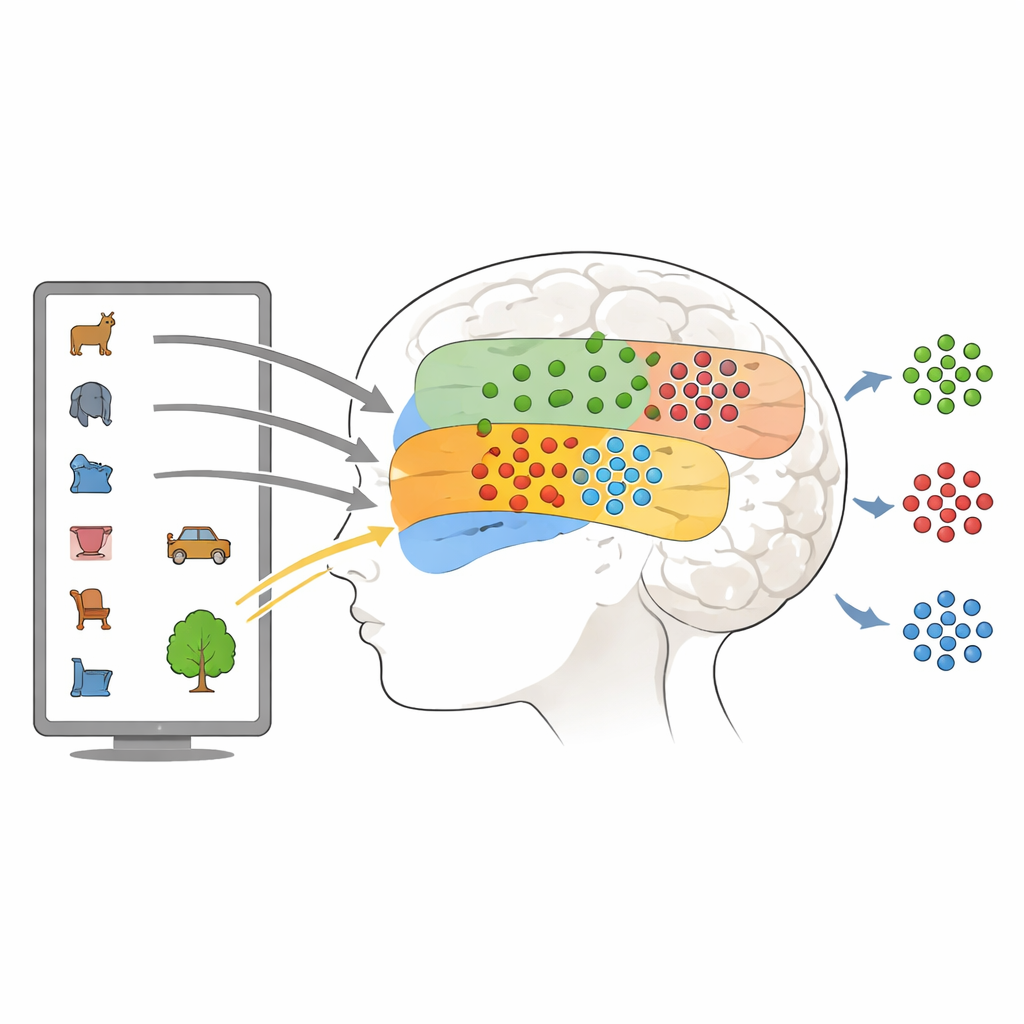
Baby Brains and Artificial Networks Agree
To better understand what kinds of visual information might support this early categorization, the team compared infant brain patterns to those in deep neural networks trained to recognize objects from images. They tested both untrained networks with random connections and fully trained networks that had learned from millions of pictures, using different learning rules. The infants’ brain activity aligned far better with the trained models, including versions that learned without explicit labels, than with untrained ones. This suggests that infants’ visual representations, even at 2 months, rely on complex features that can be extracted from the statistics of everyday visual experience—similar to how successful AI vision systems work.
What This Means for Early Minds
Together, these findings paint a picture of the infant brain as far from a blank slate. By 2 months of age, babies already possess a rich internal template that separates animals from objects and distinguishes small, graspable things from larger structures. This structure does not appear to be built step-by-step in a simple front-to-back hierarchy; instead, high-level visual areas seem ready early, then become more finely tuned as the child sees more of the world. These early category maps may form the hidden groundwork on which later abilities—such as understanding words, actions, and concepts—are built.
Citation: O’Doherty, C., Dineen, Á.T., Truzzi, A. et al. Infants have rich visual categories in ventrotemporal cortex at 2 months of age. Nat Neurosci 29, 693–702 (2026). https://doi.org/10.1038/s41593-025-02187-8
Keywords: infant vision, visual categorization, brain development, ventral visual cortex, deep neural networks