Clear Sky Science · en
Predicting onset of symptomatic Alzheimerʼs disease with plasma p-tau217 clocks
Why a Simple Blood Test Matters for Brain Health
Alzheimer’s disease often develops silently for years before memory problems appear. Families and doctors would benefit from knowing not only who is likely to develop symptoms, but roughly when this might happen. Today, such predictions usually require expensive brain scans that are available only in specialized centers. This study asks a strikingly practical question: could a single blood test provide a reasonably accurate countdown to the onset of Alzheimer’s symptoms?
A New Way to Read the Clock of Disease
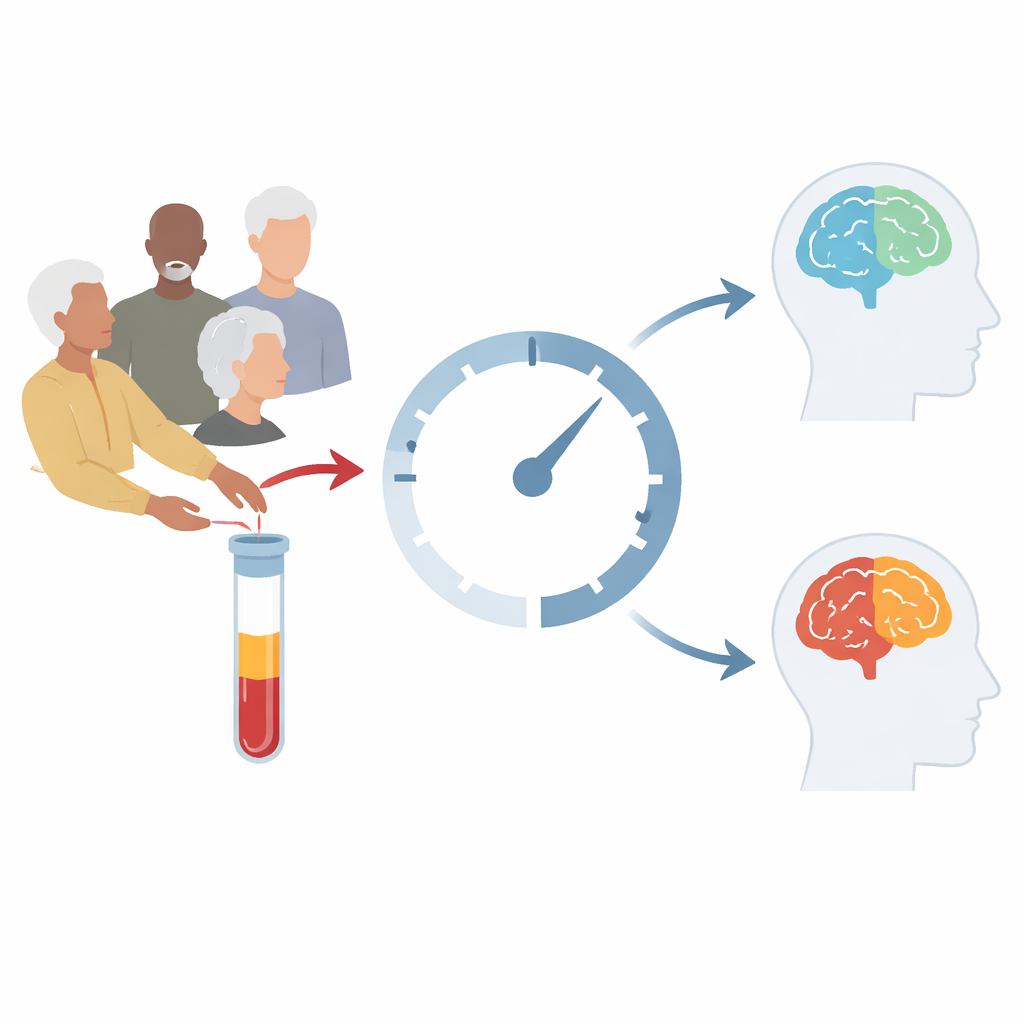
The research centers on a blood marker linked to Alzheimer’s, called plasma p-tau217. Instead of just asking whether this marker is high or low, the team treated it like the hand of a clock that moves in a fairly predictable way as disease builds up. Using years of blood samples from two large groups of older adults in the United States, they built mathematical “clocks” that connect p-tau217 levels to time. These clocks estimate the age at which a person first crosses a key threshold of this marker—what the authors call “p-tau217 positivity”—which corresponds to meaningful Alzheimer’s changes in the brain as seen on specialized scans.
Linking the Blood Clock to Future Symptoms
Once they could estimate when a person became p-tau217 positive, the researchers asked whether that estimated age relates to the age when memory and thinking problems actually appear. They focused on people who started out cognitively normal but later developed clear Alzheimer’s-type impairment. Across both study groups, the estimated age of p-tau217 positivity was closely tied to the age of symptom onset. In statistical terms, the blood-based clock explained a substantial share of the differences in when symptoms began, and it did so with a typical error of about three to four years. In other words, from a single blood sample, the model could often predict the age at which symptoms would start within a window that is small enough to be useful for planning studies and therapies.
Age Changes How Fast Trouble Arrives
An important and somewhat sobering finding was that age strongly shapes how quickly symptoms follow p-tau217 positivity. People who became positive around age 60 often remained symptom-free for roughly two decades. In contrast, those who first reached the same blood marker threshold in their late seventies or early eighties tended to develop memory problems in a little over a decade, or even sooner. This suggests that older brains, which are more likely to harbor other age-related changes such as blood vessel damage or additional protein build-up, may be less able to tolerate the same level of Alzheimer’s pathology. The same p-tau217 reading can therefore imply very different near-term risks, depending on a person’s age.
Putting the Blood Clock to the Test
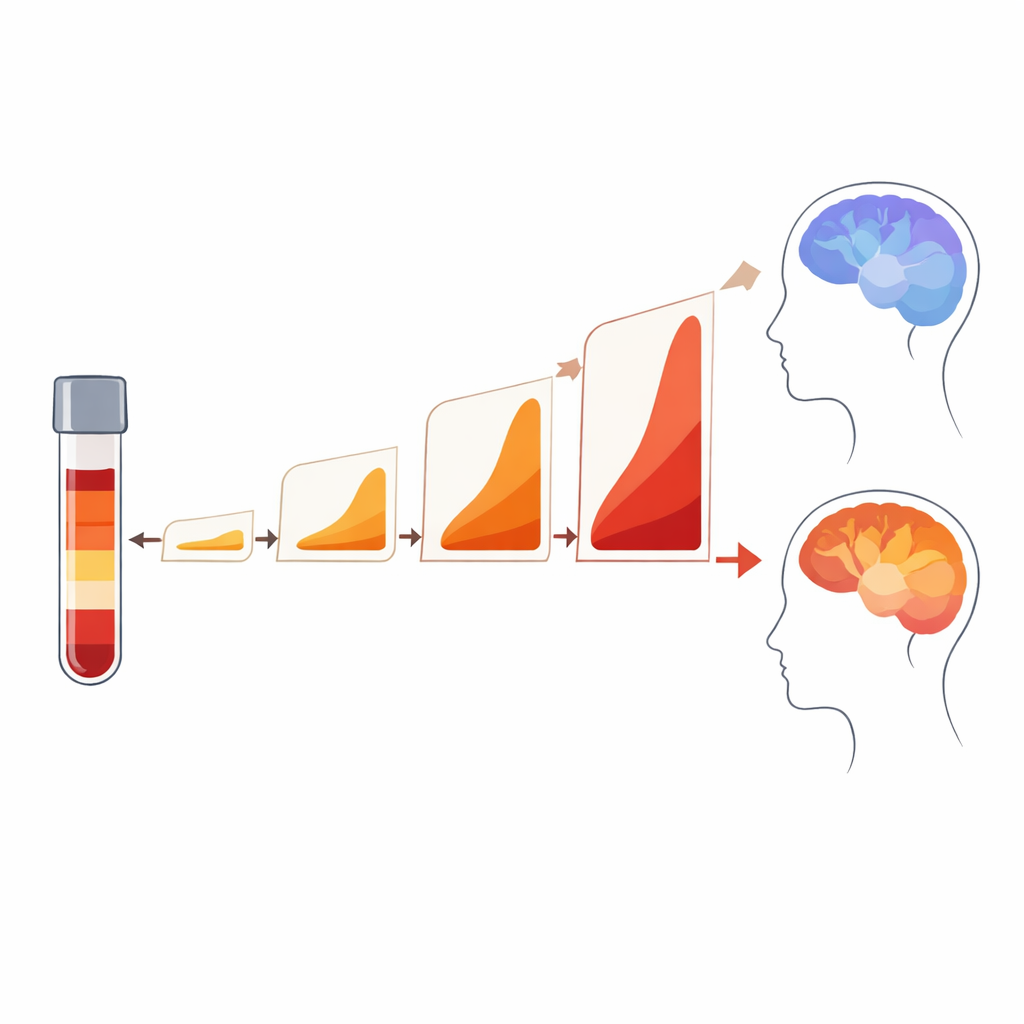
To check how robust their approach was, the scientists repeated the clock-building exercise using several other commercial tests that measure p-tau217 in slightly different ways, including combinations with another Alzheimer’s-related protein, amyloid-beta. Despite technical differences among the assays and between the two study cohorts, the overall story held up: p-tau217-based clocks consistently aligned disease progression in time and provided useful estimates of when symptoms would emerge. The models performed particularly well at ranking individuals by risk over a follow-up period, which is crucial for selecting participants in clinical trials that aim to prevent or delay symptoms.
What This Means for Trials and Patients
These blood-based clocks are not crystal balls. A three- to four-year margin of error, while impressive for a single blood draw, is too imprecise to guide life decisions for individual patients. The authors stress that such tests should, for now, be confined to research and trial settings, where they could drastically improve the efficiency of studies by enriching enrollment with people who are most likely to develop symptoms during the trial. With further refinement—potentially by combining p-tau217 with other blood markers and subtle cognitive tests—these models might eventually become accurate enough to support more personalized forecasting. For now, the work marks a major step toward turning a simple blood sample into a practical early-warning clock for Alzheimer’s disease.
Citation: Petersen, K.K., Milà-Alomà, M., Li, Y. et al. Predicting onset of symptomatic Alzheimerʼs disease with plasma p-tau217 clocks. Nat Med 32, 1085–1094 (2026). https://doi.org/10.1038/s41591-026-04206-y
Keywords: Alzheimer’s disease, blood biomarkers, p-tau217, dementia risk prediction, neurodegeneration