Clear Sky Science · en
A multimodal sleep foundation model for disease prediction
Why a Night’s Sleep Can Reveal Your Future Health
When you go to sleep in a clinic wired to monitors, those squiggly lines on the screen capture far more than snoring or restless legs. This study shows that one night of detailed sleep recording can act like a crystal ball for future health. By training a powerful artificial intelligence system on hundreds of thousands of hours of sleep data, researchers found that the way we sleep contains hidden clues about risks for dementia, heart disease, kidney problems, cancer and even early death—years before these illnesses appear.
Listening to the Body During Sleep
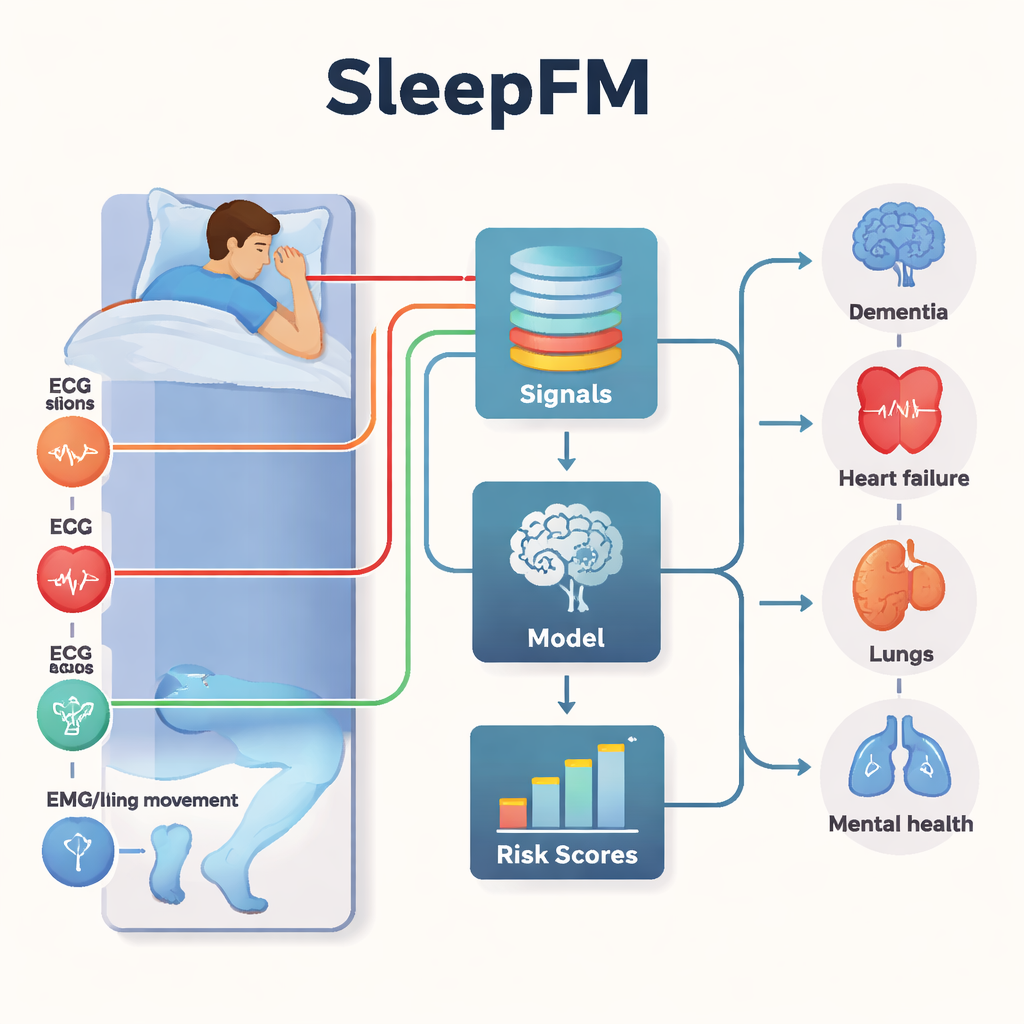
Sleep labs use a test called polysomnography, where sensors on the scalp, face, chest and legs record brainwaves, eye movements, heartbeat, breathing and muscle activity throughout the night. These tests are considered the gold standard for understanding sleep, but they generate huge, complex data streams that are hard for human experts to fully interpret. Most past research has zoomed in on just one problem at a time—such as apnea or narcolepsy—and often relied on laborious manual scoring. As a result, the deeper story hidden in the full mix of signals has been largely untapped.
Teaching an AI to Understand the Language of Sleep
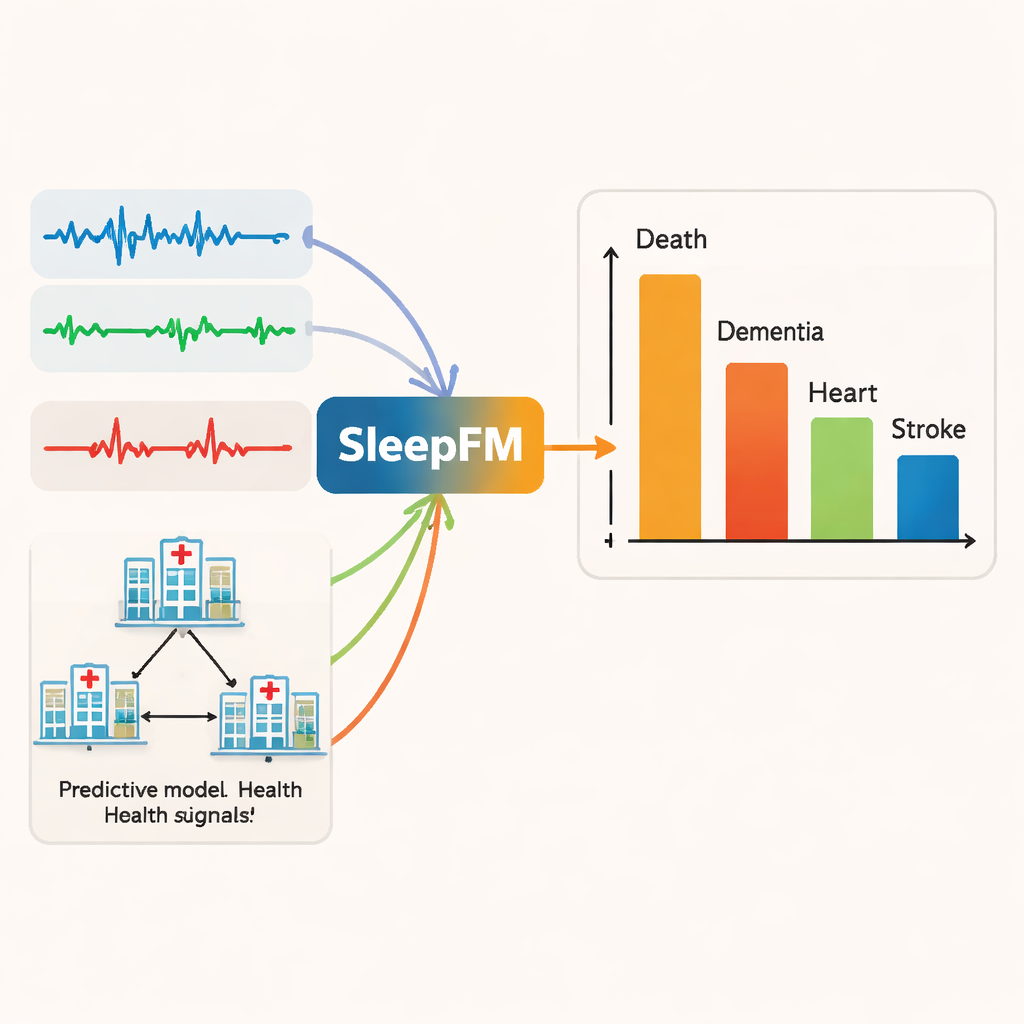
The authors built a “foundation model” called SleepFM, borrowing ideas from large language models that learn from vast amounts of text. Instead of words and sentences, SleepFM learns from raw sleep signals. It was trained on more than 585,000 hours of overnight recordings from over 65,000 people, collected at several sleep centers and population studies. The model takes in short five‑second slices of brain, heart, breathing and muscle activity, then combines them using attention‑based neural networks that can cope with different sensor setups at different hospitals. In training, it teaches itself to align information across these signal types, learning a shared internal representation of what healthy and unhealthy sleep look like, without needing human labels.
From One Night to Many Possible Diagnoses
Once trained, SleepFM’s internal “sleep fingerprints” were linked to electronic health records to see whether they could predict later disease. The researchers examined over 1,000 conditions and asked, for each patient, whether a single overnight study could forecast who would develop a disease years later. SleepFM accurately predicted 130 different diagnoses with strong reliability, including all‑cause mortality, dementia, heart failure, stroke, chronic kidney disease and several cancers. For some conditions, such as Parkinson’s disease, dementia and major heart problems, its performance approached or exceeded that of specialized tools based on brain scans or heart recordings.
How Sleep Signals Tie to the Brain, Heart and Beyond
By looking at which parts of the night and which sensors mattered most, the team found patterns that make biological sense. Brainwave and eye‑movement signals were especially helpful for predicting neurological and mental disorders, echoing evidence that changes in deep sleep and rapid eye movement sleep often precede Alzheimer’s and Parkinson’s disease. Breathing and oxygen signals were more informative for respiratory and metabolic conditions, while heart‑rhythm traces carried extra weight for circulatory diseases such as heart failure and stroke. Although each signal type contributed something, the best predictions came from combining them, suggesting that many diseases leave subtle fingerprints across the whole sleeping body.
Robust Results Across Clinics and Over Time
To test whether SleepFM would work outside its home institutions, the researchers applied it to an independent study of over 6,000 older adults that had been held back from initial training. With only light additional tuning, the model still predicted critical outcomes such as stroke, cardiovascular death and congestive heart failure with high accuracy. It also maintained good performance in more recent patients whose sleep was recorded years after the original training data, hinting that its learned sleep patterns are stable enough to handle real‑world changes in practice and populations.
What This Could Mean for Everyday Care
For non‑specialists, the takeaway is that sleep is not just a symptom of illness—it is a rich, measurable window into the body’s long‑term health. SleepFM shows that a single overnight study can help flag who is at higher risk for serious diseases well before symptoms appear, outperforming models that rely only on age, sex, weight and other basic traits. Although more work is needed to generalize beyond sleep‑clinic patients and to explain its predictions case by case, this approach points toward a future where smart analysis of sleep—potentially even from home devices—could become a routine, noninvasive tool for early warning and ongoing health monitoring.
Citation: Thapa, R., Kjaer, M.R., He, B. et al. A multimodal sleep foundation model for disease prediction. Nat Med 32, 752–762 (2026). https://doi.org/10.1038/s41591-025-04133-4
Keywords: sleep and disease risk, polysomnography, foundation models in medicine, dementia and heart disease prediction, health monitoring during sleep