Clear Sky Science · en
Real-world clinical utility of comprehensive genomic profiling in advanced solid tumors
Why reading DNA tests can change cancer care
Doctors are increasingly using powerful DNA tests to scan tumors for hundreds of genetic changes at once, hoping to match each patient with a drug that precisely targets their cancer. But outside of clinical trials, it has been unclear how often this strategy truly helps people live longer. This study looks at more than 54,000 people with advanced cancers across Japan to ask a simple but important question: when we comprehensively profile a tumor’s genes, how much real benefit do patients actually get?
Looking under the hood of thousands of tumors
The researchers drew on a nationwide database that records both genetic and clinical information for patients who received comprehensive genomic profiling (CGP) as part of routine care. All patients had advanced solid tumors and had largely finished standard treatments. Using a single test that reads 324 cancer-related genes, the team cataloged which mutations were present and how strong the evidence was that each mutation could be targeted by an existing or well-supported therapy. They grouped findings from the most firmly established (evidence level A) to those backed only by early lab work (level E) or with no current link to treatment at all.
Genetic matches and survival: who does better?
Across all cancers, nearly three quarters of patients had at least one genetic change that experts consider potentially “actionable” – something that might steer therapy. Those whose tumors carried the strongest evidence markers (level A) tended, on average, to live longer than patients whose tumors had only weaker or no evidence markers. For example, people with level A findings connected to already approved drugs had a median survival of about 16 months after testing, compared with about 12 months for patients whose findings were less informative. This pattern held in several cancers, including lung, bile duct, and endometrial cancers, suggesting that finding a high-confidence target can translate into better outcomes, even in real-world practice. 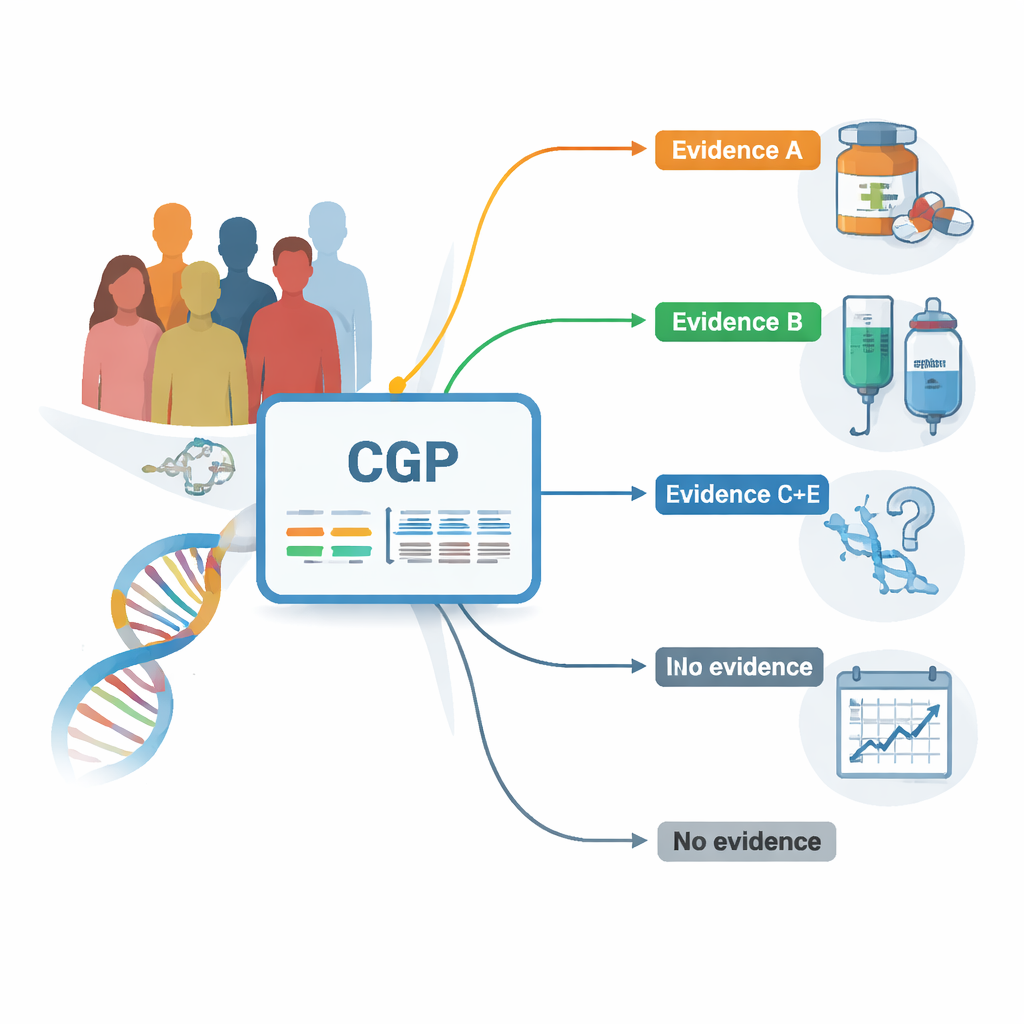
From promising mutation to actual medicine
Yet having a good target in the tumor and actually receiving a matching drug turned out to be very different things. Only about 8% of all patients went on to receive a treatment that was clearly guided by their CGP results—either an approved precision drug or an experimental therapy in a trial or off-label use. Barriers included older age, poorer overall health, and the simple fact that suitable clinical trials or drugs were not always available for every mutation. The fraction of patients who benefited did rise over time as more precision drugs were approved, but there were big differences between cancer types: more than one in five patients with thyroid or lung cancers received CGP-guided treatments, while the proportion stayed below 2% in pancreatic and liver cancers.
When one size does not fit all
The study also zoomed in on so-called “tumor-agnostic” markers, which are supposed to work across many cancers. One key example is tumor mutational burden (TMB), a count of how many DNA changes a tumor has. Patients with very high TMB—especially 20 or more mutations per million DNA letters—tended to respond better and live longer after treatment with the immune therapy pembrolizumab, regardless of another marker called microsatellite instability. However, there were striking exceptions. In a rare skin cancer known as extramammary Paget’s disease, even TMB-high tumors resisted pembrolizumab and patients fared worse, warning that a “universal” marker can fail in specific settings. The team also showed that not all DNA fusions involving NTRK genes respond equally well to TRK-blocking drugs, and that some patients whose older, narrower tests missed key mutations still benefited when CGP picked them up later. 
What this means for patients and doctors
For people with advanced cancer, this study offers both hope and realism. CGP clearly helps sort patients into groups with better or worse prospects and can uncover powerful treatment options, particularly in certain tumors and for those with very mutation-rich cancers. At the same time, most patients who have “actionable” findings still do not receive a matched drug, because of limits in drug approvals, trial access, and health status. The message is that broad DNA testing is a valuable tool—but its real benefit depends on having the right medicines, trials, and care systems in place to act on what the test finds.
Citation: Saito, Y., Horie, S., Kogure, Y. et al. Real-world clinical utility of comprehensive genomic profiling in advanced solid tumors. Nat Med 32, 690–701 (2026). https://doi.org/10.1038/s41591-025-04086-8
Keywords: precision oncology, genomic profiling, tumor mutational burden, targeted therapy, immunotherapy