Clear Sky Science · en
Metabolic quiescence of naive-like memory T cells precedes and maintains antigen-specific T cell memory
Why this matters for your immune system
Most of us get vaccines and simply trust that they will protect us for years, sometimes for life. But what actually allows a single shot to leave such a long-lasting cellular “memory” in our bodies? This study followed people for up to 26 years after yellow fever vaccination to uncover how a particular group of killer immune cells, called CD8 T cells, power up, calm down and then quietly stand guard for decades. The key insight: the most durable memory cells survive not by staying revved up, but by entering a state of deep metabolic rest.

From vaccine shot to cellular army
The researchers tracked 68 healthy volunteers who received the classic yellow fever vaccine, famous for providing protection that can last a lifetime. Using advanced flow cytometry and single-cell RNA sequencing, they repeatedly sampled blood from these individuals during the first year after vaccination and compared them to people vaccinated many years earlier. They focused on CD8 T cells that recognize a specific fragment of the yellow fever virus, watching how these cells multiplied, changed their surface markers and shifted into different functional subtypes over time. During the first weeks, rapidly expanding central memory and effector cells dominated the response, but over months and years, a more stem-like, naive-like memory population gradually took over.
Measuring how hard cells are working
To understand how “hard” each T cell subset was working, the team used clever tools that measure protein production and fuel usage at the single-cell level. By tracking how much puromycin—a drug that tags newly made proteins—was incorporated into cells, they could estimate basal protein synthesis, a major consumer of cellular energy. They then combined this with a method called SCENITH, which adds specific metabolic blockers to reveal whether cells rely more on glycolysis (burning sugar quickly) or on oxidative phosphorylation in mitochondria (a slower, more efficient energy process). During the acute phase after vaccination, central memory cells showed the highest protein production and strong activity in both energy pathways, while some highly differentiated effector cells had already begun to shut down metabolically.
The quiet power of naive-like memory cells
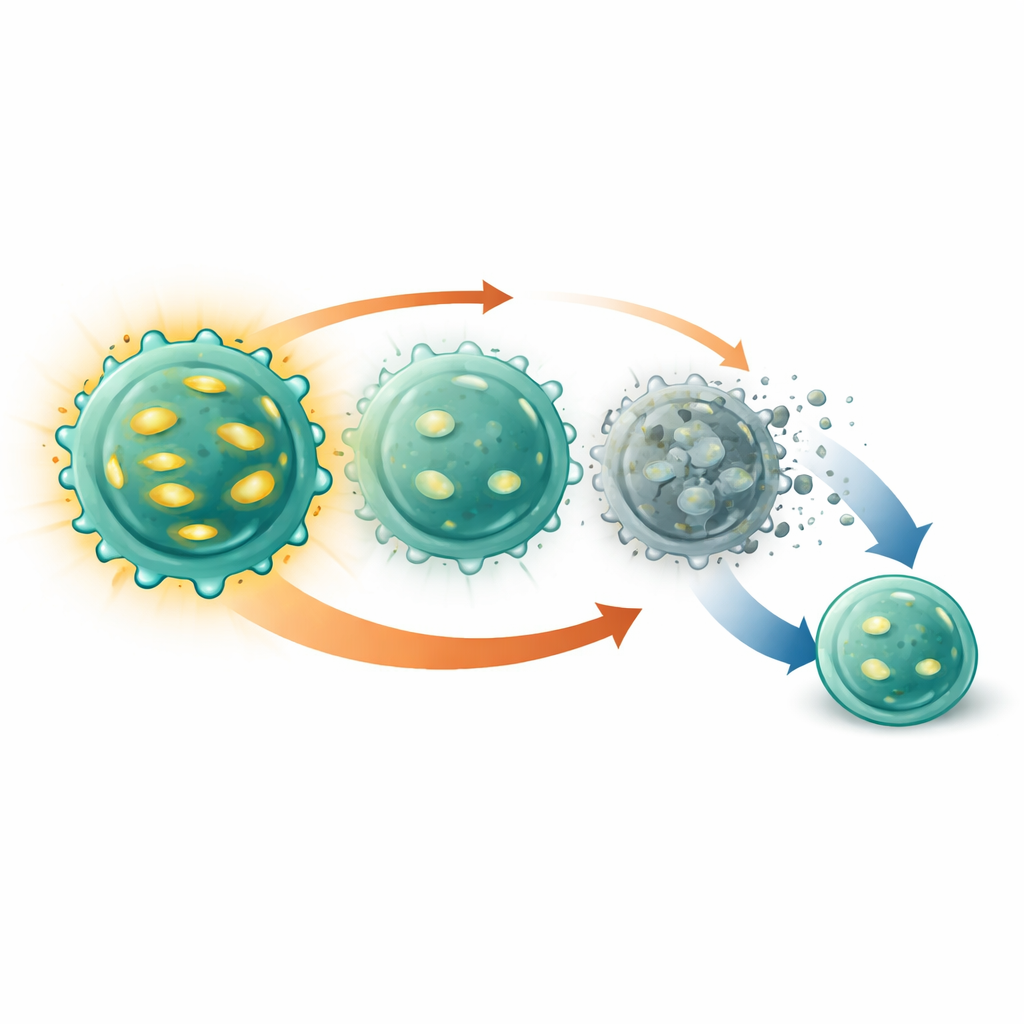
One subset stood out as particularly important for long-term protection: so‑called naive-like memory T cells. These cells look superficially like inexperienced T cells but are in fact shaped by prior exposure to the virus and respond more quickly on re-encounter. The study found that these naive-like memory cells stayed remarkably metabolically quiet throughout the immune response. They relied almost entirely on mitochondrial respiration rather than rapid sugar burning, showed low signs of DNA damage or stress, and maintained high levels of survival proteins such as BCL‑2. Decades after vaccination, these quiet cells remained the dominant yellow fever–specific population in the blood, with a diverse mix of receptors, suggesting a resilient, stem-like reservoir of memory.
Active cells burn bright and fade
In contrast, the more short-lived effector and effector-memory T cells behaved like cells that “burn the candle at both ends.” Many of them displayed low protein production together with markers of early apoptosis, indicating they were on a path to die off after doing their job. Central memory cells, while metabolically very active and essential for the early robust response, also showed more DNA damage and weaker survival signals than the naive-like memory cells. Experiments that pharmacologically interfered with different fuel pathways showed that oxidative phosphorylation was crucial for T cell proliferation, survival and function in both humans and mice, whereas blocking glycolysis mainly altered how cells differentiated without fully stopping their expansion.
Shared rules across infections and species
To see whether these patterns were unique to yellow fever, the authors reanalyzed data from people who had received mRNA vaccines against SARS-CoV-2 and performed parallel experiments in mouse infection models. Despite differences in how abundant each T cell subset was in these systems, the same basic rules appeared: intermediate “central” memory cells were the most metabolically active; more differentiated effector cells tended to become metabolically exhausted and prone to death; and less differentiated, stem-like cells stayed comparatively quiet while retaining the potential to spring into action.
What this means for long-term protection
Put simply, this work shows that the immune system’s most enduring memory does not reside in the loudest, busiest cells, but in those that learn to rest efficiently. After the initial burst of activity triggered by vaccination, a small pool of naive-like memory T cells retreats into a metabolically frugal state that minimizes wear and tear while preserving the capacity to respond rapidly if the virus ever returns. Recognizing quiescence—metabolic stillness—as a defining feature of durable T cell memory could help scientists design better vaccines and immunotherapies that deliberately foster these long‑lived guardians rather than only boosting short‑term firepower.
Citation: Frischholz, S., Schuster, EM., Grotz, M. et al. Metabolic quiescence of naive-like memory T cells precedes and maintains antigen-specific T cell memory. Nat Immunol 27, 452–462 (2026). https://doi.org/10.1038/s41590-026-02421-w
Keywords: T cell memory, immune metabolism, yellow fever vaccine, CD8 T cells, oxidative phosphorylation