Clear Sky Science · en
Identification of a potent V3 glycan site broadly neutralizing antibody targeting an N332gp120 glycan-independent epitope
Searching for New Ways to Disarm HIV
For more than four decades, HIV has stubbornly resisted our best efforts to create a vaccine or a simple, long‑lasting cure. One promising strategy is to harness rare antibodies from people whose immune systems naturally keep the virus in check and turn these molecules into medicines or vaccine blueprints. This study describes such an antibody, called 007, that recognizes a weak spot on HIV’s outer coat in an unusual way, opening new possibilities for prevention, treatment and perhaps functional cure strategies.
A Powerful Antibody from an Unusual Donor
The researchers began by screening blood from more than two thousand people living with HIV to find “elite neutralizers” – individuals whose antibodies can disable a wide range of viral strains. One donor from Tanzania, labeled EN01, stood out with exceptionally broad and potent virus‑blocking activity. From this person’s B cells, the team isolated dozens of antibodies and identified one family, named 007, that powerfully neutralized viruses from multiple HIV subtypes. Unlike some earlier antibodies that sometimes recognized the body’s own tissues, 007 showed no detectable self‑reactivity in standard safety assays, marking it as a strong candidate for further development.

Hitting a Hidden Weak Spot on the Virus Coat
HIV protects itself with a dense forest of sugars covering its outer envelope protein, which helps the virus evade most antibodies. Many of the best‑studied broadly neutralizing antibodies latch onto a region near the base of a loop on this protein, known as the V3 region, and depend heavily on a particular sugar site called N332. The 007 antibody, however, breaks this rule. Using high‑resolution cryo‑electron microscopy, the authors showed that 007 threads a long loop from its binding surface into a conserved groove on the V3 region, making precise contacts with a short stretch of amino acids there while leaning on sugars at two neighboring positions. Crucially, it does not rely on the usual N332 sugar at all, which means that viruses using the common escape trick of mutating or removing this sugar remain vulnerable to 007.
How 007 Gains Extra Grip Through Two‑Handed Binding
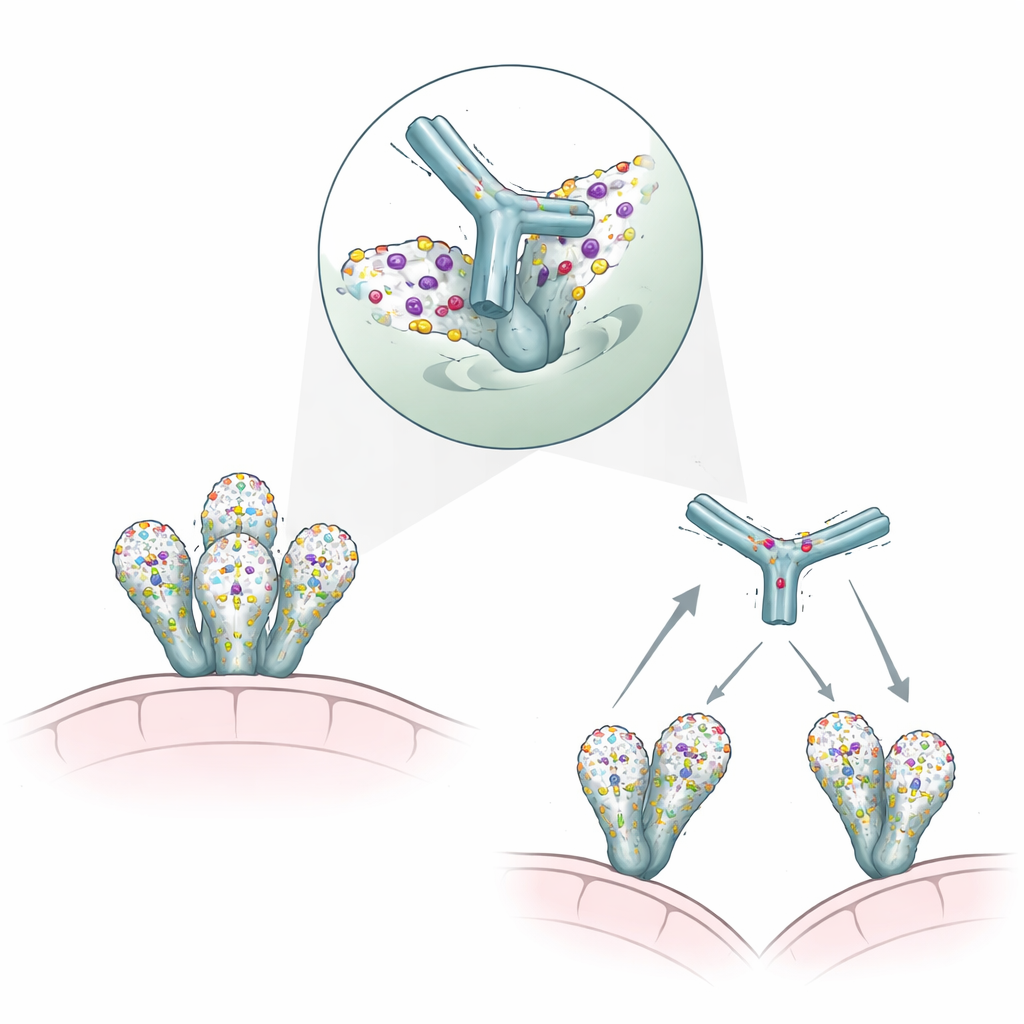
When the team tested a single “arm” of 007, called a Fab fragment, it bound only weakly to soluble versions of the HIV envelope spike. Yet the full antibody, with two arms, was remarkably potent at neutralizing live virus. Detailed binding and neutralization measurements revealed that 007 benefits strongly from using both arms at once, a phenomenon known as avidity. Structural studies with the intact antibody and trimeric envelope proteins showed that three copies of 007 can crosslink two viral spikes into a symmetric dimer‑like assembly, suggesting that the antibody can bridge spikes on the same or neighboring virus particles. This two‑handed engagement appears to compensate for modest single‑arm affinity and helps explain 007’s striking ability to inactivate tough, clinically relevant viral strains.
Standing Out from Other HIV Antibodies
To understand how 007 compares to well‑known HIV antibodies, the authors tested it against large panels of diverse viral strains, including difficult‑to‑neutralize variants from many parts of the world. Across these panels, 007 showed high breadth and potency, often outperforming classical V3‑targeting antibodies and clearly surpassing a recently described antibody that recognizes a similar region. Remarkably, 007 remained effective against many viruses that had already escaped a leading V3 antibody by altering the N332 sugar site. Conversely, viruses that resisted 007 were often neutralized by those classical antibodies. When the team modeled and then experimentally tested combinations, 007 paired especially well with the antibody 10‑1074, yielding markedly improved coverage and lower concentrations needed for neutralization.
Putting 007 to the Test in Living Organisms
The researchers next asked whether 007 could control infection in vivo. In humanized mice chronically infected with HIV‑1 ADA, treatment with 007 led to a rapid drop in virus levels in the blood, followed by eventual rebound as the virus mutated. Genetic analysis revealed that escape from 007 involved changes in regions around its novel binding site, rather than the usual N332 sugar. Importantly, viruses that escaped 007 remained sensitive to 10‑1074, and the reverse was also true. When both antibodies were given together, or one was added after resistance to the other had emerged, viral suppression lasted longer and required the virus to accumulate multiple mutations across its envelope, likely at some cost to its fitness.
Why This Work Matters for Future HIV Prevention
By uncovering an antibody that targets the V3 region of HIV without depending on the standard N332 sugar, this study expands the known landscape of vulnerable sites on the virus. Antibody 007 combines broad and potent neutralizing activity with a distinct escape pattern and powerful two‑armed binding, making it a promising addition to antibody cocktails for prevention, therapy or functional cure strategies. For vaccine designers, 007 highlights a previously underused target on the viral coat that could be mimicked to train the immune system to make similar antibodies. Together, these findings suggest that loosening our focus from a single sugar hot spot and instead co‑targeting neighboring regions may be key to finally cornering HIV’s ability to escape.
Citation: Gieselmann, L., DeLaitsch, A.T., Rohde, M. et al. Identification of a potent V3 glycan site broadly neutralizing antibody targeting an N332gp120 glycan-independent epitope. Nat Immunol 27, 572–585 (2026). https://doi.org/10.1038/s41590-025-02385-3
Keywords: HIV broadly neutralizing antibodies, V3 glycan epitope, antibody 007, HIV vaccine design, antibody combination therapy