Clear Sky Science · en
Substantial aircraft contrail formation at low soot emission levels
Why the trails behind planes matter
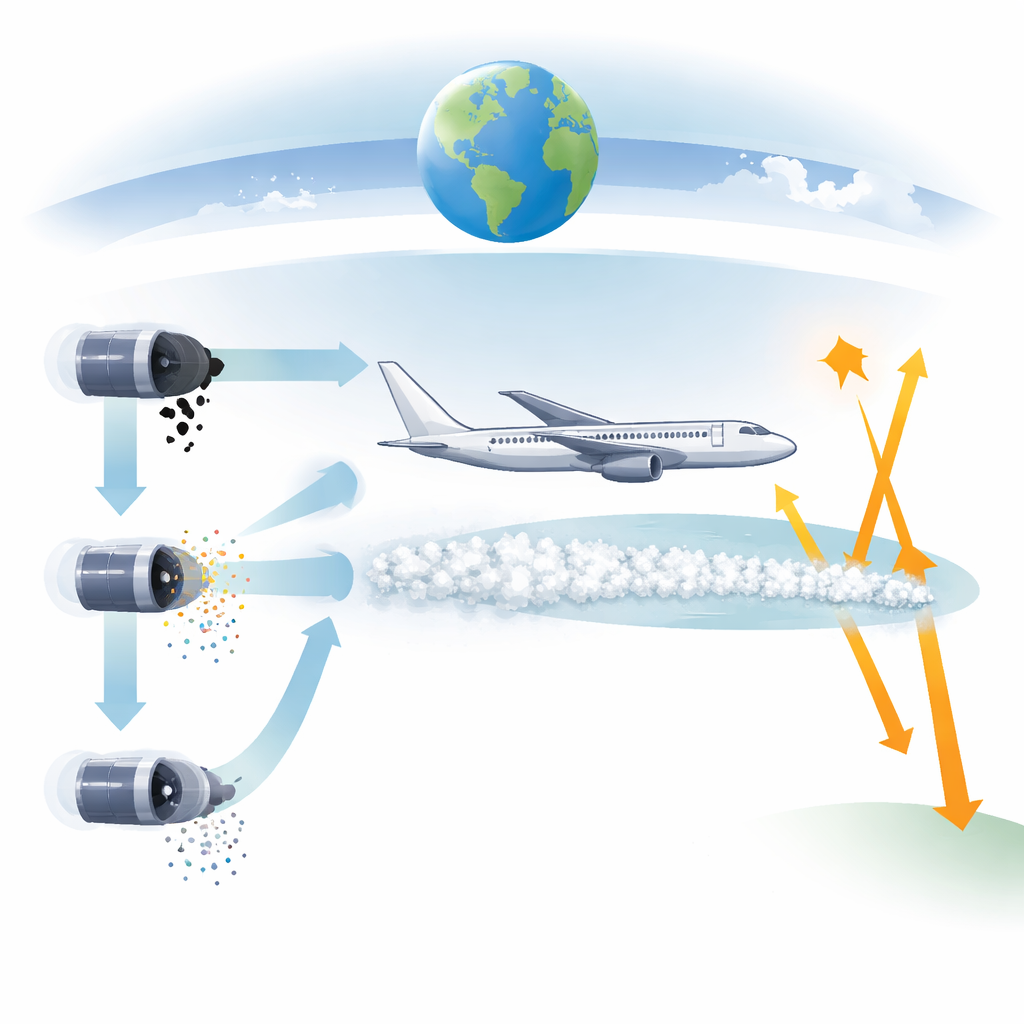
When you look up and see a jet carving a bright white streak across the sky, you are also seeing one of aviation’s biggest non‑carbon contributions to climate change. These streaks, called contrails, can spread into thin layers of cloud that trap heat in the atmosphere. Airlines and engine makers have been betting that new, cleaner‑burning engines that emit far less soot would also make far fewer contrails. This study takes a close, real‑world look at that assumption—and finds that things are not so simple.
New engines, unexpected clouds
The researchers followed an Airbus A321neo equipped with modern “lean‑burn” jet engines, which are designed to mix fuel and air more thoroughly and cut soot pollution by roughly a thousand‑fold compared with older engine designs. A second research aircraft flew just tens of meters behind the airliner to measure the particles and gases in the fresh exhaust, and then again several kilometers downwind where contrails had fully formed. The team tested a range of fuels: standard jet fuel, fully bio‑based fuel, and blends with carefully adjusted amounts of sulfur and aromatic compounds.
Cleaner exhaust, but still many ice crystals
The lean‑burn engines behaved as advertised when it came to soot. In cruise conditions they emitted about one thousand times fewer solid soot particles than in a rich‑burn mode and far less than many older engines. But when the scientists counted ice crystals in the mature contrails, they found very high numbers—up to a million billion ice particles per kilogram of fuel, similar to or only modestly lower than values seen behind soot‑rich engines. In other words, dramatically reducing soot did not translate into a similar drop in contrail ice crystals, and so it likely does not by itself deliver a large cut in contrail‑related warming.
Invisible vapors take over
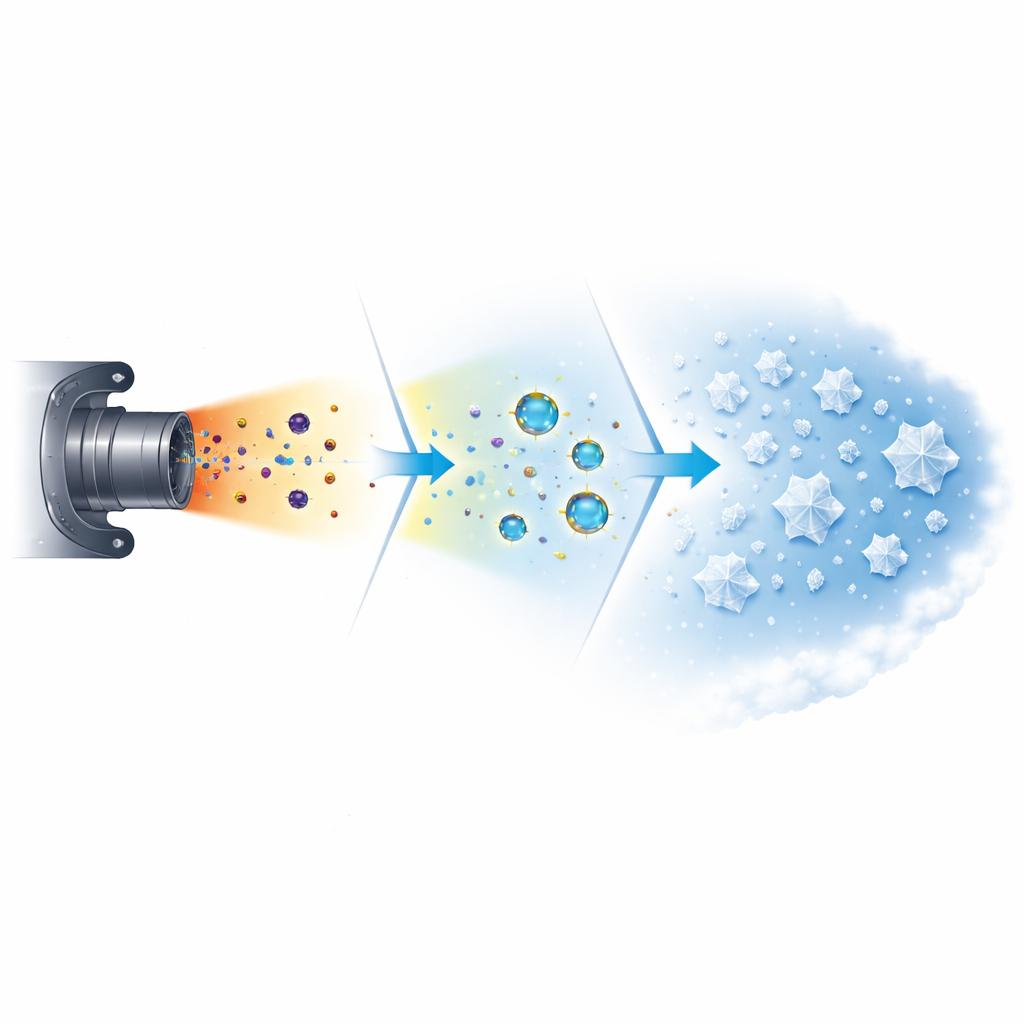
To understand where all those ice crystals were coming from in such a low‑soot exhaust, the team measured and modeled the total number of particles, including tiny volatile ones that form from gases as the exhaust cools. They showed that when soot is scarce, other ingredients take over. Sulfur in the fuel can oxidize to form sulfuric acid, which then nucleates into new sulfate particles. Organic compounds from the fuel and vapors from lubrication oil in the engine can also form or coat particles. As the exhaust plume mixes with cold, moist air, these numerous small particles grow into liquid droplets and then freeze, seeding dense contrails even without much soot present.
Fuel recipe and engine oil as climate levers
Because these volatile particles are so important in the low‑soot regime, their sources matter. When the researchers compared standard jet fuel with a blend that had lower sulfur, they found that contrail ice crystal numbers dropped by about a factor of three under similar atmospheric conditions. Using an ultralow‑sulfur, low‑aromatic bio‑based fuel in the simulations cut ice crystal numbers by about an order of magnitude. However, even then, contrails did not vanish: model‑data comparisons point to lubrication oil vapors and organic fuel residues as continuing sources of particle “seeds.” Across all engine modes and fuels, total particle numbers (soot plus volatiles) were closely linked to the number of ice crystals that formed.
What this means for future flight
For a layperson, the message is that simply building engines that burn fuel more cleanly is not enough to solve aviation’s contrail problem. Lean‑burn engines slash soot, but other, more subtle particles step in to form ice crystals, keeping contrail‑driven warming substantial. The study shows that tuning the fuel—especially lowering sulfur and certain aromatic components—and redesigning how lubrication oil is vented could greatly reduce the number of ice crystals in contrails, and therefore their climate impact. Because contrails last only hours, any reduction in their formation would cool the planet almost immediately, offering a rapid lever alongside long‑term cuts in carbon dioxide. This work narrows the scientific uncertainty around contrails and points the way toward fuels and engines that keep people and goods moving while casting a lighter shadow on the climate.
Citation: Voigt, C., Märkl, R., Sauer, D. et al. Substantial aircraft contrail formation at low soot emission levels. Nature 652, 112–118 (2026). https://doi.org/10.1038/s41586-026-10286-0
Keywords: aviation contrails, lean-burn engines, sustainable aviation fuel, aerosol particles, climate impact