Clear Sky Science · en
Advancing operational global aerosol forecasting with machine learning
Why the air we cannot see matters
The air around us is filled with tiny particles from deserts, fires, oceans and human pollution. Though invisible, these aerosols can dim the sun, seed clouds and irritate our lungs. Knowing where they are going in the next few days helps governments warn people about dust storms or wildfire smoke, guide aviation and solar power operations, and sharpen climate research. This article introduces a new global forecasting system that uses artificial intelligence to predict these particles faster and, in many cases, more accurately than today’s physics-heavy computer models.

Tiny particles with big effects
Aerosols come from many sources—soot from engines and fires, sulfate from power plants, sea salt from crashing waves and mineral dust from bare soil. Their sizes, shapes and chemistry vary widely, and so do their effects. Some cool the planet by reflecting sunlight, others warm it by absorbing heat, and many worsen air quality, contributing to respiratory and heart disease. Because these particles are pushed around by winds, washed out by rain and transformed by chemical reactions, tracking them in real time across the globe is much harder than forecasting temperature or pressure alone. Traditional models must simulate thousands of these processes, making aerosol forecasts both uncertain and extremely expensive to run.
Teaching an AI to follow the haze
The researchers developed the AI-driven Global Aerosol–Meteorology Forecasting System, or AI-GAMFS, to tackle this challenge. Instead of hand-coding every physical and chemical step, they trained a very large neural network on 42 years of a NASA reanalysis dataset that blends satellite and ground measurements into a consistent picture of the atmosphere. The model ingests three-dimensional maps of both aerosols and weather and passes them through a "vision transformer" paired with a U-Net–style encoder–decoder. In essence, it learns patterns in how winds, humidity and precipitation move and transform different particle types, then uses those learned relationships to predict what the global aerosol field will look like a few hours later.
Keeping errors in check over five days
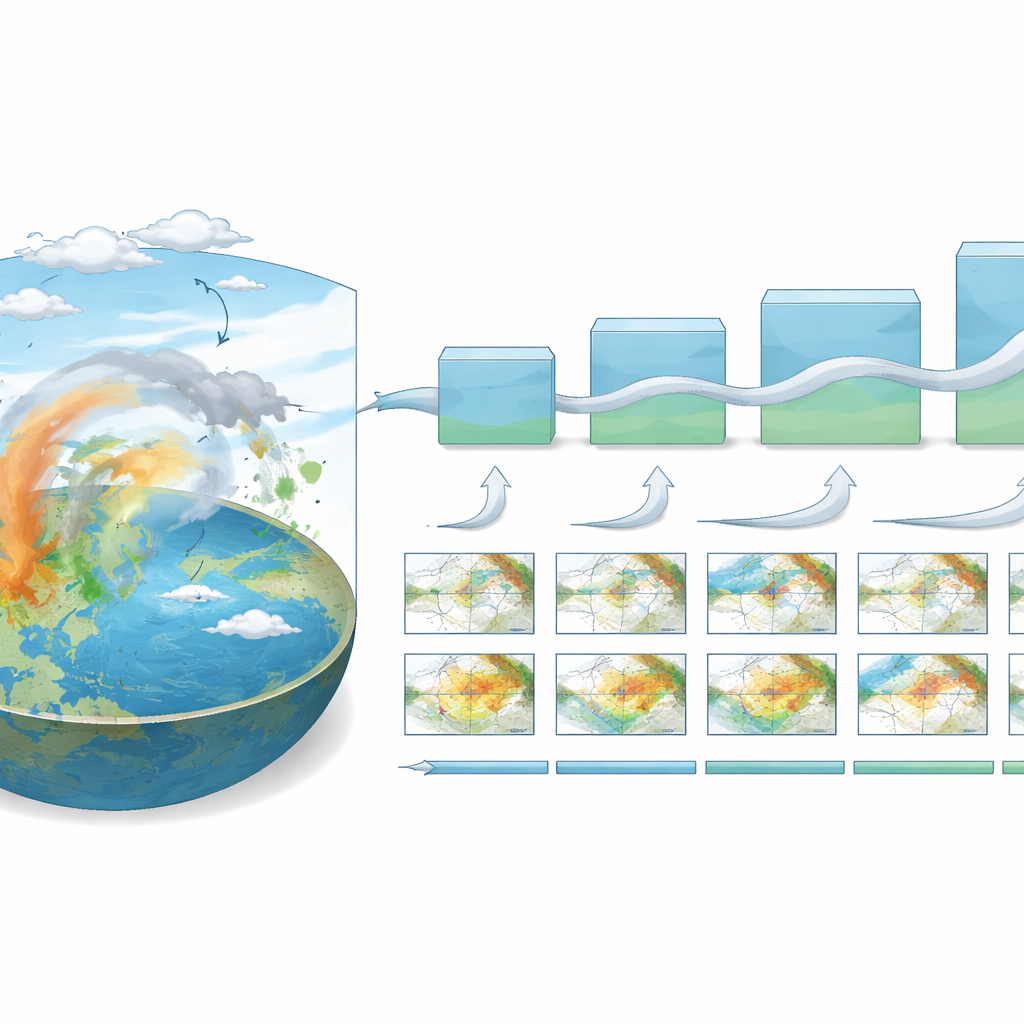
One difficulty for any multi-day forecast is that small mistakes tend to grow as a model repeatedly feeds its own output back as input. To limit this drift while still providing 5-day outlooks, the team trained four separate versions of AI-GAMFS that each jump ahead by 3, 6, 9 or 12 hours. During forecasting, these are chained in a relay: longer jumps are used where possible, and shorter ones fill the remaining gaps. Tests on year-long data show that this relay strategy clearly reduces error growth compared with using only a single short-step model. Despite its size—about 1.2 billion parameters per base model—the full system can deliver global, 3-hourly, 5-day forecasts in under a minute on a single modern graphics processor, roughly 360 times faster than one of NASA’s leading operational models on traditional supercomputers.
Outperforming today’s best aerosol forecasts
The authors then compared AI-GAMFS to several state-of-the-art systems. Against the Copernicus Atmosphere Monitoring Service, it produced more accurate global forecasts of overall haziness (aerosol optical depth) and desert dust loading over most of the five-day window, as judged by both NASA reanalysis data and independent measurements from the worldwide AERONET sun-photometer network. Over East Asia, including severe dust storms in northern China, the AI system beat four specialized dust models in reconstructing where and how strongly plumes developed and travelled. When matched against NASA’s GEOS-FP model, AI-GAMFS also gave better predictions for many surface particle concentrations—such as black carbon and organic carbon from wildfires and sulfate from human emissions—over the United States and China, while using far less computing power.
Following smoke, dust and pollution by type
Because AI-GAMFS forecasts separate particle types as well as their combined effect, it can pick out distinct pollution events almost in real time. Case studies show the system tracking Saharan dust across the Atlantic and smoke from fires in Central Africa and South America, capturing both their local buildup and long-range transport. The model’s strength comes partly from its ability to learn how key weather features—like humidity, storms and large-scale winds—shape plume evolution. At the same time, its performance still depends on the quality of those weather inputs, and the authors note that forecasts of some variables, such as wind speed and sea-salt aerosols driven by ocean winds, lag behind the best physics-based models.
What this means for everyday life
In plain terms, this work shows that a carefully trained AI can watch decades of past atmosphere data, learn how haze responds to the weather and then deliver rapid, detailed global particle forecasts that rival or surpass today’s most advanced models. That speed and accuracy could make air-quality warnings more timely, help cities and health agencies prepare for dust and smoke episodes days in advance and support climate and energy planning with more precise information about the ever-shifting veil of particles around our planet. The authors see this as an early step toward hybrid systems that blend physical laws with machine learning, promising clearer views of the air we breathe and the climate we are shaping.
Citation: Gui, K., Zhang, X., Che, H. et al. Advancing operational global aerosol forecasting with machine learning. Nature 651, 658–665 (2026). https://doi.org/10.1038/s41586-026-10234-y
Keywords: aerosol forecasting, machine learning, air quality, dust storms, wildfire smoke