Clear Sky Science · en
Integrated photonics enabling ultra-wideband fibre–wireless communication
Why Faster Connections Matter
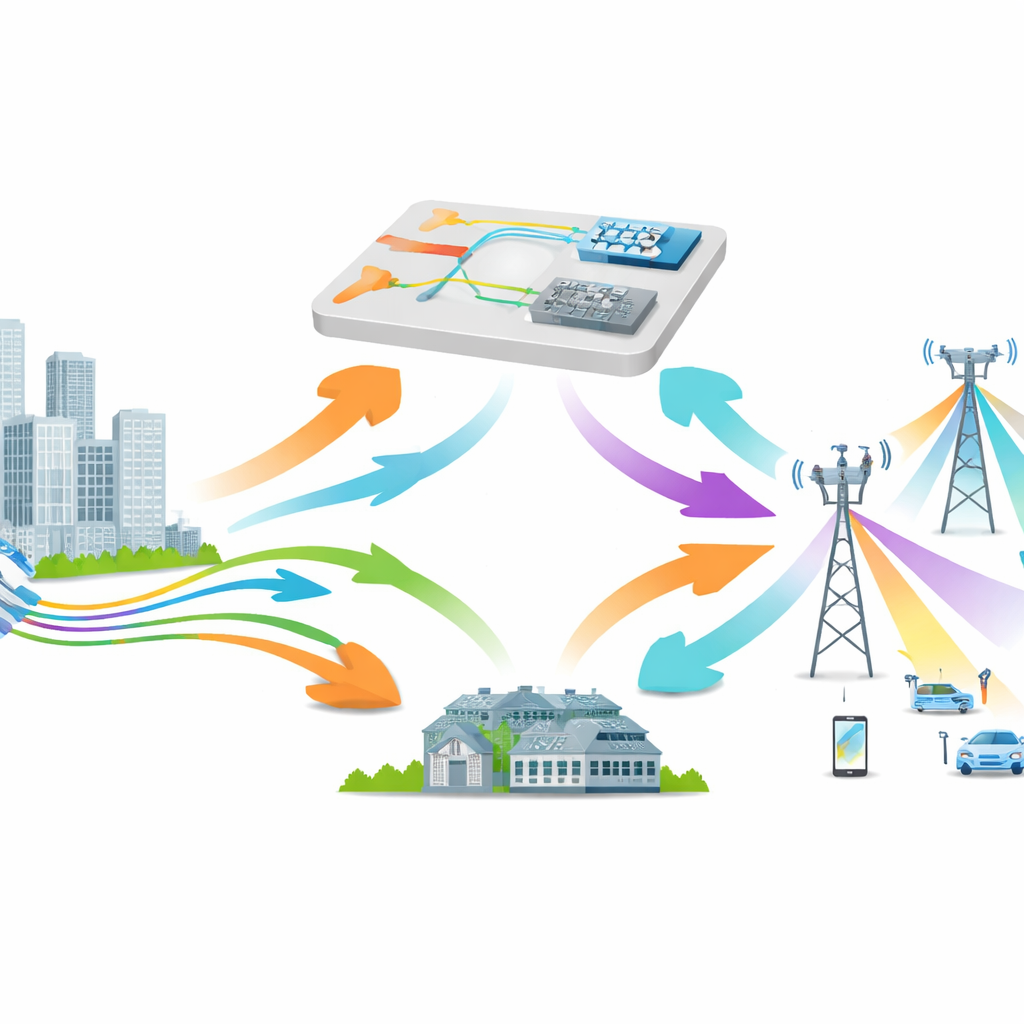
Streaming 8K video to many users at once, controlling fleets of drones, or linking vast data centers all depend on moving huge amounts of information with almost no delay. Today’s networks split this job between glass fibers under our feet and wireless links through the air, but these two worlds do not naturally speak the same “speed language.” This paper describes a new chip-based technology that helps fibre and wireless links share a much wider slice of the spectrum, promising smoother, faster, and more flexible communication for future 6G-style networks and beyond.
The Gap Between Cables and Air
Modern optical fibres can already send astonishing amounts of data, but the wireless side has struggled to keep up, especially at the ultra-high radio frequencies known as the terahertz band. Signals that rush easily through fibre must be remixed and converted before they can be broadcast, passing through bulky electronics that add noise, cost, and delay. These conversions also struggle to handle extremely wide frequency ranges, which limits how many users and how much information can be carried at once. The result is a long-standing mismatch: fibre links that can move more data than the wireless “last hop” can comfortably deliver.
A New Kind of Light-Based Translator
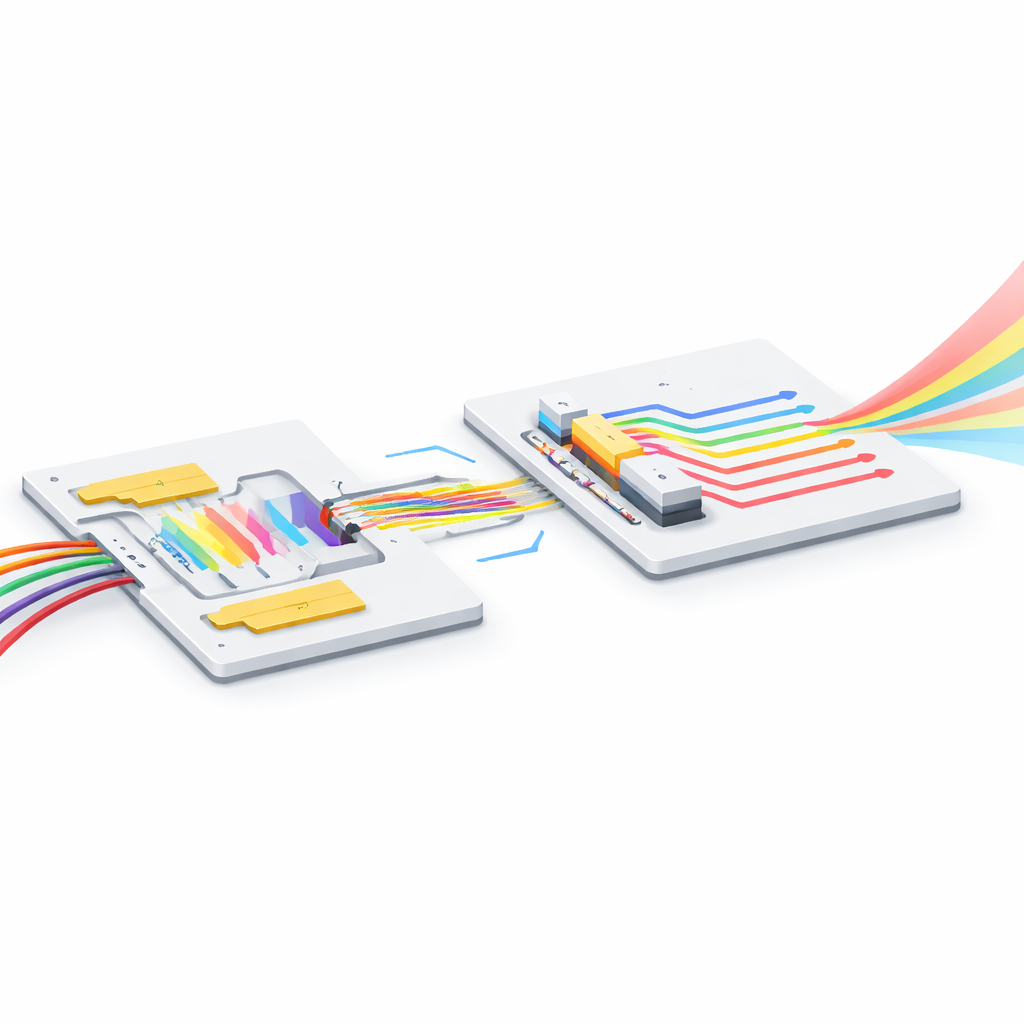
The researchers tackle this problem with an integrated photonics platform—essentially a tiny optical circuit board—that can both imprint electrical data onto light and turn light back into electrical signals over an ultra-wide frequency span. On one side of the chip, a lithium niobate modulator acts like a lightning-fast light valve, switching an infrared beam on and off or between levels with a bandwidth that extends beyond 250 gigahertz. On the other side, a specially engineered photodiode made from indium phosphide efficiently converts incoming light back into electrical waves, again over more than 250 gigahertz. Together, these two devices form a light-based “bridge” that treats fibre and terahertz wireless links as parts of the same continuous system.
Pushing Data Rates to New Heights
To test what this bridge can do, the team first used it in short fibre links similar to those inside data centers. With simple intensity coding and no advanced corrections, they reached symbol rates over 200 gigabaud. When they paired the hardware with a tailored artificial-intelligence algorithm called a complex bidirectional gated recurrent unit, they pushed a single fibre channel to 512 gigabits per second while keeping error rates low enough for standard error-correction schemes to clean up. They then turned to wireless tests around 180 gigahertz, generating and receiving terahertz waves using the same chip elements. With conventional digital processing they already exceeded earlier records; with the AI equalizer engaged, they reached 400 gigabits per second per wireless channel, again within practical error limits, at both short and multi-metre distances.
Sharing the Air Among Many Users
Beyond raw speed, the system also needs to serve many users at once. The authors built a proof-of-concept access network in which dozens of video servers fed signals into the optical chip, were translated into terahertz waves, and then converted back to light and routed to client machines. By stepping the wireless carrier across frequencies between about 140 and 220 gigahertz, they created 86 adjacent channels, each one gigahertz wide, and used them to stream real-time 8K video with clear playback. This showed that the chip could support dense, wideband access—far beyond current 5G practice—without complicated electronics or heavy digital overhead.
What This Means for Everyday Connectivity
Put simply, this work shows that a single set of tiny light-based devices can knit together ultra-fast fibre and terahertz wireless links, handling both with record-breaking speed and efficiency. By combining ultra-wideband modulators and detectors with smart AI-based signal cleanup, the system moves more information per unit of spectrum than previous approaches and scales to many simultaneous channels. For future networks, this could mean smoother streaming for crowds of users, more responsive cloud services, and reliable high-capacity links in places where cables are hard to reach. While practical products will require further integration and refinement, the demonstration points toward compact, energy-efficient network hardware that treats fibre and wireless not as separate worlds but as parts of one seamless, high-speed fabric.
Citation: Zhang, Y., Shu, H., Guo, Y. et al. Integrated photonics enabling ultra-wideband fibre–wireless communication. Nature 651, 348–355 (2026). https://doi.org/10.1038/s41586-026-10172-9
Keywords: ultra-wideband photonics, fiber wireless convergence, terahertz communication, integrated optical chips, 6G networks