Clear Sky Science · en
Entanglement-assisted non-local optical interferometry in a quantum network
Listening to Starlight in New Ways
Astronomers and physicists are always looking for sharper ways to see the universe, from distant exoplanets to the environments around black holes. One powerful trick is to combine light collected at far‑apart telescopes, effectively creating a single, giant "virtual" telescope. But when the incoming light is extremely faint, today’s methods run into basic quantum limits and losses in long optical fibers. This paper reports a laboratory demonstration of a new approach: using the strange connections of quantum entanglement, stored in tiny defects in diamond, to perform ultra-sensitive, long-distance optical measurements that could one day supercharge telescope arrays and other imaging systems.
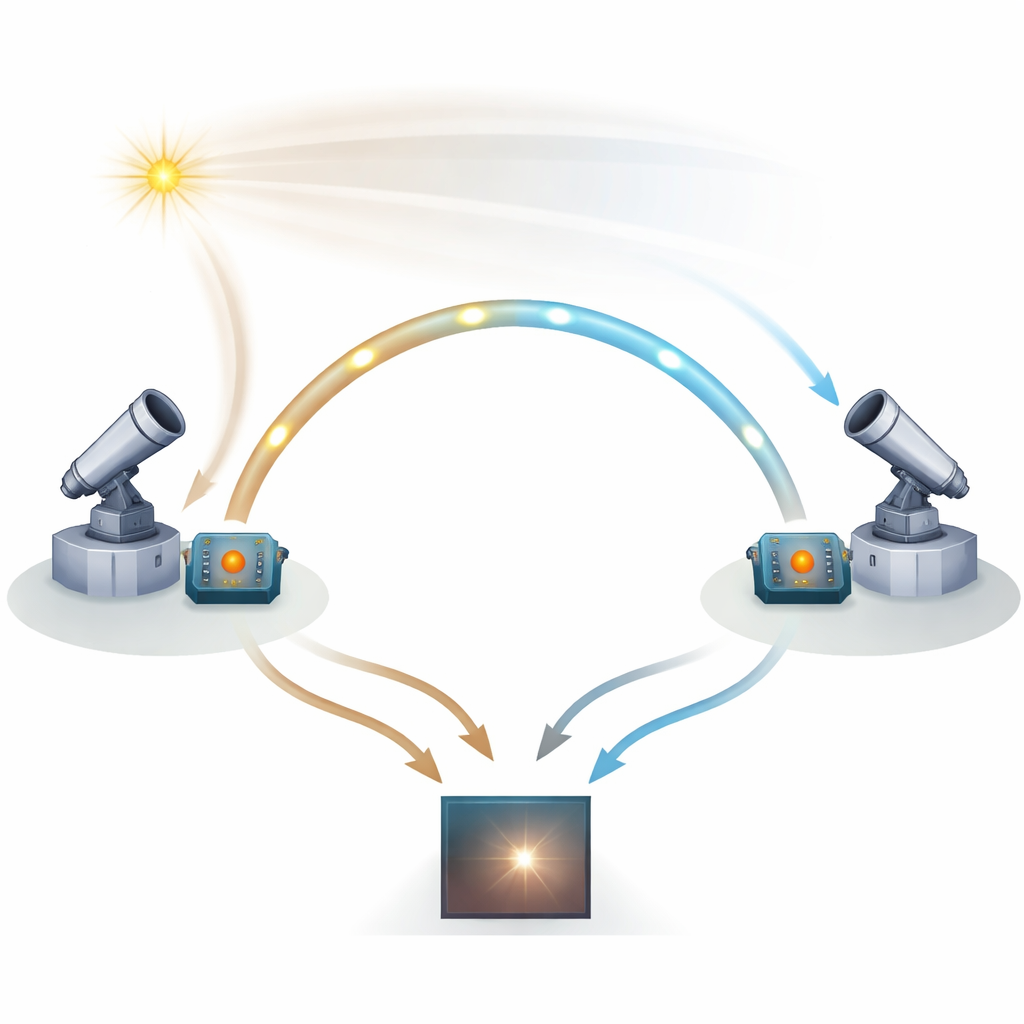
Why Combining Distant Telescopes Is So Hard
Conventional optical interferometry improves resolution by comparing how light waves from a distant object arrive at two separated stations. The key information is the phase difference between the light at each station, which encodes details like the apparent position and structure of the source. One classic method physically brings the light together at a central beam splitter, giving an ideal signal but suffering badly from losses: the longer the fiber link, the more of the already-weak starlight disappears. An alternative performs only local measurements at each station, comparing the results later. That avoids long fiber runs for the signal, but because it mixes the precious light with strong local reference beams, it can no longer distinguish real photons from empty vacuum fluctuations, which act as unavoidable quantum noise. As a result, the measurement quality grows only slowly with signal strength, and faint-light performance is fundamentally limited.
Letting Quantum Links Do the Traveling
The authors instead let entanglement, rather than the fragile signal light itself, span the distance between stations. Using silicon–vacancy centers in diamond nanocavities—solid-state "artificial atoms" that behave like tiny quantum memory chips—they first create shared quantum states between two distant nodes. Each node holds both a fast "communication" spin and a long-lived "memory" spin, acting together as a register. A specially designed optical interferometer and weak laser pulses entangle the two stations in parallel, achieving much higher entanglement rates than earlier, serial schemes. By tuning the light intensity, they balance how often they succeed against how pure the shared quantum state remains, reaching rates fast enough to support repeated sensing experiments and even operating over fiber lengths up to 1.55 kilometers.
Hiding the Path While Catching the Photon
Once entanglement is ready, the real game begins when a weak signal pulse, standing in for starlight, reaches both stations. The signal reflects from each diamond cavity, becoming gently tied to the local quantum spins. The challenge is to preserve the tiny phase difference carried by the photon while avoiding any hint about which station actually received it. To do this, each station passes its outgoing light through a beam splitter together with a carefully prepared local reference field. This "erases" which-path information: detectors can tell that a photon was present but not where it came from. At the same time, a clever sequence of local quantum gates and measurements uses the entangled spins to perform a non-local, non-destructive form of photon counting. In essence, the network can herald that at least one photon arrived somewhere, while deliberately remaining ignorant of where, and then store the phase information in the remote memory spins.
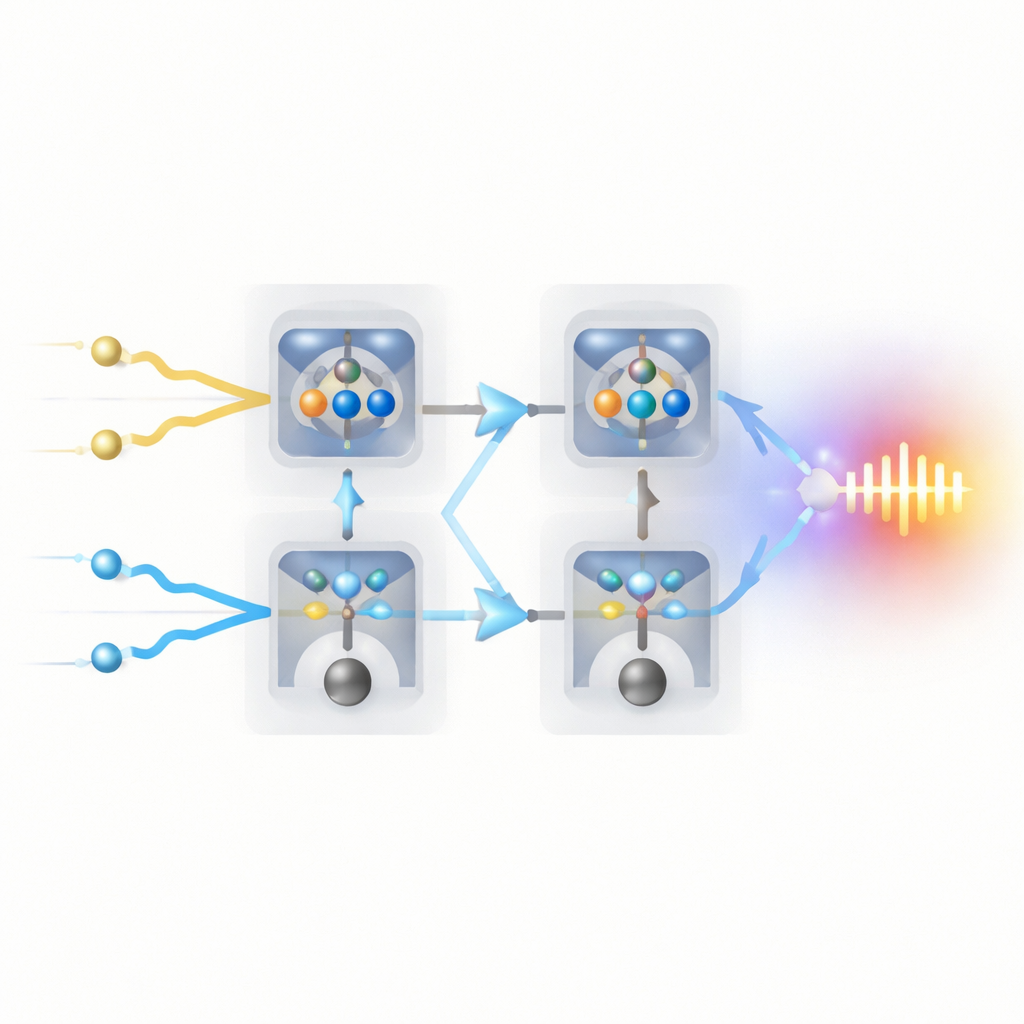
Filtering Out Empty Fluctuations
By keeping only those trials where this non-local heralding indicates a real photon, the protocol discards all the shots dominated by vacuum noise—cases where nothing useful arrived. The authors show that the phase information ends up encoded in the joint state of the two long-lived memory spins, which they can read out locally at each station. Comparing runs with and without this heralding step, they find a clear boost in the visibility of the measured phase signal, especially when the average photon number is well below one. They also show that this improvement translates into a better scaling of signal-to-noise with brightness, as predicted by quantum theory. Extending the fiber links to produce an effective baseline of 1.55 kilometers, they maintain robust entanglement and still recover phase-dependent interference, pointing toward the feasibility of quantum-enhanced, long-baseline sensing.
What This Could Mean for Future Imaging
For non-specialists, the key message is that the team has turned quantum entanglement into a practical tool for seeing extremely faint optical signals across large distances. Instead of pushing more fragile light through ever-longer fibers, they pre-share quantum links and then use them to filter out empty fluctuations while keeping the valuable information from rare photons. Although the current setup is a proof of concept in a controlled lab, the same ideas, refined and scaled with better quantum hardware and repeaters, could one day help telescope arrays study exoplanets, black holes, or other dim targets far more efficiently, and might also aid deep-space communication and advanced microscopy. In simple terms, they are teaching quantum memories to act as cooperative "ears" for light, listening together more clearly than any single detector could on its own.
Citation: Stas, PJ., Wei, YC., Sirotin, M. et al. Entanglement-assisted non-local optical interferometry in a quantum network. Nature 651, 326–332 (2026). https://doi.org/10.1038/s41586-026-10171-w
Keywords: quantum interferometry, entanglement, optical telescopes, quantum networks, weak-light imaging