Clear Sky Science · en
High-precision measurement of the W boson mass with the CMS experiment
Weighing a Cornerstone of Nature
The W boson is one of the particles that makes radioactive decay and the Sun’s fusion reactions possible. Its mass is not just a number in a table: it is tightly linked to other particles, such as the Z boson and the Higgs boson, through the equations of the Standard Model of particle physics. If the W boson is even slightly heavier or lighter than predicted, it could be a sign of new, as-yet-undiscovered particles influencing it behind the scenes. This article describes how the CMS experiment at CERN has made one of the most precise measurements ever of the W boson’s mass, helping to clarify a puzzling tension in earlier results.
Why the W Boson’s Weight Matters
Over decades, particle physicists have carefully measured the properties of particles such as the W and Z bosons, the top quark and the Higgs boson. Together, these measurements allow high-precision predictions of how heavy the W boson should be. Because heavy unknown particles can subtly tug on the W boson through quantum effects, any mismatch between prediction and experiment could be a doorway to new physics. A recent result from the CDF experiment at Fermilab reported a W mass significantly higher than the Standard Model expectation and other measurements, creating a striking tension. The new CMS result provides an independent, high-precision check using proton–proton collisions at the Large Hadron Collider.
Using Muons as a Precision Ruler
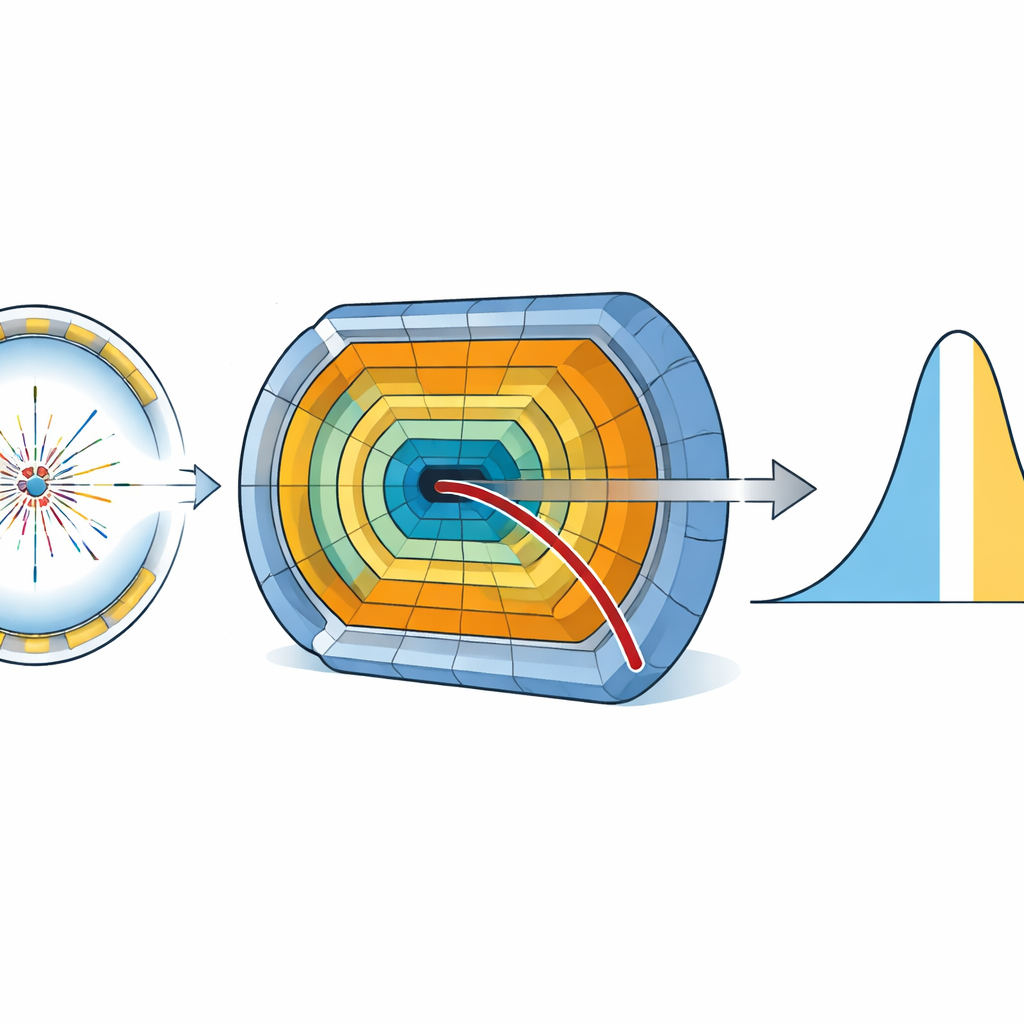
At the Large Hadron Collider, W bosons are produced when high-energy protons collide. They decay almost instantly, often into a charged lepton (such as a muon) and an invisible neutrino. Because the neutrino passes through the detector without a trace, researchers cannot reconstruct the W boson directly. Instead, CMS focuses on the muon: its direction and momentum encode the imprint of the W’s mass. The collaboration selects about 117 million events where a single, clean muon is produced, within a well-understood region of the detector and with carefully chosen momentum. Backgrounds from other processes, such as decays of heavier particles that mimic genuine W events, are estimated and subtracted using control samples and data-driven techniques.
Turning Detector Signals into a Mass
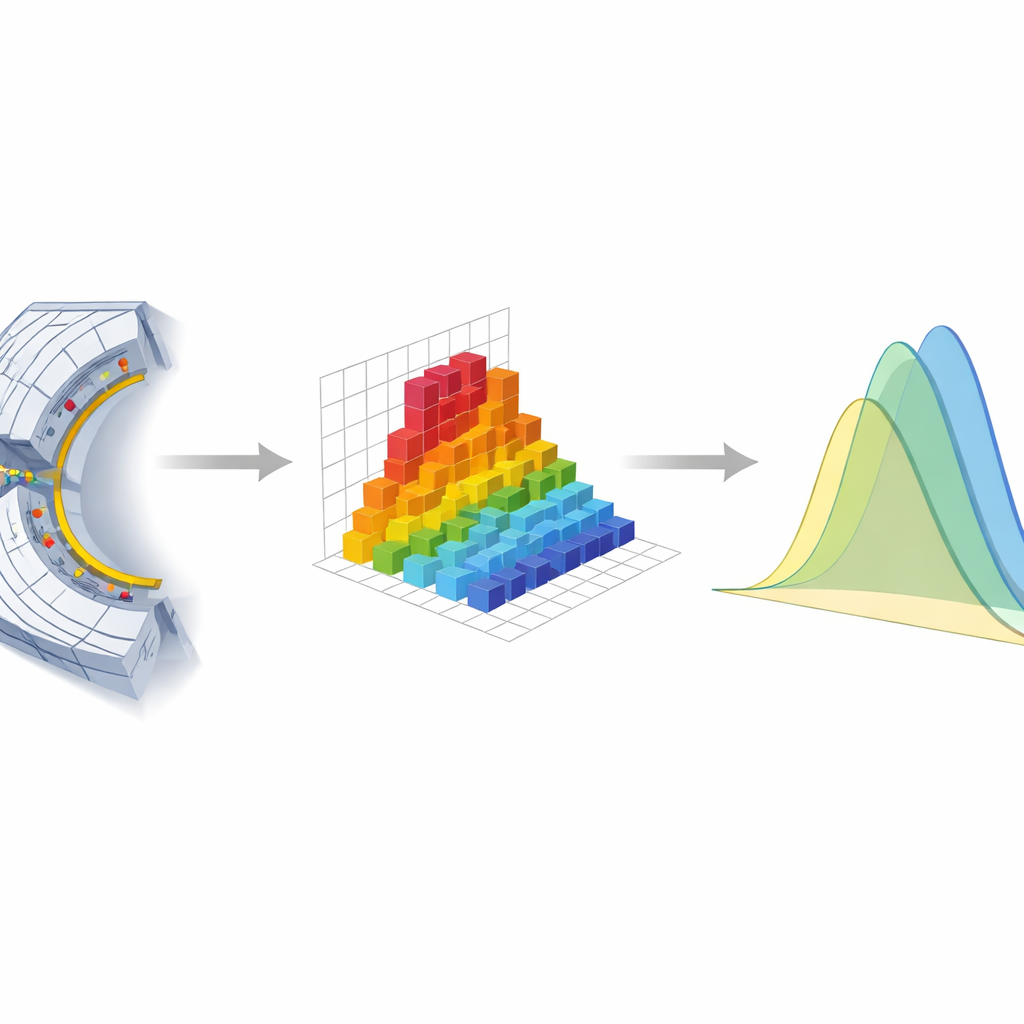
To turn these raw events into a precise mass measurement, CMS must know the muon’s momentum with extraordinary accuracy. The team refines the description of the detector’s magnetic field, material and alignment, and then calibrates muon tracks using well-known reference particles that decay into pairs of muons, such as the J/ψ and Z bosons. Any tiny mismatch between the known masses of these particles and what CMS reconstructs is used to correct the momentum scale down to a few parts in one hundred thousand. On the theory side, the shape of the muon momentum distribution depends not only on the W mass but also on how W bosons are produced and move inside the detector, which in turn depends on the internal structure of the proton. CMS uses state-of-the-art calculations that combine advanced quantum chromodynamics techniques and detailed models of the proton’s quark and gluon content, and allows key theoretical inputs to float within uncertainties and be constrained directly by the data.
Fitting the Full Picture
Instead of examining a single curve, CMS fits a three-dimensional distribution that depends on the muon’s momentum, its angle relative to the beam and its electric charge. This fine-grained view helps separate the influence of the W mass from other effects, such as how often W bosons are produced moving in different directions or with different polarizations. Sophisticated statistical tools, implemented with modern machine-learning software, are used to perform a so-called maximum likelihood fit with thousands of nuisance parameters that encode experimental and theoretical uncertainties. The same framework is first tested by “pretending” that Z boson decays are W decays, and by independently re-measuring the Z boson mass. The recovered Z mass agrees with the already very precise world average, giving confidence that the method is sound.
What the New Number Tells Us
From this analysis, CMS finds a W boson mass of about 80,360 MeV, with an uncertainty of only 9.9 MeV. This value lines up well with the Standard Model prediction obtained by combining many other measurements, and with most previous experimental results, but disagrees with the higher value reported by the CDF experiment. The CMS measurement reaches a precision comparable to that of CDF, yet points in a different direction. For non-specialists, the message is that when all known pieces of particle physics are assembled, the W boson still appears to weigh exactly what the Standard Model expects—at least within current experimental reach. While this does not rule out new physics, it removes one of the strongest recent hints and shows how carefully designed measurements can both test and reinforce our most successful theories of the microscopic world.
Citation: The CMS Collaboration. High-precision measurement of the W boson mass with the CMS experiment. Nature 652, 321–327 (2026). https://doi.org/10.1038/s41586-026-10168-5
Keywords: W boson mass, CMS experiment, Large Hadron Collider, electroweak physics, precision measurements