Clear Sky Science · en
Echinoderm stereom gradient structures enable mechanoelectrical perception
How Sea Urchin Spines Sense the World
Sea urchins may look like simple pin cushions of the sea, but this study reveals that their sharp spines hide a surprising talent: they can act like built‑in flow sensors and tiny power generators. By uncovering how a sea urchin’s skeleton turns water movement into electrical signals, the work points to new ways of designing smart materials that monitor underwater environments or harvest energy from flowing water.
Spines That React Faster Than Eyes
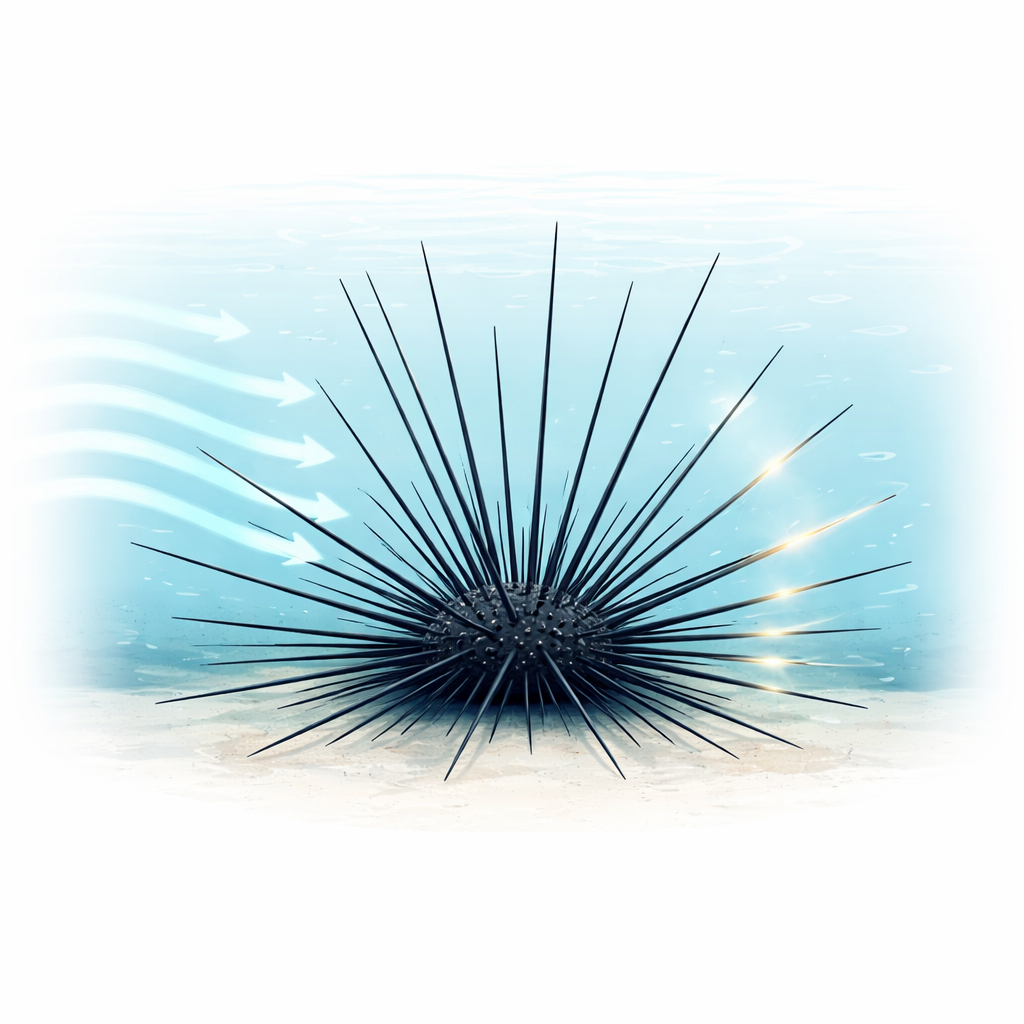
The researchers studied a common long‑spined sea urchin, whose dark needles can reach several centimeters in length. When a small droplet of seawater was placed on the tip of a spine, that single spine quickly rotated by about ten degrees, while its neighbors stayed still. Electrical measurements showed that the spine produced a surprisingly large voltage—over one tenth of a volt—in less than a tenth of a second. Remarkably, this response was one to three orders of magnitude stronger and faster than the known light‑sensing abilities of related animals, and it occurred even when the sea urchin was no longer alive. That means the effect does not depend on nerves or living tissue, but on the spine’s mineral structure itself.
A Hidden Sponge‑Like Skeleton
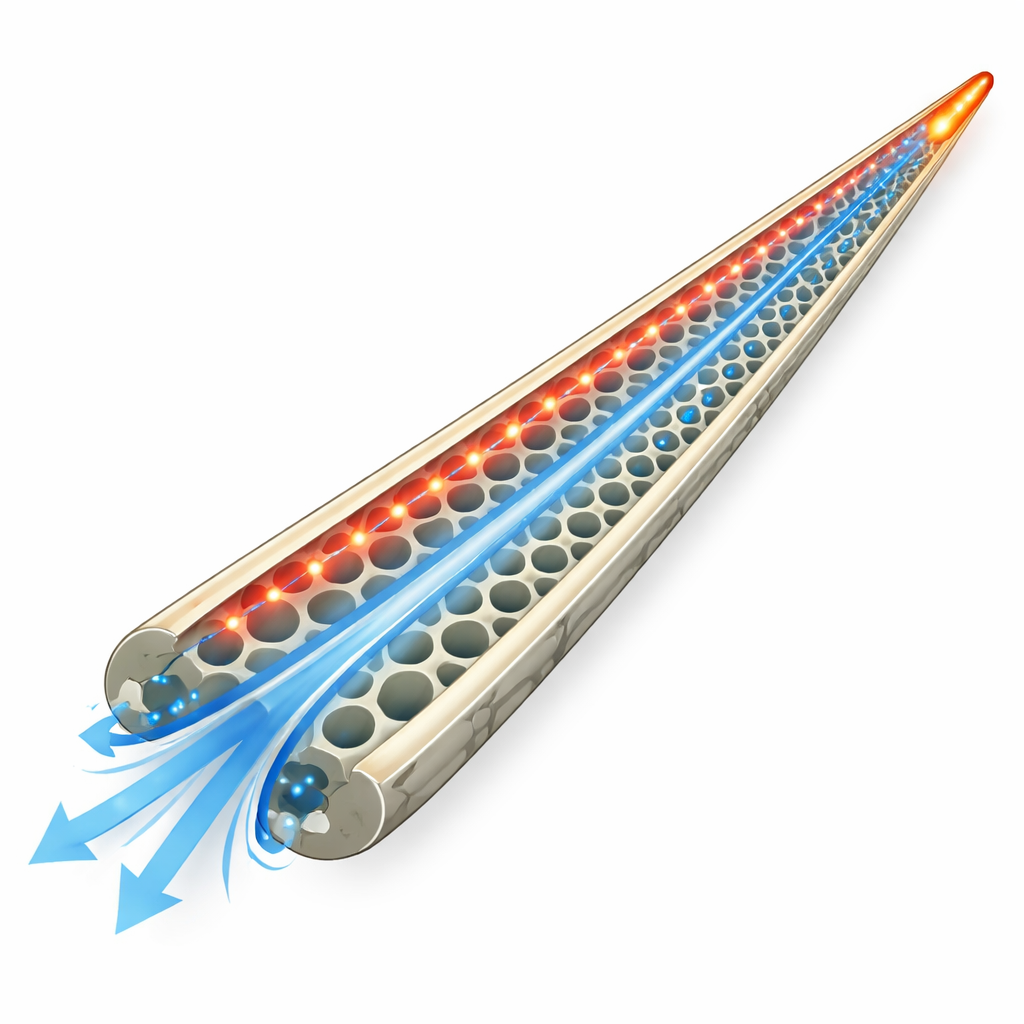
To find the source of this unusual sensitivity, the team used high‑resolution imaging to map the inside of the spine. Beneath a hard outer shell lies a hollow central channel surrounded by a delicately sculpted, sponge‑like framework known as stereom. This mineral network is made of smoothly curved, interconnected branches and pores that wind throughout the spine. Crucially, both the solid struts and the empty spaces between them become gradually smaller from the base of the spine to the tip. Near the tip, the structure has more empty space, finer pores, and a much larger internal surface area for its weight than at the base. This continuous internal gradient turns the spine into a carefully tuned pathway for moving water.
Turning Flow Into Electricity
The scientists then tested how water moving through this porous skeleton could create an electric signal. When water first wets the mineral surface, electric charges arrange themselves in a thin layer at the solid–liquid boundary. As water then flows through the narrow channels, it drags some of these charges along, leaving others behind on the surface. This separation of charge produces a so‑called streaming potential—a voltage that appears only while the fluid is moving. Because the pores are smaller and the surface area is higher near the spine’s tip, water speeds up and rubs past more mineral surface there, boosting charge separation. Measurements and computer simulations showed that this gradient in pore size and surface area is essential for generating the large voltages observed, and that the voltage grows as the water flow gets faster.
Building Artificial Flow‑Sensing Spines
Inspired by the sea urchin, the team used advanced 3D printing to build artificial spines with similar internal gradients from both polymers and ceramics. These man‑made versions, which mimic the natural sponge‑like geometry but not the exact chemistry, also produced clear voltage signals when water was pumped through them. When the internal gradient was removed, the electrical response dropped sharply: gradient‑designed samples generated about three times more voltage and showed roughly eight times larger signal changes than gradient‑free ones. The researchers went further and created a nine‑element array of such structures—a kind of three‑dimensional “skin” that could detect where water hits it and how strongly, simply by reading out the voltages at different nodes.
From Sea Urchins to Smart Underwater Materials
This work shows that sea urchin spines do more than defend the animal; their graded internal skeleton doubles as a sensitive, passive flow detector powered by the physics of moving water and charged surfaces. By copying these natural design rules—gradual changes in pore size, high internal surface area, and fully interconnected passages—engineers can create new materials that feel and map water movement without traditional sensors or power supplies. Such bio‑inspired structures could one day help monitor ocean currents, guide underwater robots, and improve systems for managing and using water resources.
Citation: Chen, A., Wang, Z., Guan, Z. et al. Echinoderm stereom gradient structures enable mechanoelectrical perception. Nature 651, 371–376 (2026). https://doi.org/10.1038/s41586-026-10164-9
Keywords: sea urchin spines, mechanoelectrical sensing, gradient porous materials, streaming potential, underwater flow detection