Clear Sky Science · en
Limited thermal tolerance in tropical insects and its genomic signature
Why hot days matter for tiny creatures
Insects may be small, but they quietly keep tropical forests and farms running by pollinating plants, recycling dead material and feeding birds and mammals. This study asks a pressing question for everyone who cares about food, forests and biodiversity: as the planet warms, can tropical insects survive the heat? By combining fieldwork on mountain slopes in Peru and Kenya with cutting‑edge genetic analysis, the researchers show that many tropical insects are already close to the hottest temperatures their bodies can handle—and may have little room left to adapt.
Climbing mountains to measure insect heat limits
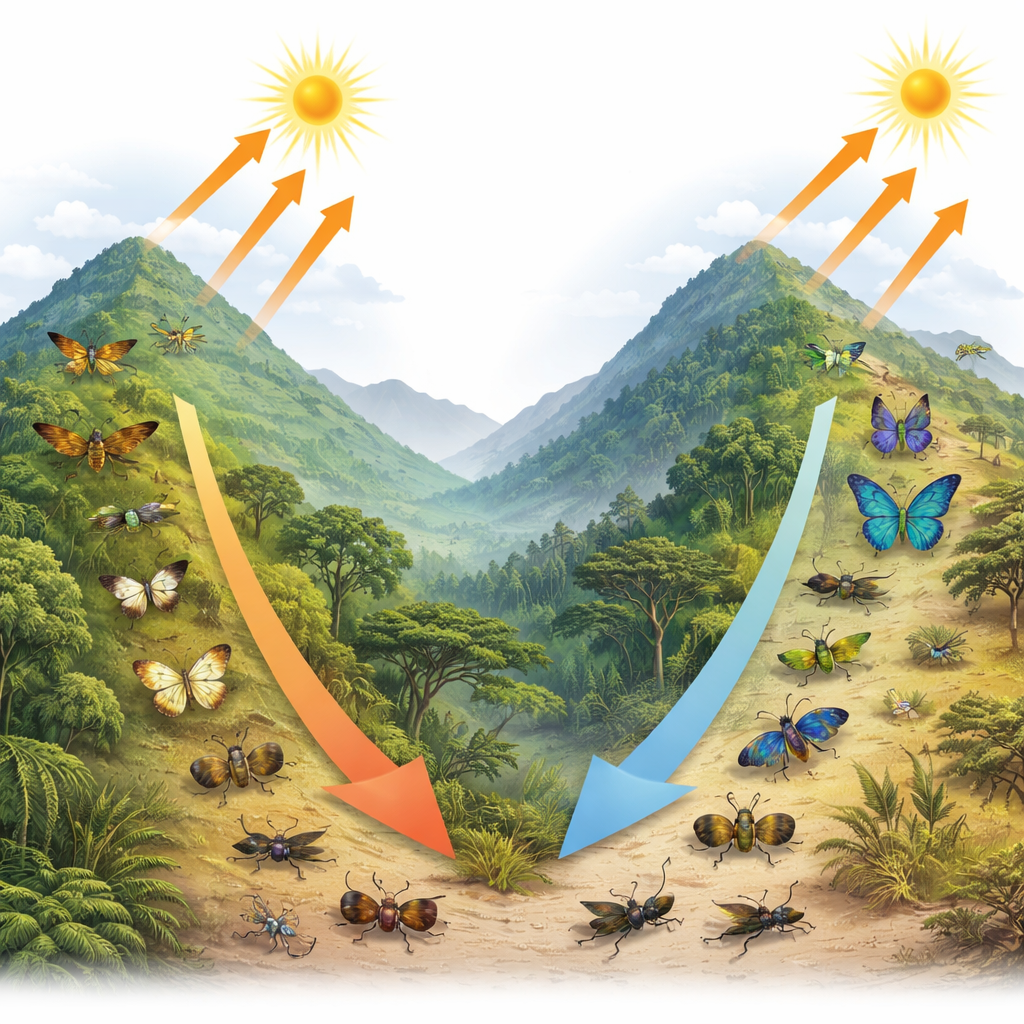
The team collected about 8,000 insects representing around 2,300 species along steep elevational gradients that run from steamy lowland rainforest and savannah up to cool cloud forests in the Andes of Peru and the mountains of Kenya. In the field, each insect was gently warmed or cooled in a controlled device until it could no longer move, revealing its upper and lower temperature limits. As expected, insects living higher up the mountains tolerated more cold and less heat than their lowland relatives. But the shift in heat tolerance did not fully match the change in local climate: as conditions grew hotter toward the lowlands, insects’ heat limits rose more slowly and then leveled off, forming a "ceiling" in the warmest sites.
Limited flexibility where it is needed most
Animals can sometimes temporarily adjust to stressful temperatures—a kind of physiological warm‑up. To test this, the researchers briefly exposed some insects to a strong but non‑lethal burst of heat before measuring their limits. High‑elevation insects responded as hoped: after the heat shock, they could tolerate slightly higher temperatures. By contrast, many lowland insects actually became less tolerant after the same treatment, as if their protective systems were already working at full throttle. Similar tests with short cold spells showed extra cold resistance mostly in high‑ and mid‑elevation species. Together, these results indicate that insects in the hottest tropical lowlands have little spare capacity to toughen up further, while their cooler‑dwelling relatives still have some room to adjust.
Heat resistance written into insect molecules
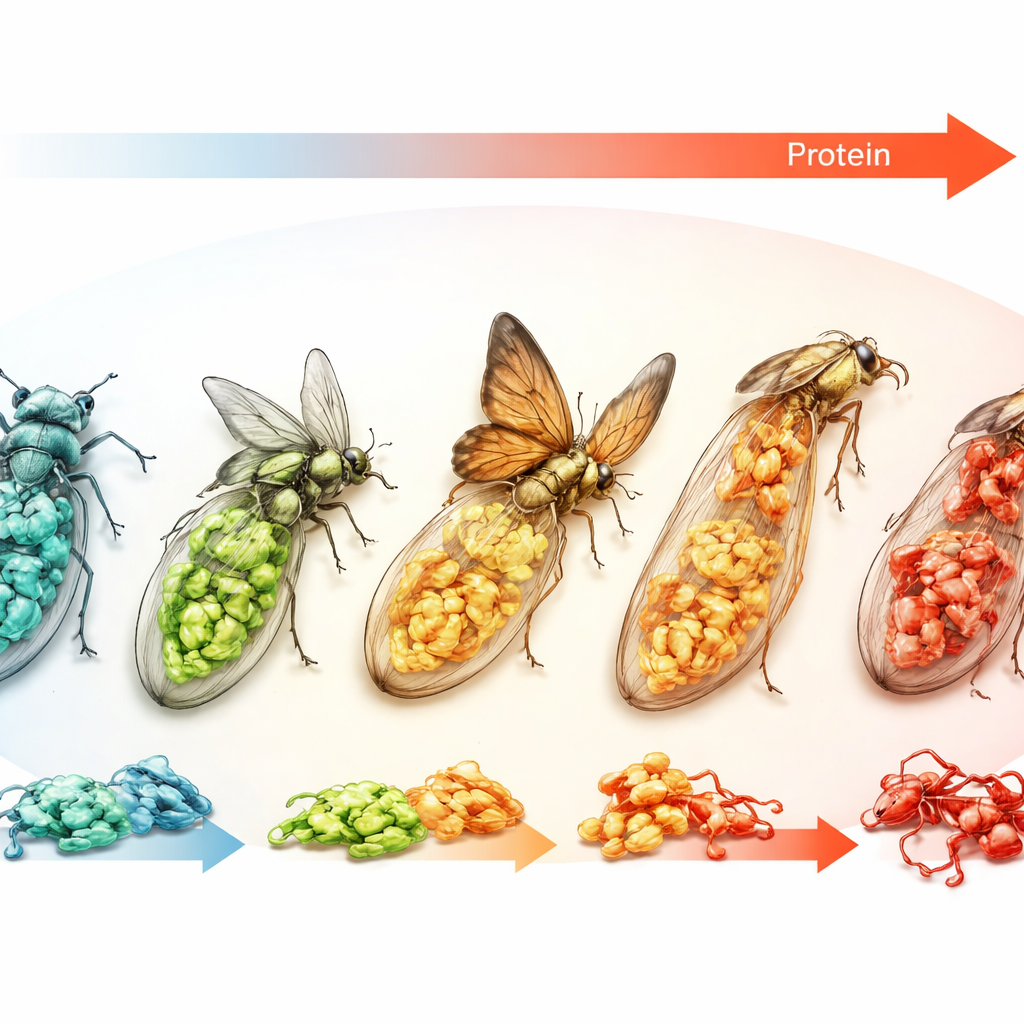
Why does this ceiling in heat tolerance exist? The authors looked for clues inside insects’ genomes. Using protein sequences from 677 species, they used a deep‑learning tool to estimate the temperature at which each protein begins to lose its shape, a key step toward cellular failure and death. They found that proteins in different insect groups have systematically different melting temperatures: for example, flies tended to have less heat‑stable proteins, while grasshoppers and stinging wasps had more robust ones. When the team compared these protein data with the field measurements of whole‑animal heat limits, the match was striking. Families whose proteins held together at higher temperatures also had insects that withstood more heat in the field, suggesting that basic molecular design—shaped over long evolutionary time—helps set each lineage’s thermal limits.
Projecting future heat danger
Armed with these physiological measurements, the researchers then asked how current and future climates translate into risk on the ground. They combined real temperature records and satellite‑based surface heat measurements with models that estimate how long an insect can endure a given temperature before entering heat coma. In today’s climate, lowland insects in the Amazon are already exposed to surface temperatures that can knock out the most sensitive species in under a minute during the hottest part of the day, even though shaded air temperatures remain safer. Climate projections to the end of this century show a much more troubling picture: in the Amazonian lowlands, under high‑emissions scenarios, roughly half of all future daytime surface temperatures, and a large share of air temperatures, are predicted to be high enough to cause serious heat injury in many species.
What this means for tropical life
The findings paint a sobering but actionable picture. Many tropical lowland insects—the backbone of the world’s richest ecosystems—are already living close to their upper temperature limits, with little ability to push those limits higher. Because their proteins and physiology appear tightly constrained by evolution, rapid genetic adaptation to hotter conditions may be slow and costly. Without relief from rising temperatures, through either cooler microhabitats or movement upslope, more frequent heat waves and cold snaps could trigger widespread insect losses, rippling through food webs and ecosystem services. Protecting intact, shaded forests, maintaining landscape connectivity so species can shift to higher elevations, and limiting future warming emerge as crucial steps to safeguard the planet’s most diverse insect communities.
Citation: Holzmann, K.L., Schmitzer, T., Abels, A. et al. Limited thermal tolerance in tropical insects and its genomic signature. Nature 651, 672–678 (2026). https://doi.org/10.1038/s41586-026-10155-w
Keywords: tropical insects, heat tolerance, climate change, protein stability, Amazon rainforest