Clear Sky Science · en
Large-scale quantum communication networks with integrated photonics
Why future messages may travel as quantum light
Every day, enormous amounts of sensitive information—bank details, health records, state secrets—move through glass fibers under our feet and across oceans. Today’s encryption methods rely on mathematical puzzles that powerful future computers may crack. This article explores a different approach: using the rules of quantum physics to share secret keys that cannot be copied or intercepted without leaving a telltale trace. The researchers show how to build a large, long-distance quantum communication network on tiny photonic chips, pointing toward a more secure “quantum internet.”
From fragile lab setups to chip-based networks
Quantum key distribution, or QKD, lets two users create a shared secret key by sending individual light particles and checking for signs of spying. So far, many demonstrations have connected just two locations at a time, or relied on intermediate stations that must be fully trusted. Scaling up to many users, spread across hundreds of kilometers, has demanded bulky lasers, delicate optics, and complex controls—hardly ideal for real-world deployment. The team behind this work set out to shrink and simplify the hardware by moving key parts of the system onto mass-producible photonic chips, much like those that already power high-speed data centers.
A new way to stretch distance without trusted middlemen
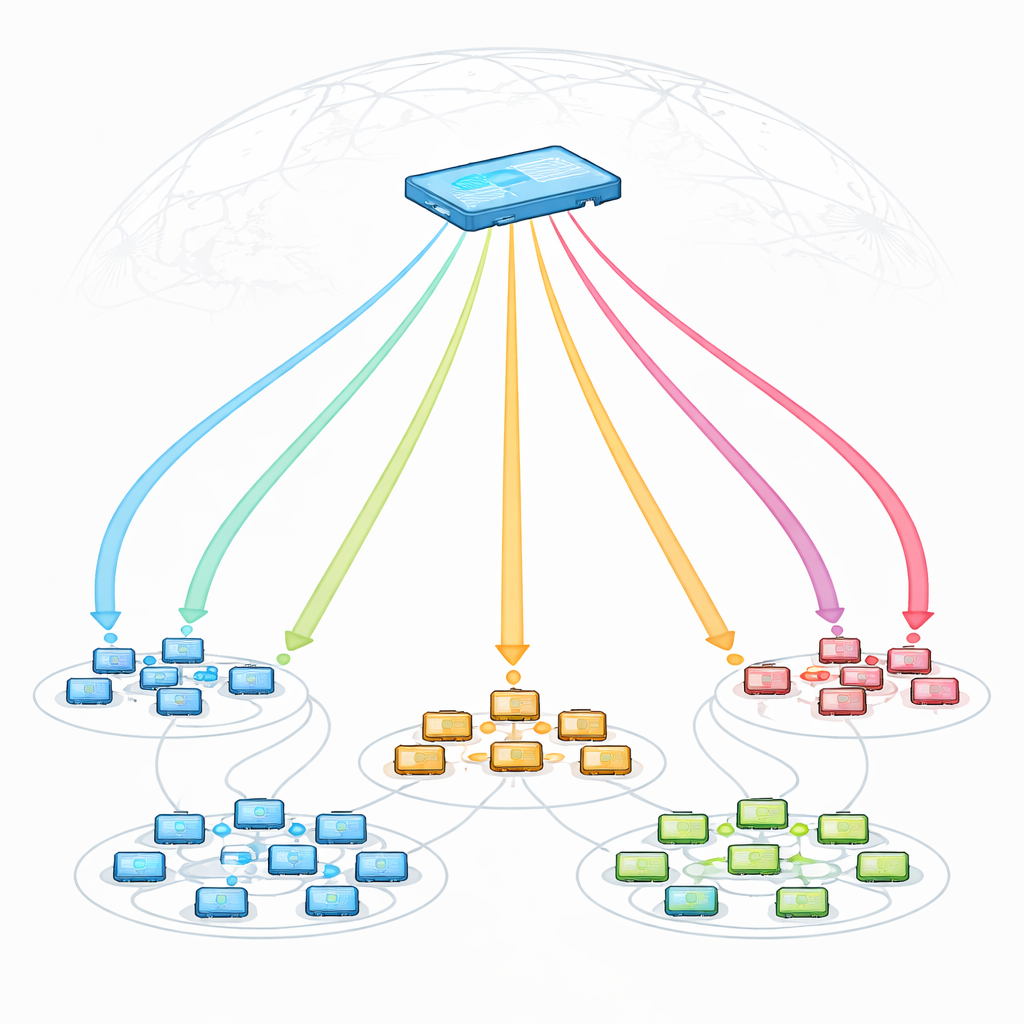
The network in this study is based on a protocol called twin-field quantum key distribution. Instead of users sending light directly to each other, pairs of users send very weak light pulses to a central station, where the pulses meet and interfere. Thanks to how the protocol is designed, the central station does not need to be trusted—it can even be controlled by an eavesdropper—yet it still helps extend how far secure keys can be shared. Crucially, this approach can beat a fundamental distance limit that applies when no such interference-based trick is used. Turning this elegant idea into a practical network, however, requires many extremely quiet lasers that stay in lockstep over hundreds of kilometers of fiber.
A comb of colors that keeps everything in sync
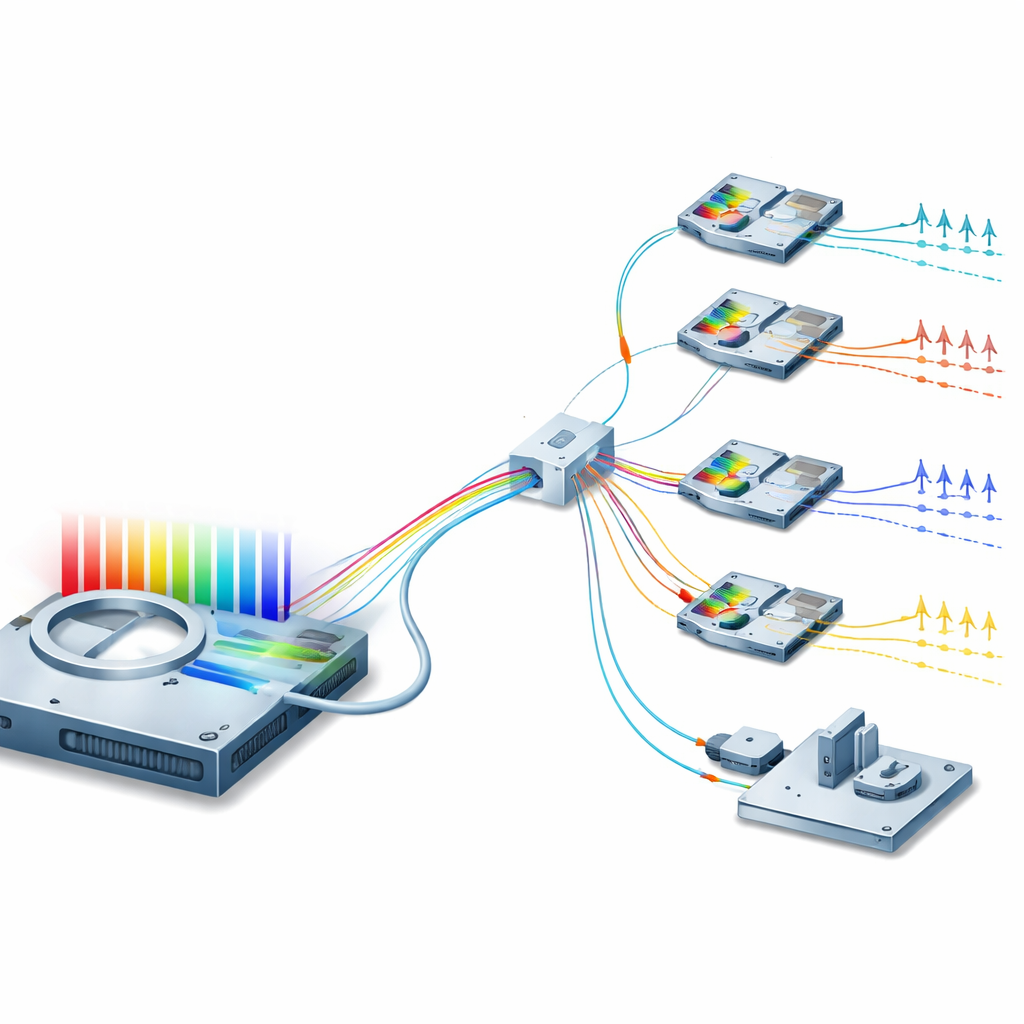
To solve the laser challenge, the researchers built a special chip at the network’s center that generates an “optical microcomb” – a set of evenly spaced, ultra-stable colors of light. This comb is produced by feeding a compact semiconductor laser into a tiny, high-quality ring-shaped resonator made from silicon nitride. The interaction inside this resonator narrows the laser’s frequency noise to the level of just a few dozen hertz, far quieter than typical telecom lasers. Each distinct color from the comb is sent out over the fiber network to serve as a shared reference. On the user side, another kind of chip made from indium phosphide receives these reference colors and forces its own on-chip lasers to lock onto them. In effect, a single central comb chip seeds many user chips with perfectly synchronized, low-noise light.
Building many identical quantum senders on a wafer
The user chips do more than just host lasers. Each one integrates all of the optical components needed to prepare quantum signals: elements that carve light into pulses, adjust their brightness, and impose controlled changes in phase. The team fabricated 24 such transmitter chips on a single wafer and randomly selected 20 for their experiment—mirroring how real-world manufacturing would work. Tests showed that nearly all of the key components operated within tight, predictable performance ranges, and that the on-chip lasers could be tuned across multiple comb lines while remaining tightly locked. This high yield and uniformity are essential if a future quantum network is to serve dozens or hundreds of customers without bespoke tuning for each device.
Reaching thousands of kilometers of combined secure links
Using these chips, the researchers built a star-shaped network in the laboratory with 20 user nodes connected in pairs through 10 different wavelengths, all sharing the same central comb chip. They ran a specific “sending-or-not-sending” version of twin-field QKD, which is well suited to long distances. Pairs of users were linked by fiber loops that effectively stretched up to 370 kilometers between them, and the system continuously tracked and corrected slow drifts in the optical phase caused by temperature and vibration along the fibers. Across all 10 channels, the measured error rates in the quantum signals remained low, and at the longest distance the secret key rates exceeded the best possible performance of any scheme that does not use this kind of twin-field strategy. Taken together, the 20 users and 370-kilometer links correspond to a total networking capability of 3,700 kilometer-pairs of secure connections.
What this means for everyday communications
This work does not yet replace the internet’s backbone, but it shows that large, long-distance quantum-secure networks can be built from compact, repeatable chips rather than bespoke laboratory setups. By proving that a single microcomb chip can coordinate many user transmitters, and that these devices can be mass-produced with consistent performance, the study outlines a practical path toward city- and country-scale quantum networks. Combined with future improvements in detectors, fibers, and protocols, such integrated photonic systems could eventually protect financial transactions, health data, and government communications with security rooted not in hard math problems, but in the unbreakable laws of quantum physics.
Citation: Zheng, Y., Wang, H., Jia, X. et al. Large-scale quantum communication networks with integrated photonics. Nature 651, 68–75 (2026). https://doi.org/10.1038/s41586-026-10152-z
Keywords: quantum key distribution, integrated photonics, optical microcomb, secure communication, quantum networks