Clear Sky Science · en
CO2 subsurface mineral storage by its co-injection with recirculating water
Turning a Climate Problem into Underground Rock
Burning fossil fuels releases vast amounts of carbon dioxide (CO2) into the air, driving climate change. One promising way to tackle this problem is to lock CO2 safely underground for thousands of years. This study shows how engineers in arid western Saudi Arabia turned a local volcanic rock formation into a giant natural sponge for CO2, using almost no fresh water from the surface. Their approach points to a practical path for cutting emissions in dry regions that host some of the world’s largest industrial polluters.
Storing Carbon as Stone, Not Gas
Many current carbon storage projects inject compressed CO2 into deep underground layers trapped beneath impermeable rock. But in some parts of the world, these natural “lids” are missing, making it risky that CO2 could leak back to the surface. An alternative is to turn CO2 into solid minerals inside reactive rocks like basalt, a dark volcanic rock rich in metals such as calcium, magnesium and iron. When CO2 is dissolved in water and flows through basalt, it can react to form stable carbonate minerals—essentially man‑made limestone and related rocks. Until now, however, this strategy has been limited by its huge water demand, which is a serious obstacle in deserts.
Using the Groundwater Itself as the Working Fluid
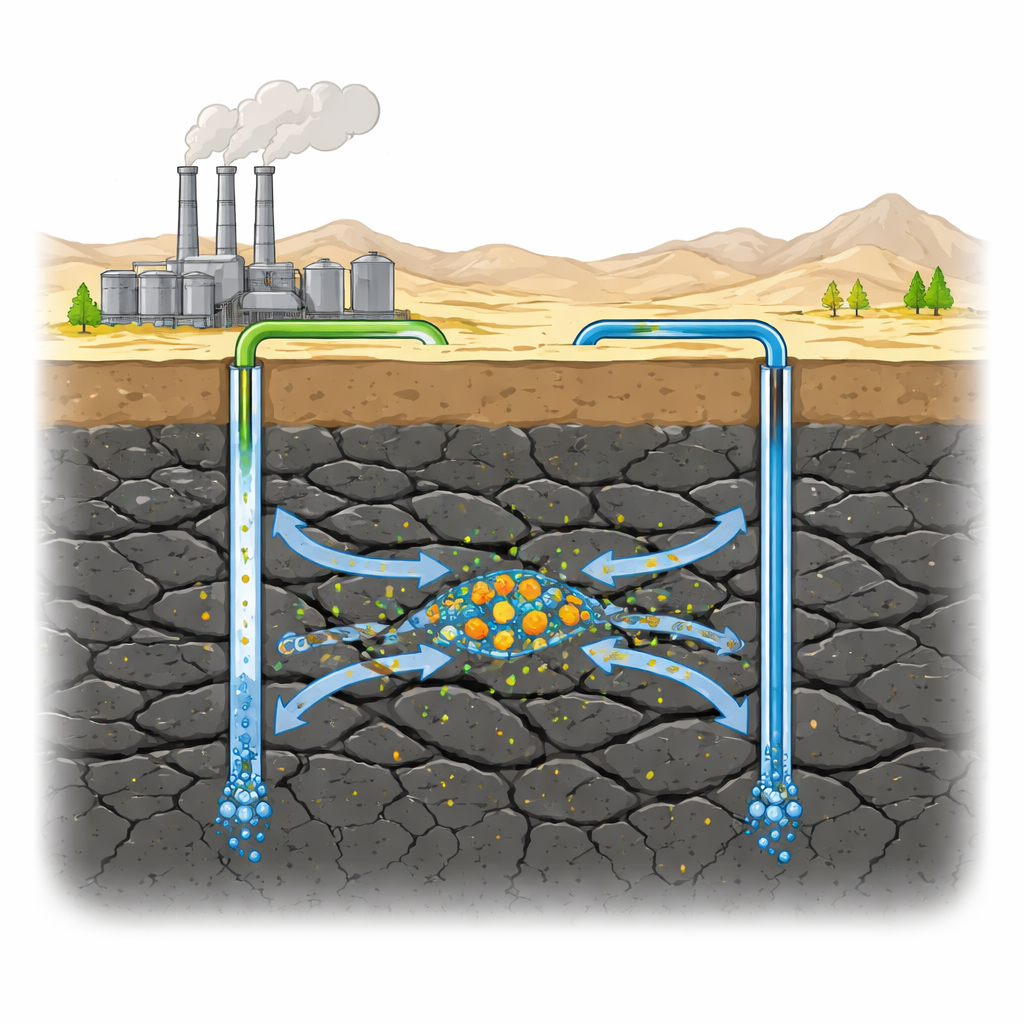
The pilot project, sited near the Jizan Economic Complex on Saudi Arabia’s Red Sea coast, drilled a cluster of wells into a thick sequence of 21–30‑million‑year‑old basalt. Two wells, about 130 meters apart, were used as a paired system: one to pump groundwater up, and the other to send it back down after adding CO2. Inside the injection well, pure CO2 was bubbled into flowing water at depth so that it dissolved completely, creating a cool, dense, slightly acidic CO2‑rich water that would not rise buoyantly toward the surface. The same subsurface water was continuously recirculated between the two wells, eliminating the need to truck in external water and reducing pressure build‑up in the rock.
Following the Water and Watching New Minerals Form
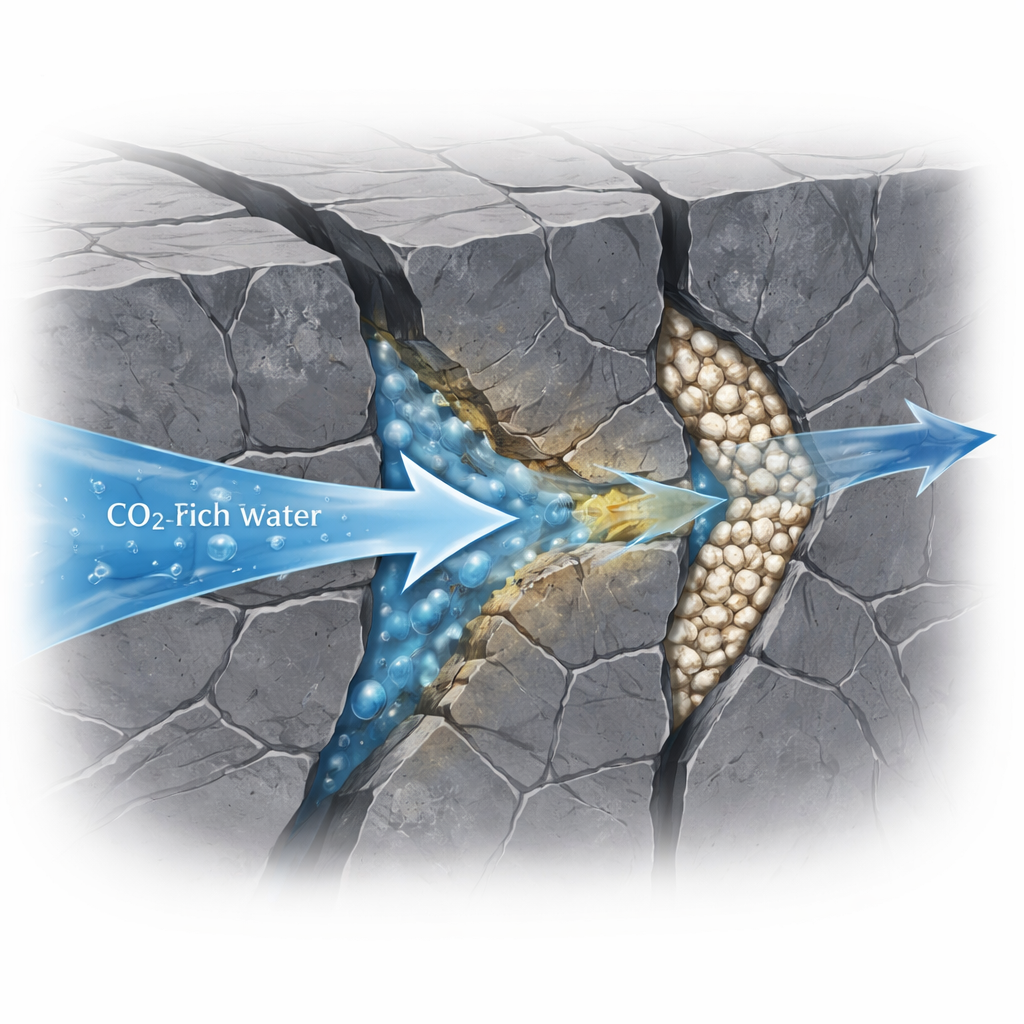
Once continuous CO2 injection began, the team carefully tracked how the circulating water changed as it flowed through the fractured basalt. They monitored its acidity, carbon content and dissolved elements such as calcium, magnesium, silicon and iron, and added two harmless chemical tracers to follow the fluid paths. As the CO2‑charged water spread underground, it became enriched in these rock‑derived elements, showing that the basalt was dissolving and releasing the building blocks for new minerals. Over time, the dissolved carbon content in the produced water first rose and then steadily fell, while the chemistry indicated that carbonate minerals such as calcite, ankerite and siderite were becoming saturated and starting to precipitate within the rock fractures.
Measuring How Much Carbon Turned to Rock
To move beyond inference, the researchers used the tracer chemicals to estimate what the dissolved carbon levels would have been if no reactions had occurred. Comparing this “no‑reaction” baseline with the actual measurements showed a growing shortfall of carbon in the water, meaning it was being locked away as new solids. Two independent tracers, sodium fluorescein and sulfur hexafluoride, gave consistent results: within about ten months after injection started, roughly 70 percent of the 131 tons of CO2 pumped into the formation had been converted into solid minerals. Physical evidence from a recovered downhole pump, coated and clogged with fresh carbonate crystals, further confirmed that the injected CO2 had indeed turned to stone.
What This Means for Future Climate Solutions
By proving that recycled groundwater can carry and mineralize large amounts of CO2 in fractured basalt, this project offers a blueprint for carbon storage in dry regions that lack conventional underground traps. The method uses less energy than traditional high‑pressure CO2 injection, because the dissolved CO2 is pushed mainly by gravity rather than powerful pumps, and it avoids heavy competition for scarce surface water. Although questions remain about long‑term capacity and rock‑space limitations, the Jizan pilot shows that turning CO2 into rock underground is not just a laboratory curiosity—it can work at industrial scale, even in deserts closely tied to the fossil‑fuel economy.
Citation: Oelkers, E.H., Arkadakskiy, S., Ahmed, Z. et al. CO2 subsurface mineral storage by its co-injection with recirculating water. Nature 651, 954–958 (2026). https://doi.org/10.1038/s41586-026-10130-5
Keywords: carbon mineralization, basalt storage, carbon capture and storage, Saudi Arabia, subsurface CO2 recirculation