Clear Sky Science · en
Sub-part-per-trillion test of the Standard Model with atomic hydrogen
Measuring the Smallest Building Blocks
How big is a proton? The answer might seem like arcane trivia, but it is actually a sharp test of the laws of physics that describe everything from starlight to smartphone electronics. For more than a decade, different ultra-precise experiments have disagreed about the proton’s size, hinting that our best theory of light and matter—the Standard Model—might be missing something. This paper describes a new, record-breaking measurement on ordinary hydrogen atoms that finally brings the picture into focus and delivers one of the most exacting tests of modern physics ever achieved.
A Long-Standing Size Disagreement
The proton sits at the center of every hydrogen atom, surrounded by a single electron. Quantum physics predicts that the electron’s energy depends very slightly on how big the proton is, because the electron’s wave spreads into the tiny region occupied by the proton. For years, experiments that probed hydrogen with lasers gave one value for the proton’s “charge radius,” while a different kind of experiment using “muonic hydrogen”—where the electron is replaced by a heavier cousin called a muon—gave a noticeably smaller value. This mismatch, dubbed the “proton radius puzzle,” raised the tantalizing possibility that either our calculations or even the Standard Model itself might be wrong.
Listening to Hydrogen with Extreme Precision
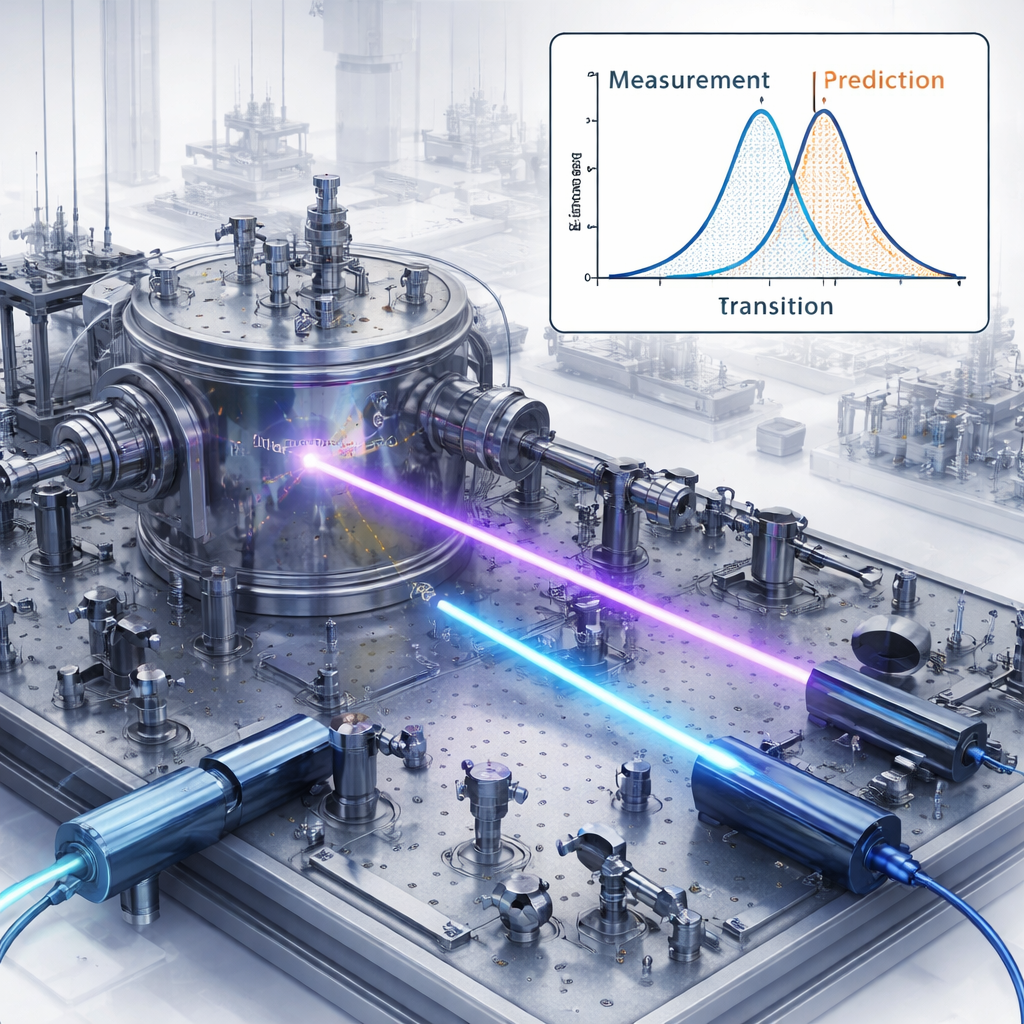
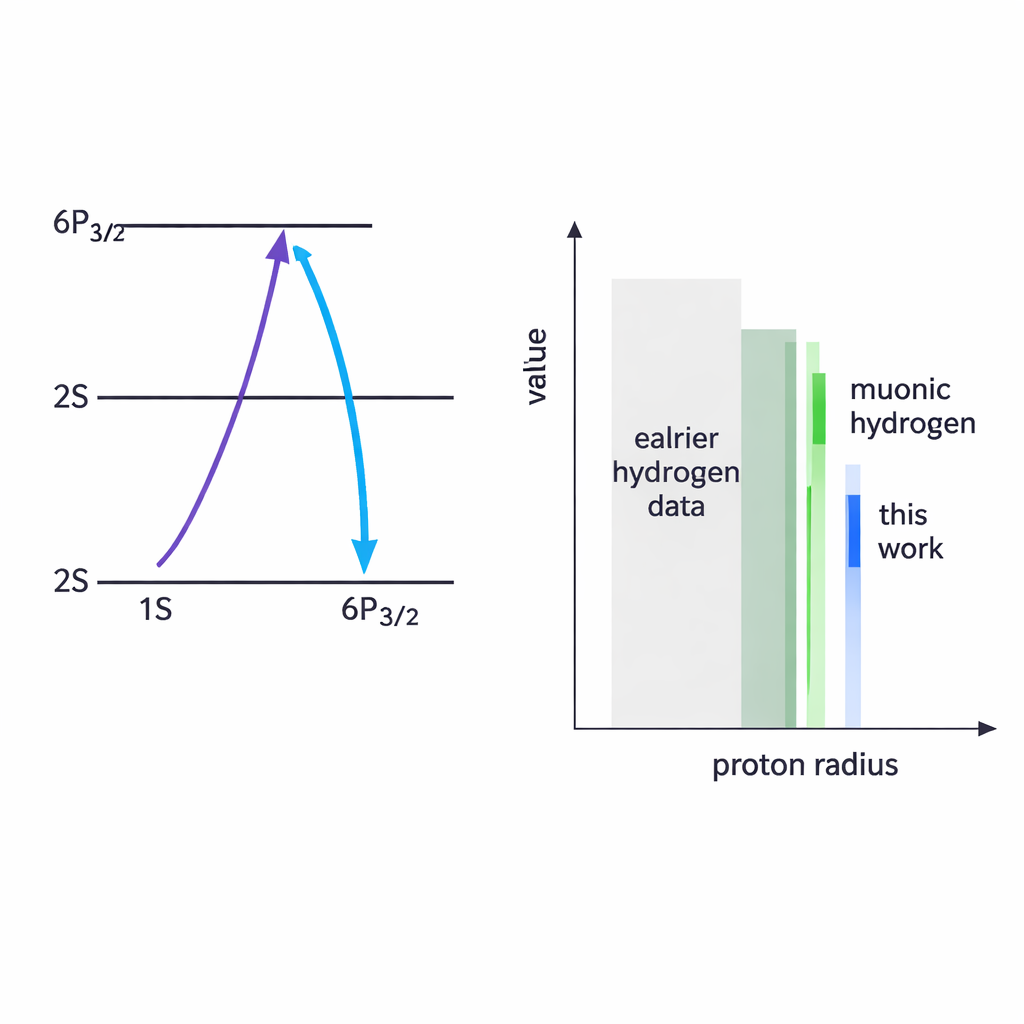
To tackle this puzzle, the authors measured the color, or frequency, of a very rare transition in atomic hydrogen called 2S–6P. In simple terms, they used lasers to push the electron from one long-lived state (2S) to a higher one (6P), and detected the resulting flash of light when it fell back down. They sent a beam of cold hydrogen atoms through a specially designed vacuum chamber and crossed it with exquisitely controlled laser beams. By arranging the lasers to hit the atoms from opposite directions, they canceled the usual Doppler blurring caused by atomic motion, and then used detailed simulations to correct for more subtle distortions from light pressure, quantum interference, and tiny relativistic effects.
Beating Down Every Source of Error
Reaching the needed accuracy meant tracking down shifts in the measured color hundreds to thousands of times smaller than the natural width of the spectral line. The team monitored different groups of atoms moving at different speeds, then mathematically extrapolated to what the frequency would be for atoms at rest. They carefully characterized how standing waves of laser light could nudge the atoms and skew the signal, how stray electric and magnetic fields inside the apparatus could bend energy levels, and how the motion of the atoms produced minute relativistic corrections. Each of these effects was modeled and experimentally checked, then used to adjust the raw data. In the end, the remaining uncertainty in the transition frequency was less than one part in a trillion.
Weighing Theory Against Experiment
Once they had the 2S–6P frequency, the researchers combined it with an earlier world-leading measurement of another hydrogen line, the famous 1S–2S transition. Together, and using the highly developed quantum theory of hydrogen, these two numbers allow one to solve for both the proton’s radius and a key constant called the Rydberg constant. The extracted proton radius is 0.8406 femtometers—about a million billion times smaller than a meter—and is 2.5 times more precise than any previous determination from ordinary hydrogen. Crucially, it agrees perfectly with the value from muonic hydrogen and clearly rules out the older, larger radius that had been used in standard reference tables.
What This Means for Our Picture of Nature
For a lay audience, the bottom line is that this painstaking experiment shows that the existing Standard Model of particle physics still passes one of its harshest tests. The measured hydrogen line matches the theoretical prediction at the level of less than one part in a trillion, and the subtle quantum corrections that account for the finite size of the proton are confirmed to about one part in a million. Rather than signaling a breakdown of known physics, the proton radius puzzle now appears to have been resolved in favor of the smaller radius. This result tightens the web of constraints on any new physics beyond the Standard Model and showcases how carefully “listening” to a simple atom can probe the deepest workings of the universe.
Citation: Maisenbacher, L., Wirthl, V., Matveev, A. et al. Sub-part-per-trillion test of the Standard Model with atomic hydrogen. Nature 650, 845–851 (2026). https://doi.org/10.1038/s41586-026-10124-3
Keywords: proton radius, hydrogen spectroscopy, Standard Model test, quantum electrodynamics, Rydberg constant