Clear Sky Science · en
Uncovering origins of heterogeneous superconductivity in La3Ni2O7
Why tiny islands of superconductivity matter
Superconductors—materials that carry electricity with zero resistance—promise ultra-efficient power lines, powerful magnets and faster electronics. A new class based on nickel, rather than copper, has recently shocked researchers by working at unusually high temperatures, but only when squeezed between diamond anvils at enormous pressures. This paper asks a deceptively simple question with big implications: when these nickel-based crystals "go superconducting," do they all participate, or only small regions? And what, exactly, controls where superconductivity appears and vanishes?
Seeing hidden currents under crushing pressure
To answer this, the authors study a compound called La3Ni2O7, a layered nickel oxide that becomes superconducting above the boiling point of liquid nitrogen when compressed to more than 100,000 times atmospheric pressure. Working in such extreme conditions usually makes detailed imaging impossible. Here, the team turns the pressure cell itself into a microscope by implanting a thin sensing layer of special atomic-scale defects, known as nitrogen-vacancy centers, just beneath the surface of one diamond anvil. These quantum sensors glow differently depending on local magnetic fields and internal stresses, allowing the researchers to take wide-field "pictures" of both magnetism and pressure at sub-micrometer resolution while the sample is being squeezed. 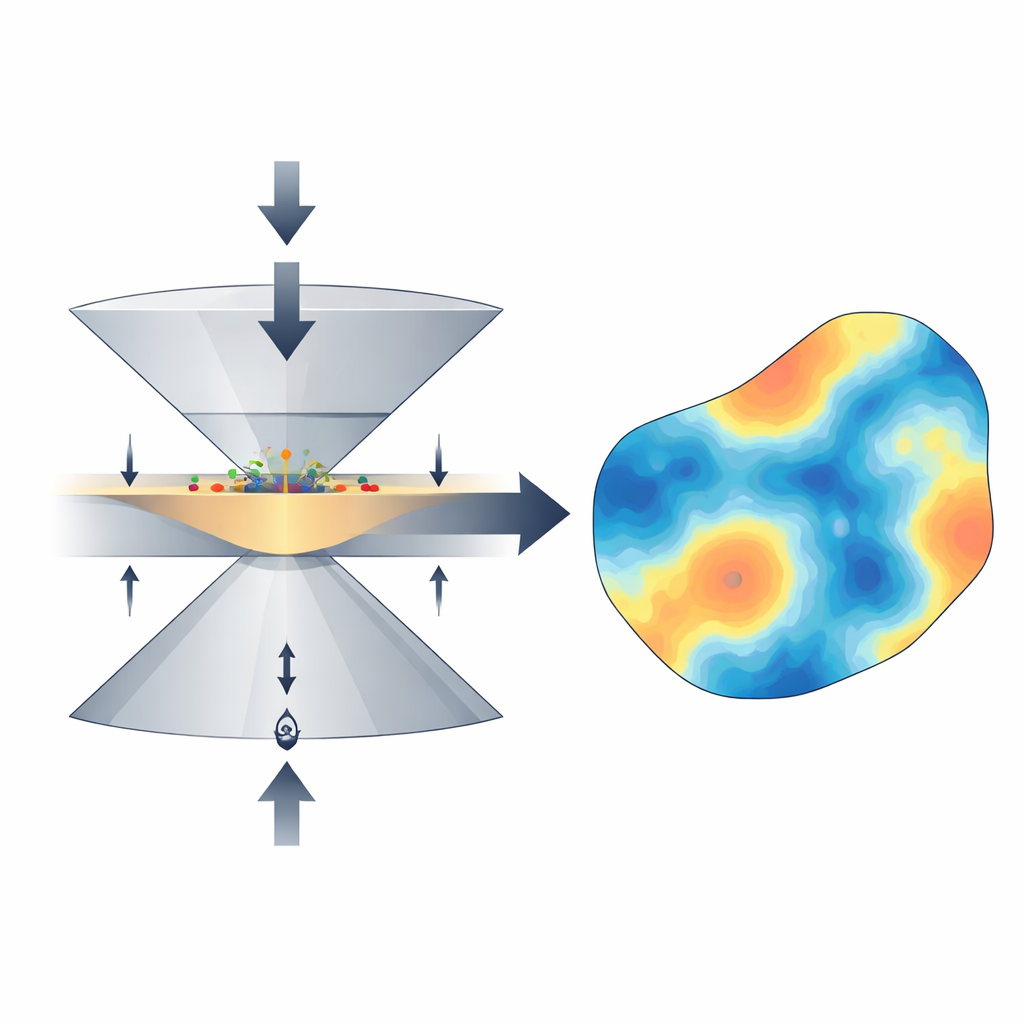
Mapping patchy superconductivity in real space
When a material becomes superconducting, it expels magnetic field from its interior—a hallmark known as the Meissner effect. By cooling La3Ni2O7, applying a gentle magnetic field and reading out the quantum sensors across the diamond surface, the authors reconstruct a detailed map of the field above the sample. Regions where the field is suppressed mark superconducting patches; areas where it is enhanced trace where field lines are pushed aside or bunched up. These maps reveal that superconductivity in La3Ni2O7 is far from uniform: instead of the whole crystal turning superconducting at once, only irregular, micron-sized pockets do, with shapes and locations that shift as pressure and temperature change. The team also observes trapped magnetic flux locked into the sample when it is cooled in a field, again in localized regions that coincide with the strongest superconducting response.
How pushing and sliding stresses help or hurt
Because the same quantum defects are also sensitive to mechanical strain, the researchers can simultaneously reconstruct how the sample is being squeezed. They distinguish between normal stress, which presses straight down on the crystal, and shear stress, which tends to slide layers past one another. By correlating pixel-by-pixel magnetic behavior with these two stress components, they show that superconductivity first appears in spots experiencing higher-than-average normal stress, helping explain why bulk measurements see an onset only over a range of nominal pressures. More unexpectedly, they find that when shear stress exceeds roughly 2 gigapascals, superconductivity is strongly suppressed or completely absent, even if the normal compression is otherwise favorable. This leads to a refined three-dimensional phase diagram in which temperature, straight-on pressure and sideways shear jointly determine whether any given microscopic region is superconducting. 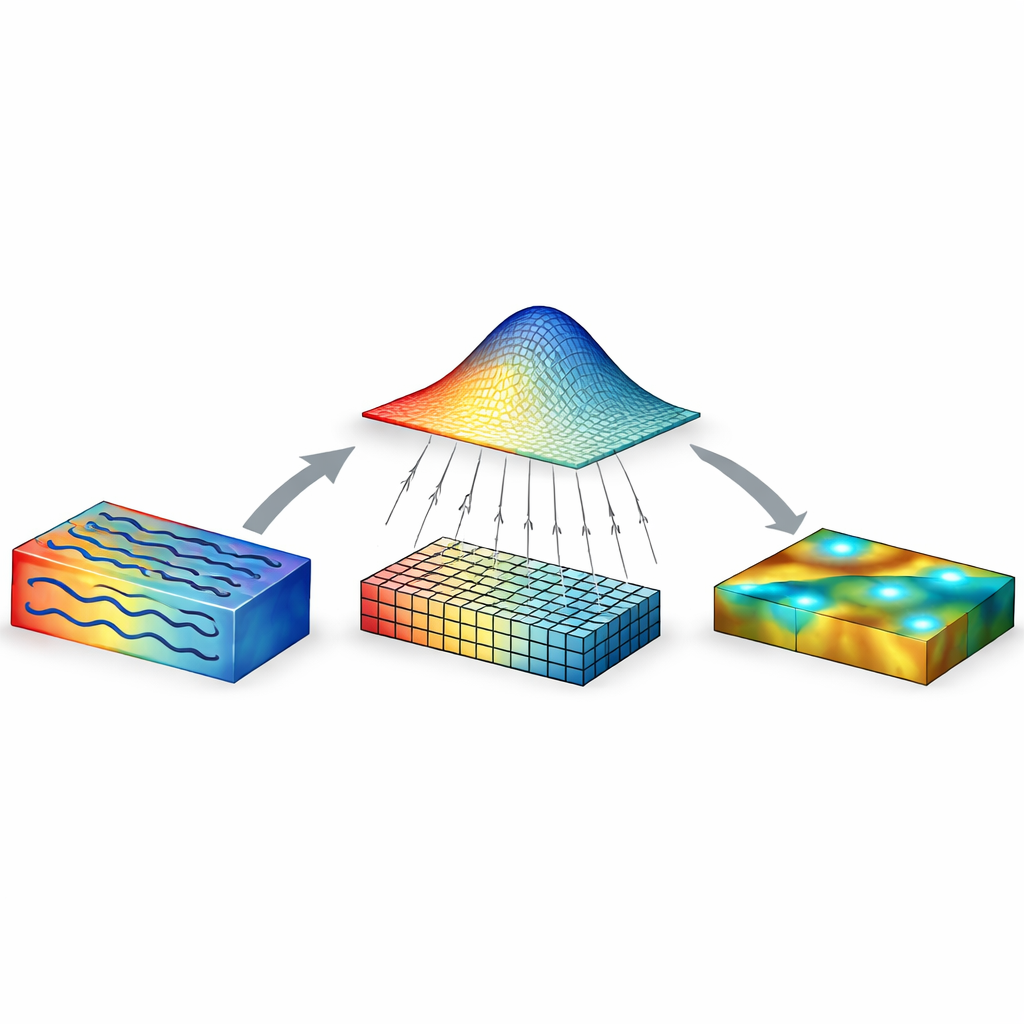
Chemistry stripes and superconducting pockets
The team then turns to samples whose chemical makeup is deliberately less uniform. In one crystal, the ratio of lanthanum to nickel varies in broad stripes, as measured by energy-dispersive X-ray spectroscopy. Globally, this sample shows no clear drop in electrical resistance, which would normally signal superconductivity. Yet the quantum magnetic images reveal small, sharp pockets that do become diamagnetic at low temperature. When the authors overlay the magnetic and chemical maps, they find that these pockets sit precisely where the local composition is closest to the ideal 3:2 lanthanum-to-nickel ratio. Regions that are too nickel-rich or too lanthanum-rich fail to superconduct at all. In other words, the material can harbor islands of superconductivity that are too sparse to dominate the overall resistance, but are clearly visible in local magnetic images.
Turning imperfections into a roadmap
Taken together, these experiments show that high-temperature superconductivity in pressurized La3Ni2O7 is both fragile and highly sensitive to its microscopic environment. Local variations in pressure, shear and stoichiometry carve the crystal into a patchwork of superconducting and non-superconducting zones, explaining why bulk measurements often see weak or "filamentary" signals. By treating this inhomogeneity as a feature rather than a flaw, the authors use a single crystal to map out how different combinations of stress and composition favor or destroy superconductivity. For a non-specialist, the key message is that making better nickelate superconductors will not just require the right average pressure or chemistry—it will demand careful control of tiny mechanical and chemical variations that determine where, and how robustly, supercurrents can flow.
Citation: Mandyam, S.V., Wang, E., Wang, Z. et al. Uncovering origins of heterogeneous superconductivity in La3Ni2O7. Nature 651, 54–60 (2026). https://doi.org/10.1038/s41586-025-10095-x
Keywords: nickelate superconductors, high pressure physics, quantum sensing, strain engineering, La3Ni2O7