Clear Sky Science · en
Transmission of MPXV from fire-footed rope squirrels to sooty mangabeys
Why this wildlife mystery matters to you
Mpox, once thought of as a rare tropical disease, has recently re-emerged around the world, raising urgent questions about where the virus hides in nature and how it first reaches people. This study follows a real-life outbreak in wild monkeys in a West African rainforest and tracks the virus back to an unexpected suspect: a common squirrel that is also hunted and eaten by local communities. Understanding this chain from forest to village helps explain how new epidemics can start—and how they might be stopped at the source.
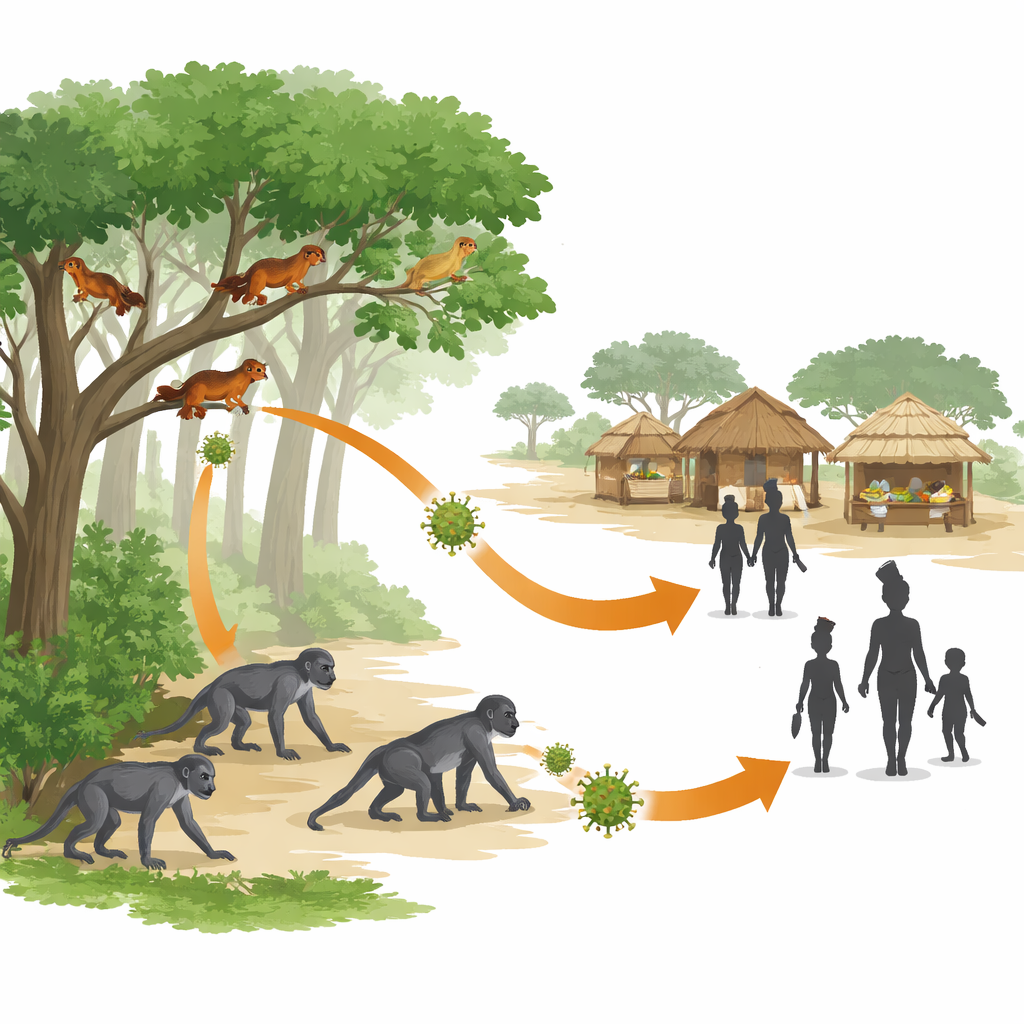
A sudden illness in a forest monkey troop
In early 2023, researchers working in Taï National Park in Côte d’Ivoire noticed something alarming in a well-studied group of sooty mangabeys, a ground-dwelling monkey species. Infants developed red spots that quickly turned into pus-filled blisters, became weak and stopped eating, and several died within days. Over about three months, one-third of the 80-member group showed visible skin lesions, and four infants died. Because these symptoms resembled mpox, veterinarians performed careful examinations on the dead infants and tested tissue samples. They found mpox virus DNA throughout the bodies, confirming that the outbreak in this wild monkey troop was caused by the same family of virus currently worrying human health officials.
Clues hidden in droppings and DNA
The team then set out to reconstruct how the virus had entered the group and spread silently before the first visible rash. For years, they had been collecting fecal samples from the mangabeys as part of a long-term health program. By testing 444 samples from before, during and after the outbreak, they showed that viral DNA appeared in the group’s droppings weeks before anyone looked sick and vanished once the visible disease faded. Many adults, including mothers of sick infants, shed viral traces without ever showing obvious symptoms, suggesting that mpox can circulate quietly in wild monkeys and only sometimes cause severe disease.
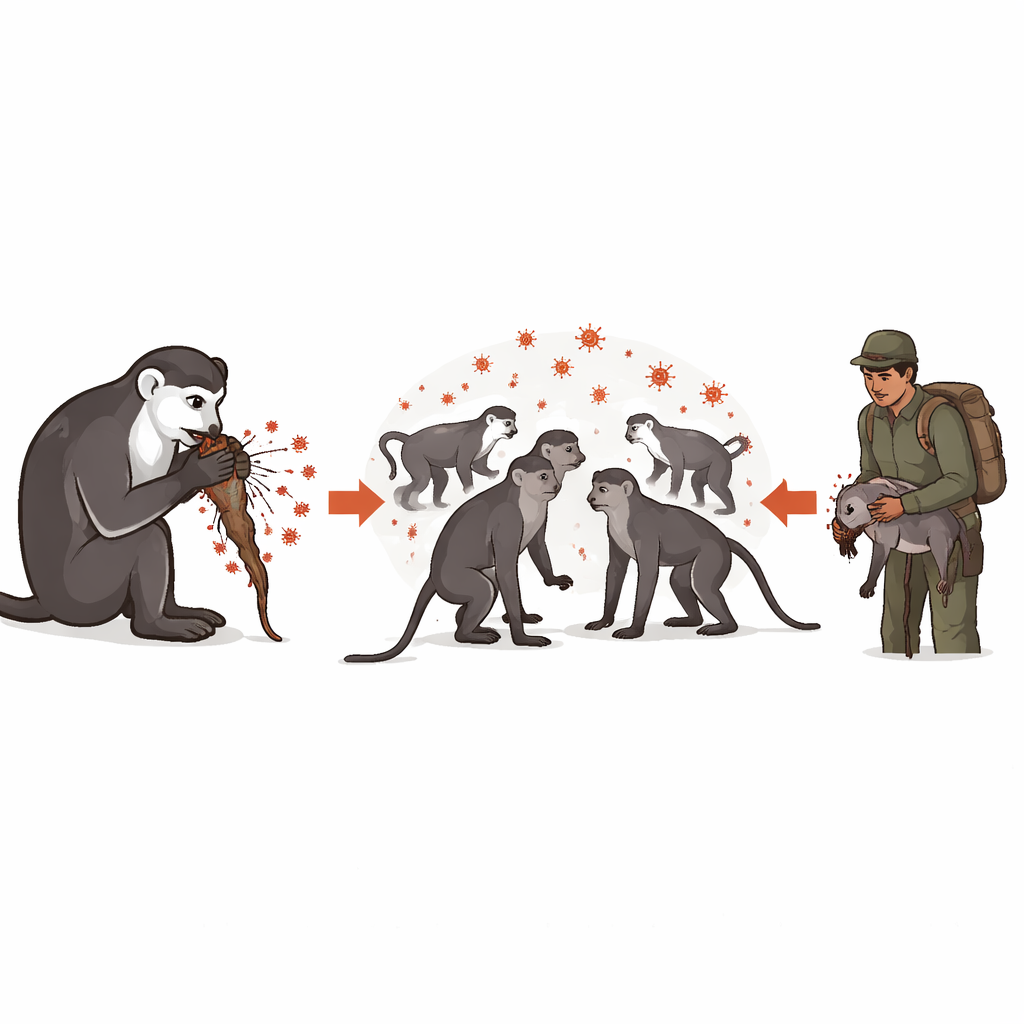
Following the trail back to a squirrel
To find the original source, the researchers widened their search beyond the monkeys. Over several years they had trapped or examined nearly 700 small mammals—mostly rodents and shrews—in and around the park. Only one animal tested strongly positive for mpox: a fire-footed rope squirrel found dead about three kilometers from the mangabeys’ home range twelve weeks before the monkey outbreak. Every organ from this squirrel contained large amounts of virus, and the team was able to grow live virus from its tissues in the lab. When they read the genetic code of the virus from the squirrel and from the mangabeys, the sequences were almost identical, differing only in a few small repeated regions. This near match strongly suggested a recent connection between the squirrel virus and the monkey outbreak.
Evidence from meals and maps
Still, a genetic match alone could not prove how the virus jumped species. Sooty mangabeys are known to hunt small animals, so the scientists turned to two unusual sources of evidence: archived video and the monkeys’ own droppings. A video from 2014 showed a mangabey from the same group eating a clearly identifiable fire-footed rope squirrel. Using a DNA “barcode” method on fecal samples collected before the outbreak, the team detected rope squirrel DNA in two samples, proving that group members had recently eaten this exact species. Strikingly, one of these samples came from the first individual later linked to the outbreak—and that same sample also contained mpox virus DNA. In other words, the researchers appear to have caught a cross-species transmission event in the act: a mangabey ate an infected squirrel and began shedding the virus soon afterward.
From forest food to human risk
The story does not end with monkeys and squirrels. In the villages surrounding the park, both primates and rodents are hunted, traded and eaten as bushmeat, sometimes by children using simple traps. Fire-footed rope squirrels, which thrive not only in intact forest but also in plantations and secondary growth near people, show up in local markets alongside larger rodents. The study’s authors argue that these squirrels are likely long-term natural hosts of mpox in the region and that their close contact with both wild monkeys and humans creates multiple bridges for the virus to cross. They call for better monitoring of squirrel populations, continued tracking of mpox genetic diversity in humans and wildlife, and community programs that reduce risky contact with potentially infected animals without ignoring the reality of bushmeat dependence. In plain terms, the work shows how a small forest squirrel can link a hidden virus reservoir, endangered primates and human villages—and how breaking that chain could help prevent future mpox outbreaks.
Citation: Riutord-Fe, C., Schlotterbeck, J., Lagostina, L. et al. Transmission of MPXV from fire-footed rope squirrels to sooty mangabeys. Nature 651, 185–190 (2026). https://doi.org/10.1038/s41586-025-10086-y
Keywords: mpox, zoonotic spillover, squirrels, bushmeat, wild primates