Clear Sky Science · en
Contemporaneous mobile- and stagnant-lid tectonics on the Hadean Earth
How Old Crystals Reveal Earth’s Turbulent Baby Years
Earth’s first billion years are almost entirely missing from the rock record, yet they set the stage for continents, oceans and life. This study uses tiny, durable mineral grains called zircons—some more than 4 billion years old—to peer back into that lost era. By reading their chemical fingerprints, the authors show that early Earth did not behave as a simple, frozen world or as a fully modern plate-tectonic planet, but as a patchwork of different tectonic styles operating at the same time.
Reading the Planet’s Memory in Sand Grains
Because no intact rocks older than about 4.03 billion years have been found, scientists turn to detrital zircons: crystals eroded from ancient rocks and preserved in younger sediments. The study focuses on zircons from two famous sites. One is Jack Hills in Western Australia, home to the oldest known terrestrial minerals. The other is the Barberton Greenstone Belt in South Africa. Each zircon records when it crystallized and the conditions in the magma that formed it, through subtle variations in trace elements and isotopes of hafnium and oxygen. By analyzing thousands of these grains, the team reconstructs how and where Earth’s earliest continental crust was made and reworked.
Two Competing Pictures of Early Earth
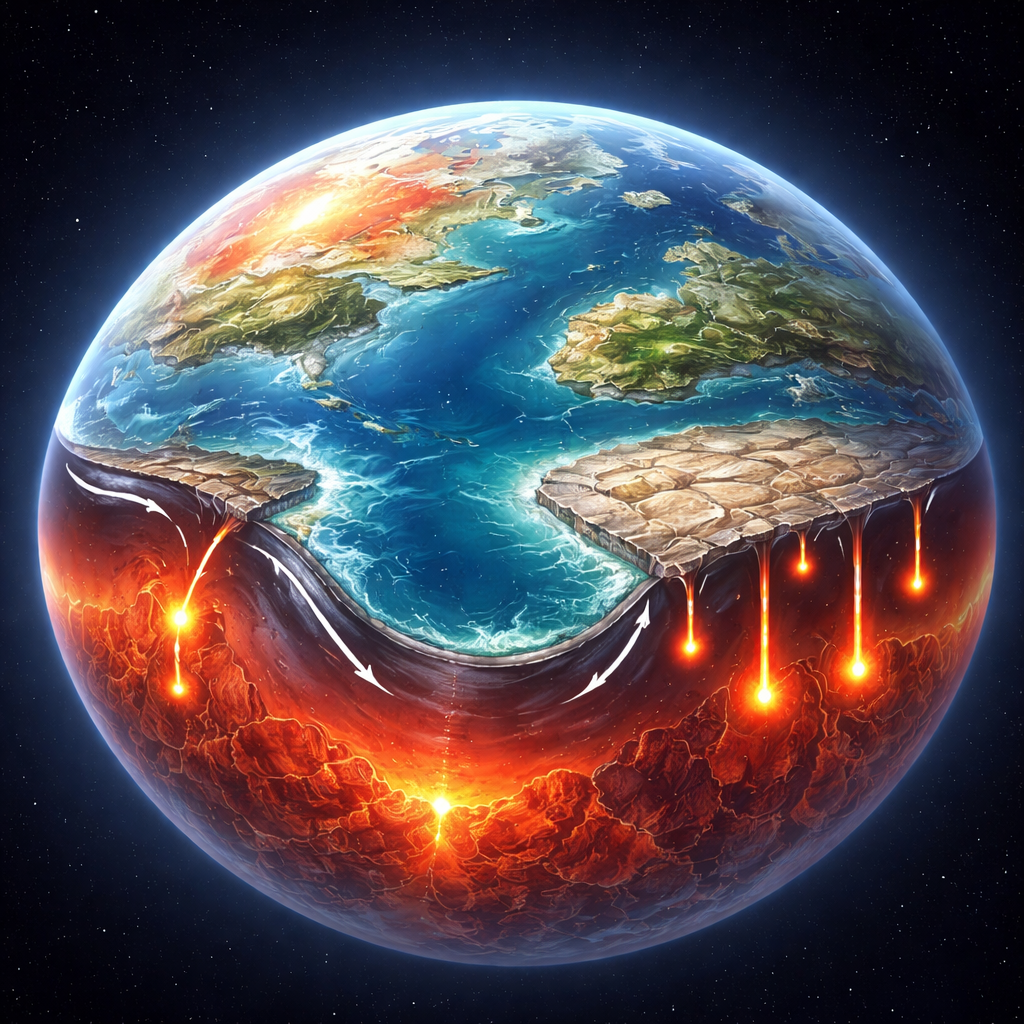
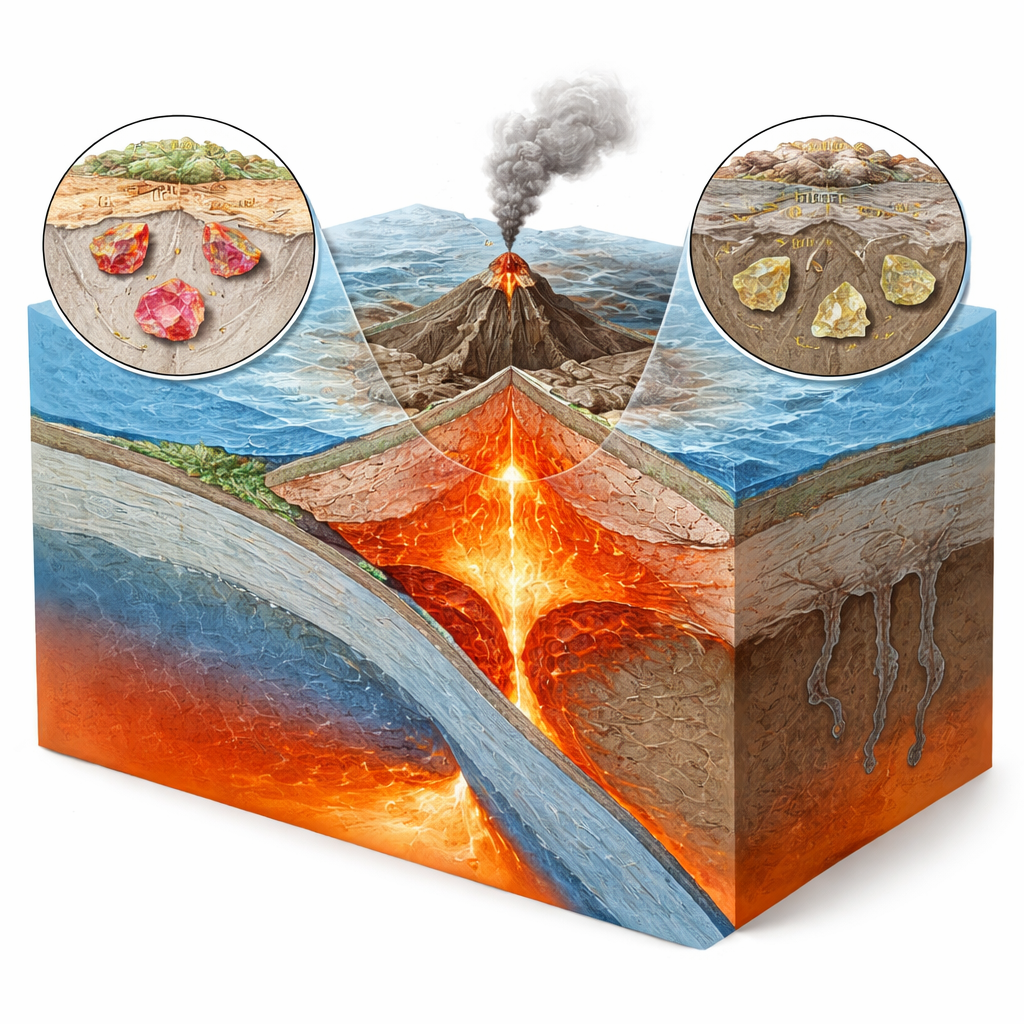
For decades, researchers have debated whether the Hadean Earth was capped by a single, thick, motionless shell of crust—the so-called “stagnant lid”—or whether some kind of subduction and mobile plates already operated. In modern subduction zones, surface rocks and seawater are dragged down into the mantle, generating water-rich magmas that build continental crust. In contrast, a stagnant lid mainly sheds dense, dry drips of lower crust into the mantle, producing far less granitic material. The authors use specific element ratios in zircon, especially combinations involving niobium, scandium, uranium and ytterbium, to distinguish magmas formed in subduction-like continental arcs from those formed above deep mantle plumes or at ocean ridges.
A Tale of Two Ancient Terranes
The Jack Hills zircons reveal a surprisingly strong signal of subduction-like environments in the Hadean. More than 70% of the Jack Hills grains older than 3.8 billion years show chemical ratios typical of continental arc magmas, and nearly half carry another subduction indicator. Their oxygen isotopes are often elevated, implying that surface water had interacted with the rocks before they melted, as happens where oceanic crust is recycled beneath continents. By contrast, Hadean zircons from Barberton more often resemble those from ocean-island settings, linked to deep mantle plumes rather than classic subduction. Only after about 3.8 billion years ago do Barberton zircons show a strong shift toward continent-like, arc signatures.
Stop-and-Go Tectonics on a Young World
Hafnium isotopes in zircon give clues to when fresh material rose from the mantle to form new crust versus when older crust was merely remelted. At Jack Hills, these isotopes point to two major pulses of “juvenile” input, around 4.0 and 3.6 billion years ago, separated by long intervals dominated by crustal recycling. Barberton, in contrast, records a single major switch near 3.8 billion years ago, from long-lived reworking under a mostly stagnant lid to more vigorous input of new mantle-derived magmas. Geodynamic computer models show that such behavior is plausible on a hotter early Earth: patches of subduction could flare up, driven by powerful plumes, then fade back into slower, stagnant regimes, with different styles coexisting in separate regions of the globe.
What This Means for Earth’s Earliest Habitable Surface
To a non-specialist, the key message is that early Earth was neither a frozen, unchanging shell nor a miniature version of today’s plate-tectonic planet. Instead, it was a restless world where some regions already experienced subduction-like recycling of wet surface rocks, building granitic crust and perhaps creating long-lived landmasses, while other regions remained under a thick, mostly immobile lid. This mixed tectonic picture helps explain the varied chemical signals preserved in ancient zircons and suggests that stable continents and habitable environments may have started to form earlier, and in more diverse ways, than previously thought.
Citation: Valley, J.W., Blum, T.B., Kitajima, K. et al. Contemporaneous mobile- and stagnant-lid tectonics on the Hadean Earth. Nature 650, 636–641 (2026). https://doi.org/10.1038/s41586-025-10066-2
Keywords: Hadean Earth, early plate tectonics, Jack Hills zircons, continental crust formation, subduction and stagnant lid