Clear Sky Science · en
Cavity-altered superconductivity
A New Way to Tune Superconductors
Superconductors—materials that conduct electricity without resistance—are usually controlled by changing their chemistry, temperature or pressure. This research explores a very different knob: the invisible electromagnetic “vacuum” that surrounds the material. By reshaping this environment with an ultrathin crystal acting as a built‑in optical cavity, the authors show that it is possible to alter a superconductor’s ground state without shining any external light at all.
Building a Quiet Electromagnetic Cage
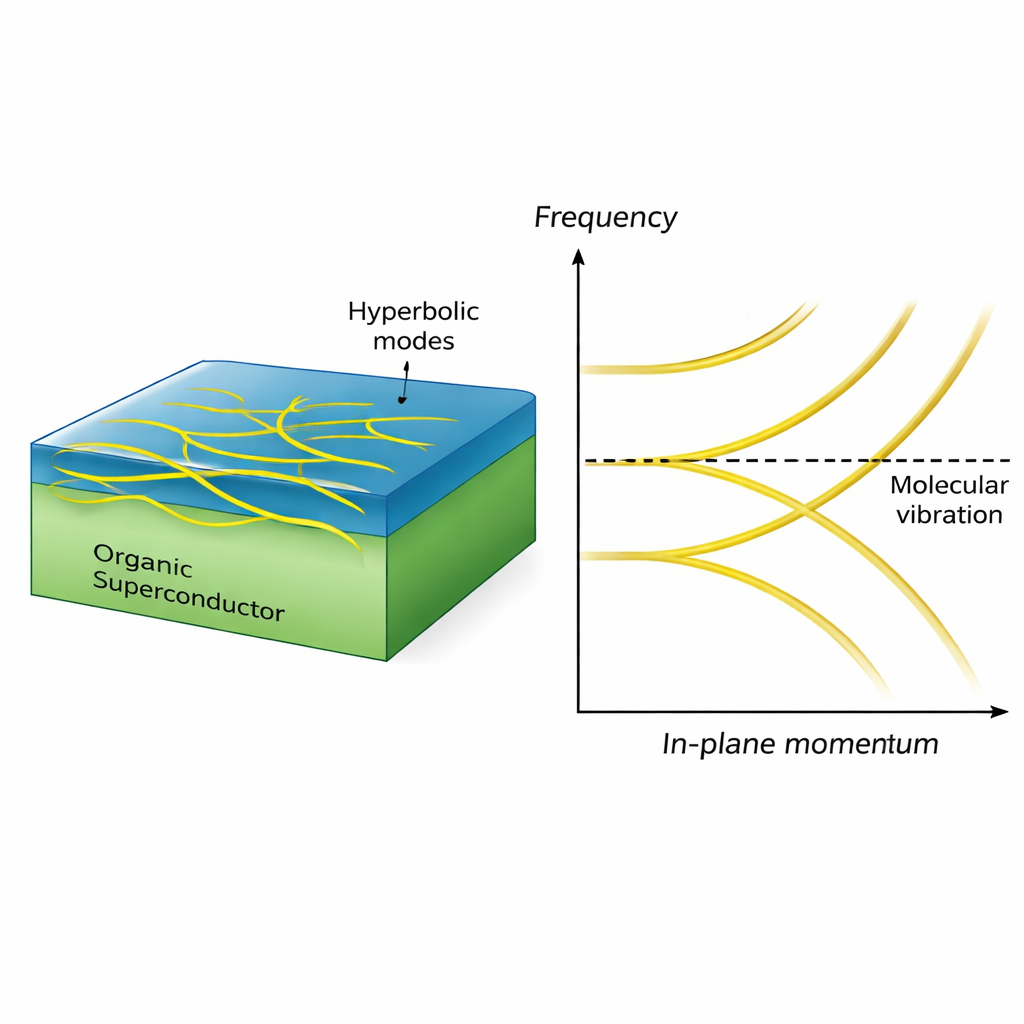
The team studied an organic superconductor known as κ‑ET, which normally becomes superconducting at temperatures below about 11.5 kelvin. On top of this crystal, they placed thin flakes of hexagonal boron nitride (hBN), a layered insulator that, at certain infrared frequencies, behaves as a “hyperbolic” material. In this regime, hBN traps and guides light‑like vibrations called hyperbolic modes, greatly boosting the number of electromagnetic states available in a narrow frequency window. Crucially, those modes line up with a specific carbon–carbon bond vibration in κ‑ET that earlier work had linked to its superconducting behavior.
Seeing Superconductivity Weaken at the Interface
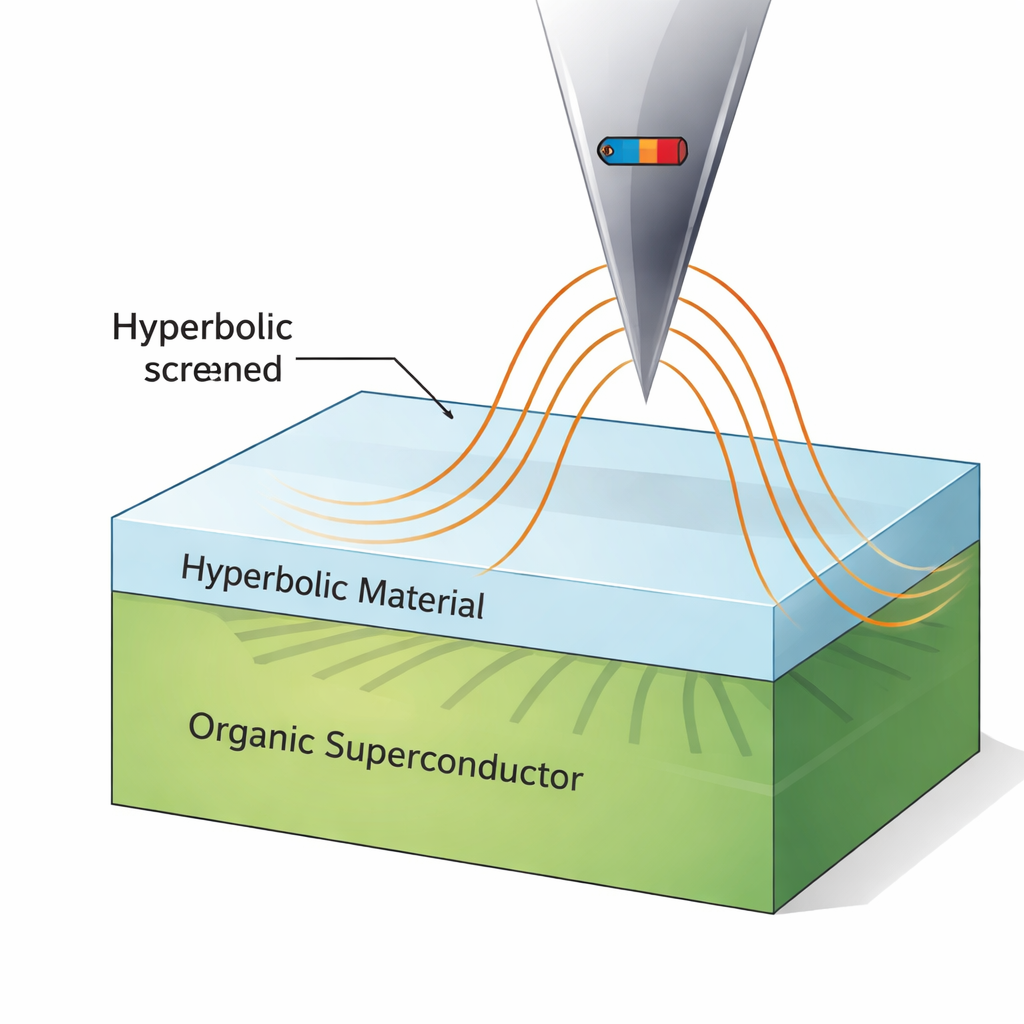
To find out whether this tailored environment actually changed κ‑ET, the researchers used magnetic force microscopy, a technique that senses how strongly a superconductor expels magnetic fields—a direct measure of its “superfluid density,” or the density of paired electrons. They scanned a tiny magnetized tip above regions of bare κ‑ET and regions covered by hBN. Under the hBN, the repulsive force was markedly weaker, corresponding to at least a 50 percent drop in superfluid density, and this suppression persisted across a wide range of hBN thicknesses. When the temperature was raised above the superconductor’s transition temperature, the contrast vanished, confirming that the effect was tied specifically to superconductivity.
Ruling Out Simple Explanations
Could this weakening simply come from adding any insulating overlayer, or from strain or charge transfer at the interface? To test this, the team repeated the experiment with a different material, RuCl₃, which has a similar static dielectric constant to hBN but vibrates at much lower infrared frequencies, far from the carbon–carbon mode in κ‑ET. In this non‑resonant case, the superfluid density was barely affected. They also combined hBN with a different superconductor, BSCCO, whose phonons sit far below the relevant hBN modes; again, no strong suppression was seen. These controls show that the dramatic change arises only when the optical cavity provided by hBN is tuned into resonance with a key molecular vibration in κ‑ET.
Watching Light‑Like Waves Lock to a Molecular Vibration
Next, the authors probed what happens to the electromagnetic waves inside the hBN when it sits on κ‑ET. Using near‑field infrared microscopy, they launched hyperbolic phonon polaritons—guided waves of light and lattice motion—along the hBN and imaged the resulting interference fringes with nanometer resolution. As they swept the infrared frequency, the wavelength of these fringes usually changed smoothly, but showed a clear kink right where the κ‑ET carbon–carbon vibration lies. Calculations of the reflection spectrum at the interface revealed avoided crossings: the polariton branches were interrupted and repelled at the molecular vibration frequency, signaling strong coupling between the confined hyperbolic modes and the κ‑ET vibration even in the absence of external photons.
How Vacuum Fluctuations Reshape a Quantum State
To understand the microscopic origin of this effect, the team performed first‑principles molecular dynamics with an added oscillating electric field mimicking the zero‑point fluctuations of the hyperbolic modes. Because these modes possess an electric field component pointing out of the plane—aligned with the dipole of the carbon–carbon stretch—they can directly drive or suppress that molecular motion. The simulations show that the fluctuating field reduces the amplitude of the vibration and splits its spectral peak, demonstrating that even vacuum‑level fields in the cavity can reshape how the molecules move. In turn, theory suggests that such changes in vibrational behavior can either weaken or enhance superconductivity, depending on the details of how electrons couple to the lattice.
Why This Matters for Future Quantum Materials
In this organic superconductor, the outcome of cavity engineering is a pronounced reduction of superfluid density near the hBN interface—a clear sign that the superconducting ground state has been altered by structuring the surrounding vacuum. Although κ‑ET is an unconventional superconductor and a full theory will require more work, the principle is broad: by stacking van der Waals crystals that host hyperbolic or other strongly confined modes, researchers can create “dark cavities” that reshape a material’s quantum properties without continuous driving. This approach opens a new design space for quantum matter, where electronic phases can be tuned not only by chemistry and geometry, but also by the engineered emptiness around them.
Citation: Keren, I., Webb, T.A., Zhang, S. et al. Cavity-altered superconductivity. Nature 650, 864–868 (2026). https://doi.org/10.1038/s41586-025-10062-6
Keywords: cavity quantum materials, superconductivity, hyperbolic phonon polaritons, van der Waals heterostructures, hexagonal boron nitride