Clear Sky Science · en
Spin-wave band-pass filters for 6G communication
Why future phones need better "traffic cops" for radio waves
Every text message, video call and smart sensor relies on tiny components that decide which radio signals get through and which are blocked. As wireless networks move toward 6G, they will use higher frequencies and far wider channels than today, putting intense pressure on these microscopic “traffic cops,” called band-pass filters. This paper introduces a new kind of filter based on spin waves in magnetic materials that could shrink hardware, cut power loss and make radios far more flexible.
A growing crowd on the airwaves
Modern wireless systems already juggle smartphones, Wi‑Fi, cars, satellites and the Internet of Things. To support faster data rates, upcoming 5G FR3 bands and 6G proposals plan to use frequencies from about 7 to 24 gigahertz, with channel widths of hundreds of megahertz or more. Today’s phones handle different bands by packing in well over a hundred fixed-frequency filters. Scaling that approach to 6G would make devices bulkier, more complex and more expensive. Engineers therefore want filters that can tune across many bands, stay compact, pass wide chunks of spectrum and still strongly block unwanted signals from neighboring channels.
Using ripples of magnetism instead of sound
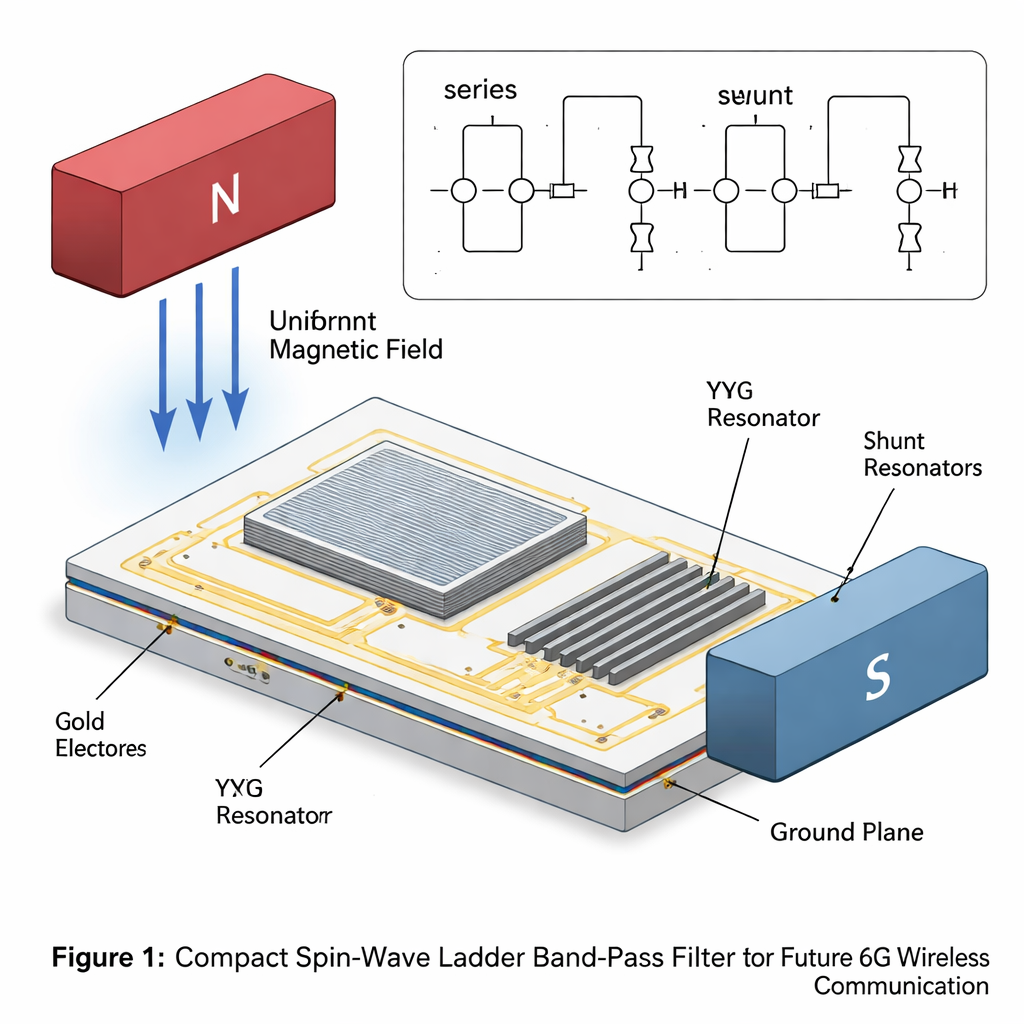
The authors build their tunable filters using spin waves—tiny ripples in the magnetic state of a material—travelling through thin films of yttrium iron garnet (YIG). Unlike conventional acoustic filters that use vibrations in crystals, these spin-wave devices can be tuned simply by changing an external magnetic field. Spin waves have wavelengths shorter than radio waves but longer than sound waves, allowing substantial miniaturization without sacrificing high-frequency operation. Importantly, key performance measures of spin-wave resonators actually improve at higher frequencies, which matches the needs of future mid-band 5G and 6G systems.
Smart geometry for a single magnetic "knob"
A central challenge is building a practical “ladder” filter, a proven architecture that combines series and shunt resonators to form a clean passband with strong rejection elsewhere. Typically this would require two different magnetic fields to shift the resonances apart, complicating packaging and wasting space. The team instead sculpts the YIG into two distinct shapes: a wide rectangular mesa for the series resonator and an array of narrow fins for the shunt resonators, all sitting above a carefully positioned metal ground plane. Because the magnetic behavior depends strongly on geometry, these structures naturally resonate at different frequencies even under the same magnetic bias. Advanced micromachining of the supporting gadolinium gallium garnet (GGG) substrate lets the ground plane sit just 10 micrometers below the YIG, boosting coupling and keeping loss low across many devices on a chip.
Wide tuning and clean signals across 7–22 gigahertz
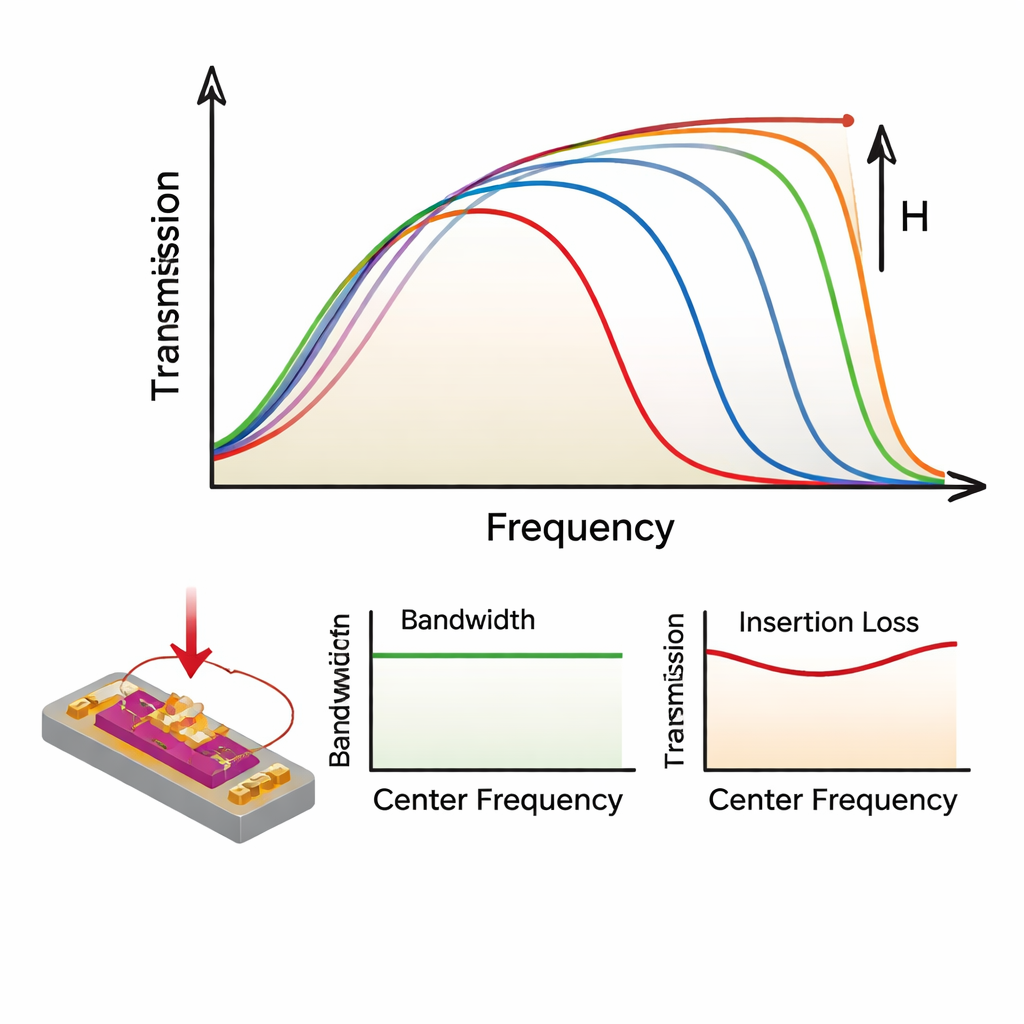
The fabricated filters, smaller than two square millimeters, achieve bandwidths up to 663 megahertz—comfortably in the range needed for 5G FR3 and many proposed 6G channels—while showing insertion loss as low as 2.54 decibels. By sweeping a single out‑of‑plane magnetic field, the same filter can shift its center frequency from 7.08 to 21.6 gigahertz, spanning more than two octaves, with nearly constant absolute bandwidth. The authors also report strong suppression of unwanted extra passbands, good rejection of out‑of‑band signals and high linearity, meaning the filter handles stronger signals without distortion. A higher-order version with more resonator stages further improves blocking of nearby interference at the cost of somewhat higher loss.
A test drive in a tunable radio
To show real-world relevance, the researchers insert their spin-wave filter into a prototype frequency‑agile radio. A digital data stream, encoded using quadrature amplitude modulation, is sent through a noisy channel while the radio continuously hops its operating frequency between 8 and 18 gigahertz. The magnetic field that tunes the filter is swept in sync with the radio’s local oscillator so that the passband always follows the desired channel. Even when the team injects a strong interfering signal only 300 megahertz away, the filter sufficiently suppresses the unwanted energy, allowing the receiver to recover clean eye diagrams and constellation plots that represent accurate data reception.
What this means for everyday wireless devices
In simple terms, this work shows that tiny magnetic structures can act as highly selective, tunable gates for radio signals across a wide range of frequencies relevant to 5G and 6G. Because a single spin-wave ladder filter can replace many fixed filters and still fit in a very small footprint, it points toward slimmer, more power‑efficient front-ends in future phones, base stations and satellite links. Further improvements in packaging and magnet design are still needed, but the approach offers a promising path to radios that can quickly dodge interference and share crowded airwaves more intelligently.
Citation: Devitt, C., Tiwari, S., Zivasatienraj, B. et al. Spin-wave band-pass filters for 6G communication. Nature 650, 599–605 (2026). https://doi.org/10.1038/s41586-025-10057-3
Keywords: 6G filters, spin waves, tunable RF devices, wireless communication, YIG resonators