Clear Sky Science · en
Bandwidth-tuned Mott transition and superconductivity in moiré WSe2
Why twisting ultra-thin crystals could unlock warmer superconductors
Superconductors—materials that conduct electricity with zero resistance—usually work only at extreme cold, limiting their use in everyday technologies. This paper shows how carefully twisting two atomically thin sheets of the semiconductor tungsten diselenide (WSe2) creates a highly controllable playground where superconductivity, magnetism and unusual metallic behavior all appear side by side. By dialing simple knobs such as twist angle and electric field, the authors mimic the behavior of much more complex high‑temperature superconductors, offering a cleaner window into one of physics’ hardest puzzles.
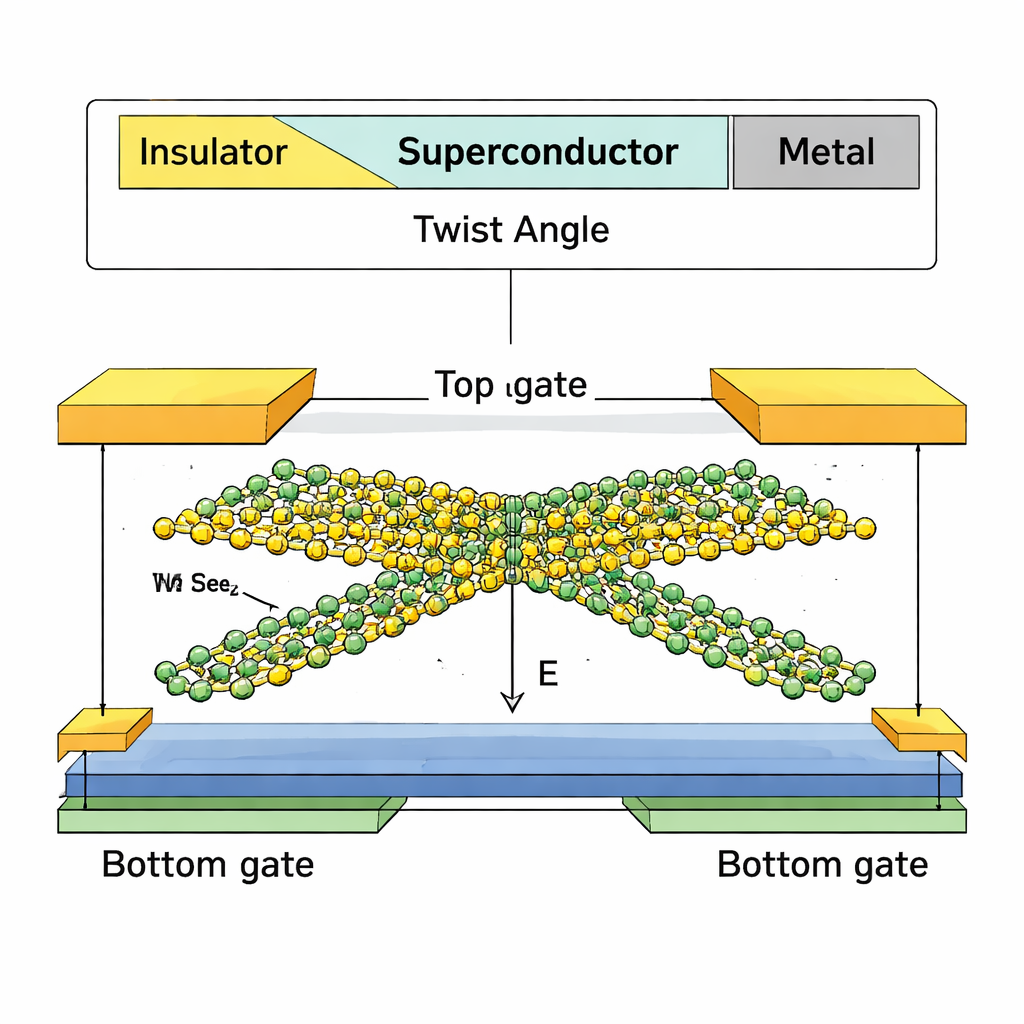
Building a designer crystal with a twist
When two single-atom-thick WSe2 layers are stacked with a slight rotation, their atomic grids form a large-scale interference pattern called a moiré lattice. Electrons moving in this patterned landscape behave as if they live on a regular grid where they hop between sites and repel each other strongly—exactly the situation captured by the famous Hubbard model used to study high‑temperature superconductors. Here, the researchers fabricate ultra‑clean “twisted bilayer” devices and place them between metal gates. By choosing a twist angle of about 4.6 degrees and applying voltages to the gates, they can tune both how easily electrons move (the bandwidth) and how many electrons occupy each moiré cell, all in a single chip‑scale structure.
From electrical maps to an electronic phase diagram
The team systematically measures how the electrical resistance of these twisted bilayers changes with temperature, carrier density and an applied vertical electric field. At extremely low temperatures—down to about 0.05 kelvin—they map out where the system behaves as an insulator, a superconductor or a metal. Near the point where there is on average one missing electron (one “hole”) per moiré cell, they find a robust insulating state that disappears when the twist angle is increased or the electric field is tuned too far. The sweet spot lies in a “moderately correlated” regime where the energy cost of crowding electrons together is comparable to their kinetic energy. In this regime, narrow superconducting “domes” appear on both the electron‑doped and hole‑doped sides of the insulator, closely echoing the iconic phase diagrams of copper‑oxide superconductors.
Magnetism and strange metals in a flat landscape
To uncover what kind of insulator forms at one hole per moiré site, the authors use sensitive optical probes that track how the material responds to circularly polarized light in a small magnetic field. The data show a clear signature of antiferromagnetism: neighboring electron spins tend to point in opposite directions below a characteristic Néel temperature of a few kelvin. As the material is slightly doped away from this point, the magnetic order weakens but does not immediately vanish, giving rise to metallic states with a small “Fermi surface,” meaning only a small fraction of available electronic states carry current. In certain doping and field ranges, the resistivity grows exactly in proportion to temperature over a huge window, and related quantities follow simple power laws. These features mark a “strange metal” regime where the usual quasiparticle picture of electrons fails.
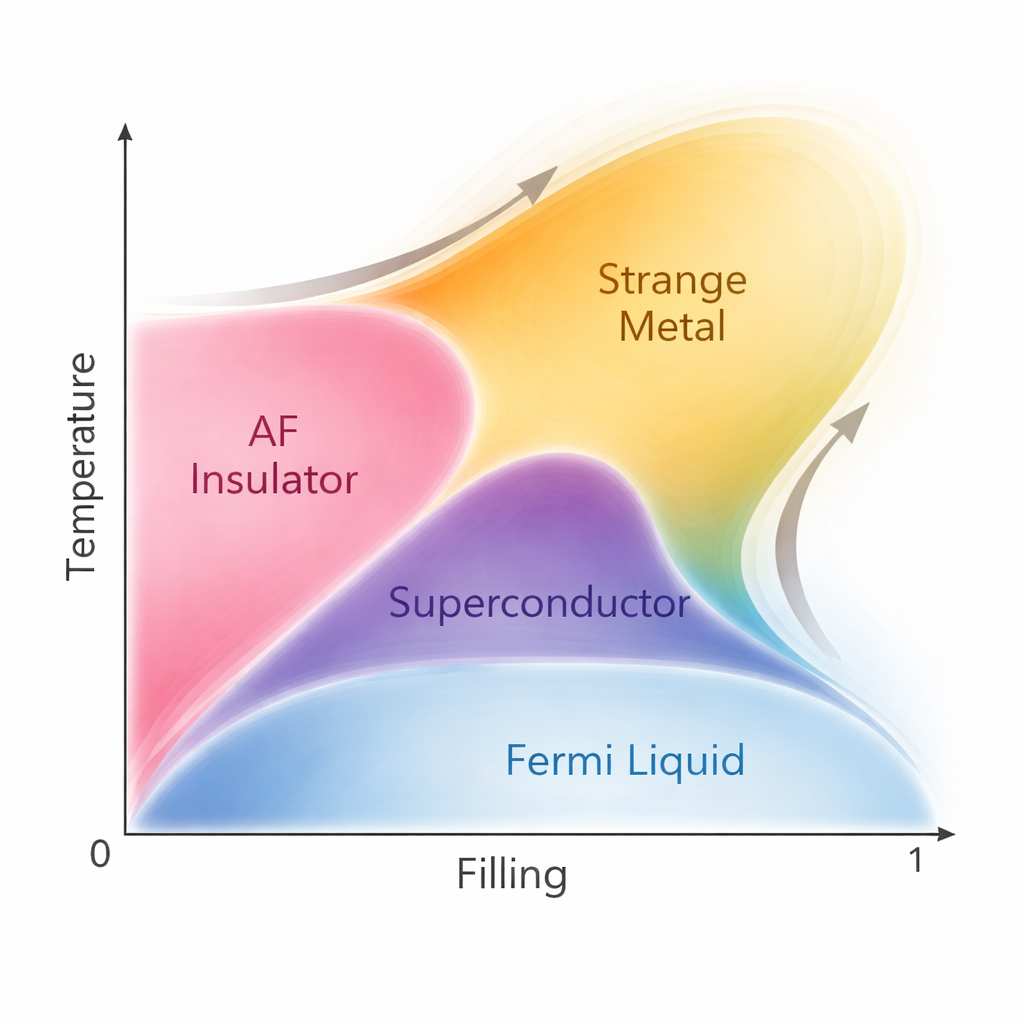
Watching superconductivity grow out of a Mott transition
By sweeping the vertical electric field, the researchers drive the system through a bandwidth‑controlled Mott transition: the antiferromagnetic insulator at one hole per cell gradually gives way to a correlated metal. As this transition is approached from the insulating side, the magnetic ordering temperature steadily decreases, while the maximum superconducting temperature rises, and the superconducting domes widen. Right at the critical field, the ratio of the superconducting temperature to the effective Fermi temperature—a standard measure of how “strong” a superconductor is—matches that of many unconventional high‑Tc materials. Across this evolution, abrupt jumps in Hall carrier density reveal sudden reconstructions of the electronic states, closely tied to the peaks of the superconducting domes.
What this means for future superconductors
In plain terms, this work shows that twisting two atomically thin semiconductor sheets creates a clean, tunable model system where superconductivity reliably appears right next to a transition from an electron‑frozen (Mott insulating) state to a metal. Because the behavior closely matches long‑standing theoretical expectations from the Hubbard model, yet is far easier to control than traditional complex crystals, twisted WSe2 emerges as a powerful test bed for ideas about high‑temperature superconductivity and strange metals. Insights from this platform could guide the design of new materials that superconduct at higher temperatures and in more practical conditions.
Citation: Xia, Y., Han, Z., Zhu, J. et al. Bandwidth-tuned Mott transition and superconductivity in moiré WSe2. Nature 650, 585–591 (2026). https://doi.org/10.1038/s41586-025-10049-3
Keywords: twisted bilayer WSe2, moiré superconductivity, Mott transition, antiferromagnetic insulator, strange metal