Clear Sky Science · en
Rising atmospheric CO2 reduces nitrogen availability in boreal forests
Why forest nutrients matter to all of us
Forests are often celebrated for pulling planet-warming carbon dioxide out of the air. But trees need more than carbon to grow. Like crops in a field, they also depend on nutrients—especially nitrogen—in the soil. This study asks a deceptively simple question with far-reaching implications: as atmospheric carbon dioxide keeps rising, are the world’s northern, boreal forests running short on nitrogen, and could that shortage eventually weaken their role as a brake on climate change?
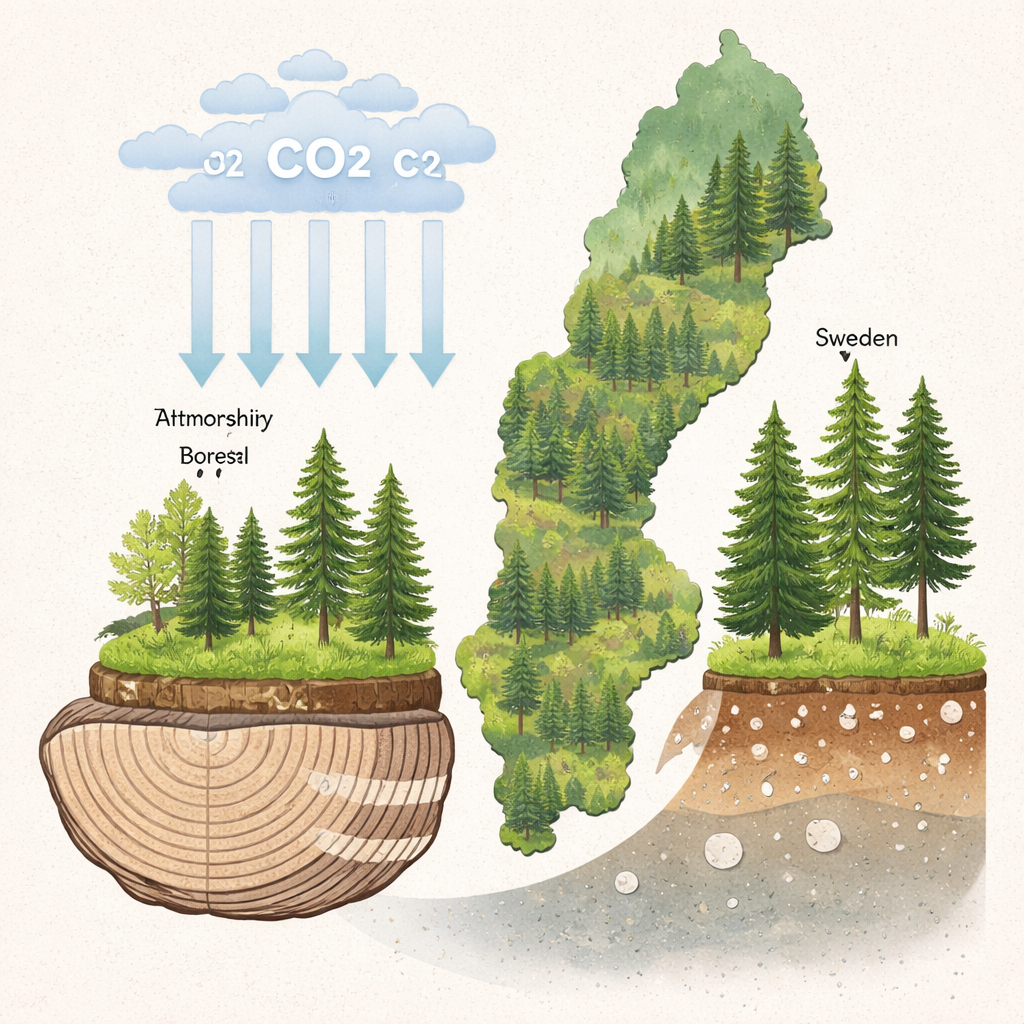
Tracing history inside tree rings
To answer this, researchers turned to an unusual archive: thousands of tree cores collected over decades by Sweden’s National Forest Inventory. Each core is a narrow cylinder drilled from a tree trunk, preserving rings that record year-by-year growth. The team analysed more than 1,600 cores from two common boreal species—Scots pine and Norway spruce—covering forests across Sweden from the 1950s to the 2010s. Instead of measuring growth alone, they focused on a chemical fingerprint in the wood, the ratio of two forms of nitrogen. This ratio, written as δ15N, shifts in a consistent way when nitrogen in the ecosystem becomes more or less available, allowing the scientists to reconstruct the history of forest nitrogen status over nearly seven decades.
A nationwide signal of thinning nitrogen
Sweden is especially well suited to disentangle the forces at play. From north to south, the country spans a fourfold gradient in nitrogen pollution from the air, driven largely by human activities such as fossil fuel burning and fertilizer use. By contrast, carbon dioxide in the atmosphere is almost uniform across this region. If declining nitrogen in forests were mainly due to changing nitrogen pollution, the δ15N trends should differ strongly between heavily and lightly polluted areas. Instead, the researchers found that δ15N in tree rings declined over time in all four Swedish regions, including the far north where nitrogen deposition has always been very low and relatively stable. This widespread downward shift points to a driver that acts everywhere at once—rising carbon dioxide—rather than local pollution changes alone.
Testing rival explanations
To probe the causes more rigorously, the team used statistical models that related tree-ring δ15N to several environmental factors: atmospheric carbon dioxide, different measures of nitrogen deposition, temperature, and forest structure. Across many model variants, carbon dioxide consistently emerged as the strongest predictor of δ15N, with a clearly negative relationship: as carbon dioxide increased, δ15N in wood decreased. Nitrogen deposition and temperature did play detectable roles, but their influence was much weaker. Notably, a proposed explanation based on shifts between different chemical forms of airborne nitrogen—ammonium versus nitrate—was not supported by the data. These results strengthen the case that rising carbon dioxide is directly tightening the nitrogen cycle in boreal forests, rather than simply masking the effects of cleaner air laws.
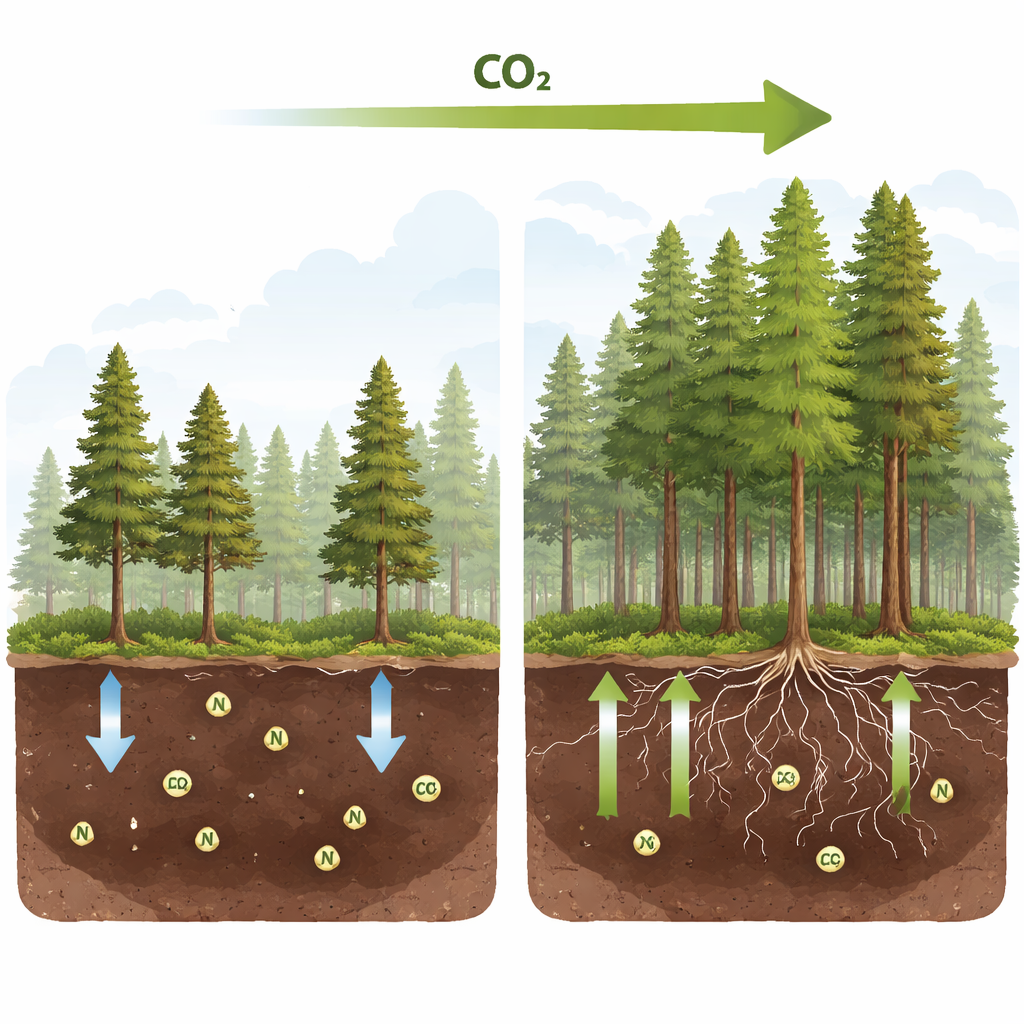
How more carbon can mean less nitrogen
The study also looked at how changes in forest growth relate to nitrogen status. National inventory data show that Swedish pine and spruce forests have grown faster since the 1950s, accumulating more wood each year. When the authors compared these growth trends to δ15N, they found that plots with the strongest increases in growth tended to show the largest declines in δ15N, consistent with the idea of “progressive nitrogen limitation.” In everyday terms, extra carbon dioxide acts like a temporary fertilizer for photosynthesis, encouraging trees to grow and demand more nitrogen. Over time, this heightened demand can outstrip the nitrogen that naturally becomes available in the soil. Trees may respond by investing more sugars into their root partners—mycorrhizal fungi—which help them mine organic nitrogen from deeper or more resistant pools. This strategy keeps growth going for a while, but it also locks more nitrogen into biomass and fungal tissue, reducing the amount left over in the soil and streams.
What this means for the climate future
Because boreal forests hold a disproportionately large share of the world’s land carbon, their long-term response to rising carbon dioxide will shape how much of our emissions stay in the atmosphere. This research shows that as carbon dioxide climbs, nitrogen in these forests is quietly becoming scarcer, even in places far from industrial pollution. The authors conclude that declining nitrogen availability—signalled by falling δ15N in tree rings—will increasingly limit how much extra carbon boreal forests can absorb. For a layman, the message is straightforward: we cannot count on northern forests to soak up ever more of our emissions. Their growth spurt under higher carbon dioxide comes with a hidden nutrient cost, making it all the more urgent to reduce greenhouse gas emissions at the source rather than relying on forests alone to bail us out.
Citation: Bassett, K.R., Hupperts, S.F., Jämtgård, S. et al. Rising atmospheric CO2 reduces nitrogen availability in boreal forests. Nature 650, 629–635 (2026). https://doi.org/10.1038/s41586-025-10039-5
Keywords: boreal forests, carbon dioxide, nitrogen limitation, tree rings, global carbon cycle