Imagine being able to build working machines smaller than a grain of sand—valves, filters and even tiny robots—by steering clouds of nanoparticles with a beam of light. This paper introduces a new way to "print" such three-dimensional micro- and nanostructures from many different materials, overcoming long‑standing limits in how we make devices at these tiny scales.
Why Current Tiny 3D Printing Falls Short
Today’s finest 3D “nanoprinters” rely mostly on special plastics that harden when hit by a tightly focused laser. This method, called two-photon polymerization, can draw incredibly delicate shapes, but it works best only with tailor‑made light‑sensitive polymers. Turning metals, ceramics or quantum dots into similar printing inks is possible but complicated, and each material typically needs its own custom chemistry. As a result, engineers who want miniature lenses, catalysts or microrobots often have to compromise on the material that would work best.
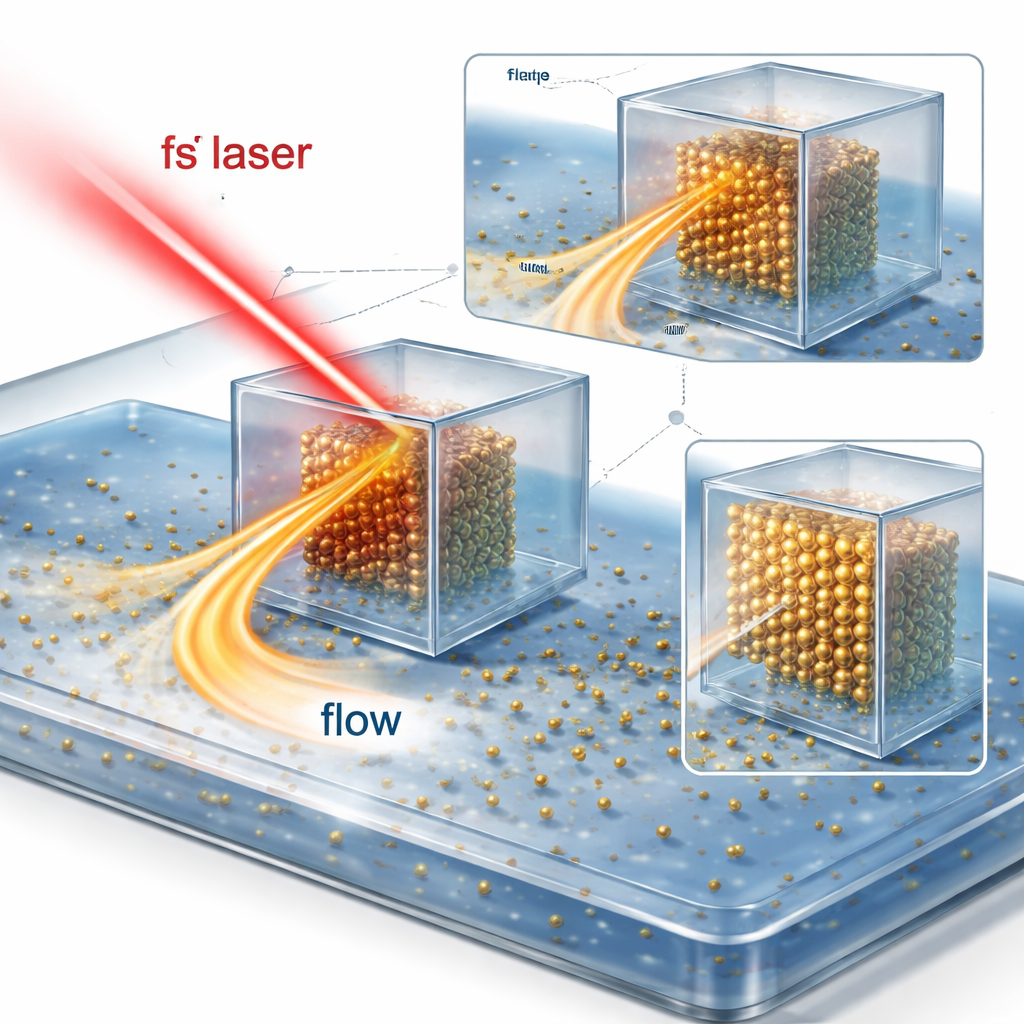
Using Light-Driven Flow as a Nano-Broom Figure 1.
The authors combine the strengths of existing 3D printers with a new physical trick. First, they use a standard laser printer to create an empty "shell"—a hollow polymer template shaped like a cube, gourd, valve or robot frame, with one or more openings. This shell sits in a liquid full of floating nanoparticles. A very short, intense laser pulse is then focused near an opening. The spot heats the liquid locally, setting up sharp temperature differences that stir the fluid. This light‑driven flow acts like a microscopic broom, sweeping vast numbers of particles into the hollow template where they gradually pack together and solidify into the template’s three‑dimensional shape. Finally, the polymer shell is gently removed, leaving behind a free‑standing structure made purely of the chosen material.
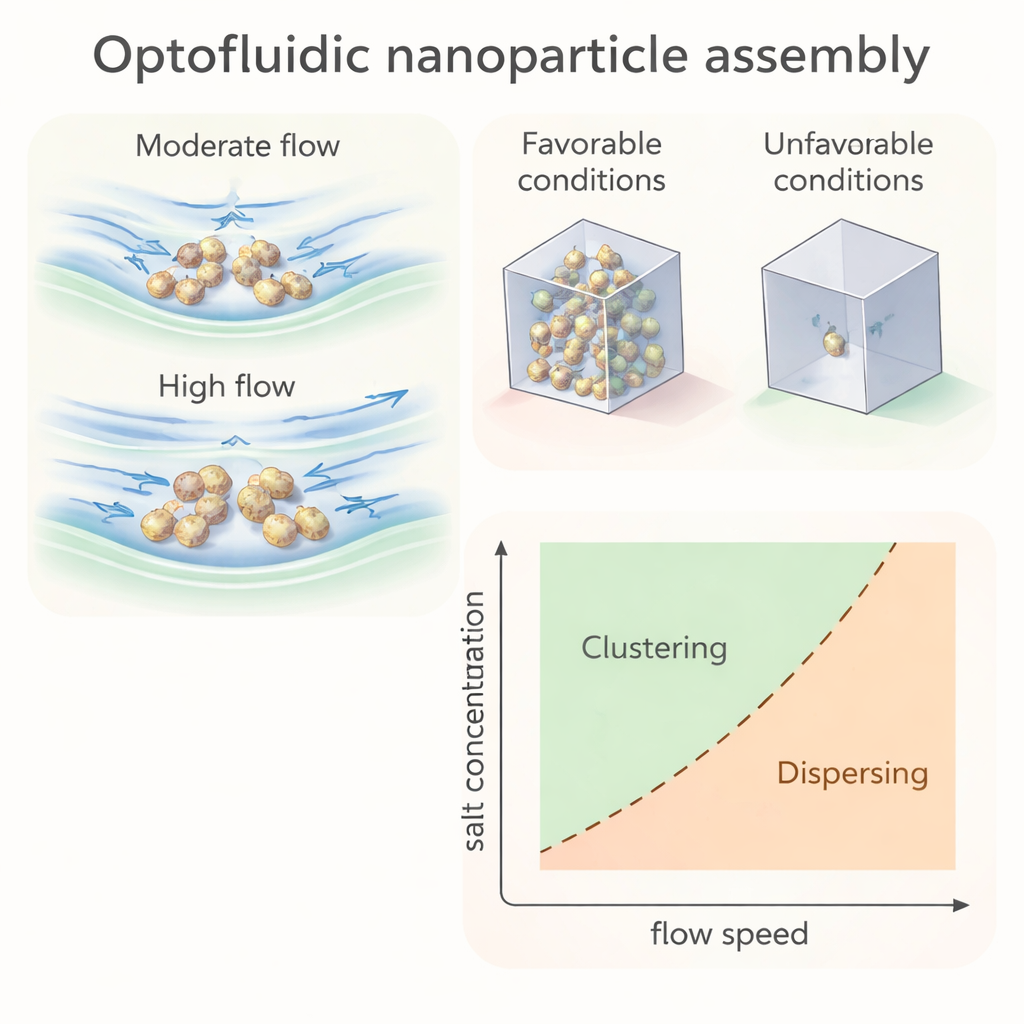
Balancing Forces to Make Particles Stick Figure 2.
At these scales, whether particles clump or drift apart depends on a tug‑of‑war between attraction, repulsion and the push of the surrounding liquid. The researchers show that by adjusting simple factors—such as the amount of salt in water, the choice of solvent, the laser power and the scanning speed—they can tip this balance. More salt or certain oils weaken the natural repulsion between particles, helping them stick together into stable clusters. Too much flow, however, pulls them apart. The team maps out where clustering occurs versus where particles stay dispersed, and demonstrates that surfactant molecules (similar to those in soap) can fine‑tune surface tension and bubble formation so the flow is strong enough to feed the template but not so violent that it tears clusters apart.
From Cubes and Letters to Filters and Microrobots
Because this approach relies on general physical effects rather than special chemistry, it works with many ingredients: silica, metal oxides, diamond nanoparticles, silver, magnetic iron oxide and even glowing quantum dots. The team builds intricate shapes such as screws with nanoscale threads, alphabet letters and multi‑material blocks. They then turn these into working devices. In one example, they embed a particle‑built, sponge‑like microvalve inside a narrow channel. Liquid flows through quickly, but nanoparticles are held back and concentrated at one side, enabling size‑selective sieving and enrichment. In another, they assemble microrobots that combine materials responding to magnets, light and chemical fuel, allowing them to roll, rotate or swim along different paths depending on the stimulus.
What This Means for Future Tiny Technologies
For non‑experts, the key message is that the authors have turned a focused laser and a particle‑filled liquid into a kind of universal micro‑construction kit. Instead of inventing a new ink for every new material, they use light‑driven flow inside pre‑printed templates to gather almost any kind of nanoparticle into solid 3D shapes. This greatly widens the menu of materials available for miniature devices. In the future, the same strategy could help create more powerful tiny sensors, advanced optical components, catalytic reactors on a chip and swarms of smart microrobots, all built from the materials best suited to the job rather than from whatever happens to be easy to print.
Citation: Lyu, X., Lei, W., Gardi, G. et al. Optofluidic three-dimensional microfabrication and nanofabrication.
Nature650, 613–620 (2026). https://doi.org/10.1038/s41586-025-10033-x
Keywords: 3D microfabrication, nanoparticle assembly, optofluidics, microrobots, microfluidic devices