Clear Sky Science · en
Rock art from at least 67,800 years ago in Sulawesi
Hands Reaching Out from the Deep Past
On a limestone island in Indonesia, faint red handprints on a cave wall have turned out to be among the oldest artworks ever found on Earth. By showing that people were painting at least 67,800 years ago in Sulawesi, this study doesn’t just rewrite the history of art; it also sharpens our picture of how our species first braved the seas to reach Australia and New Guinea.
Island Caves and Ancient Artists
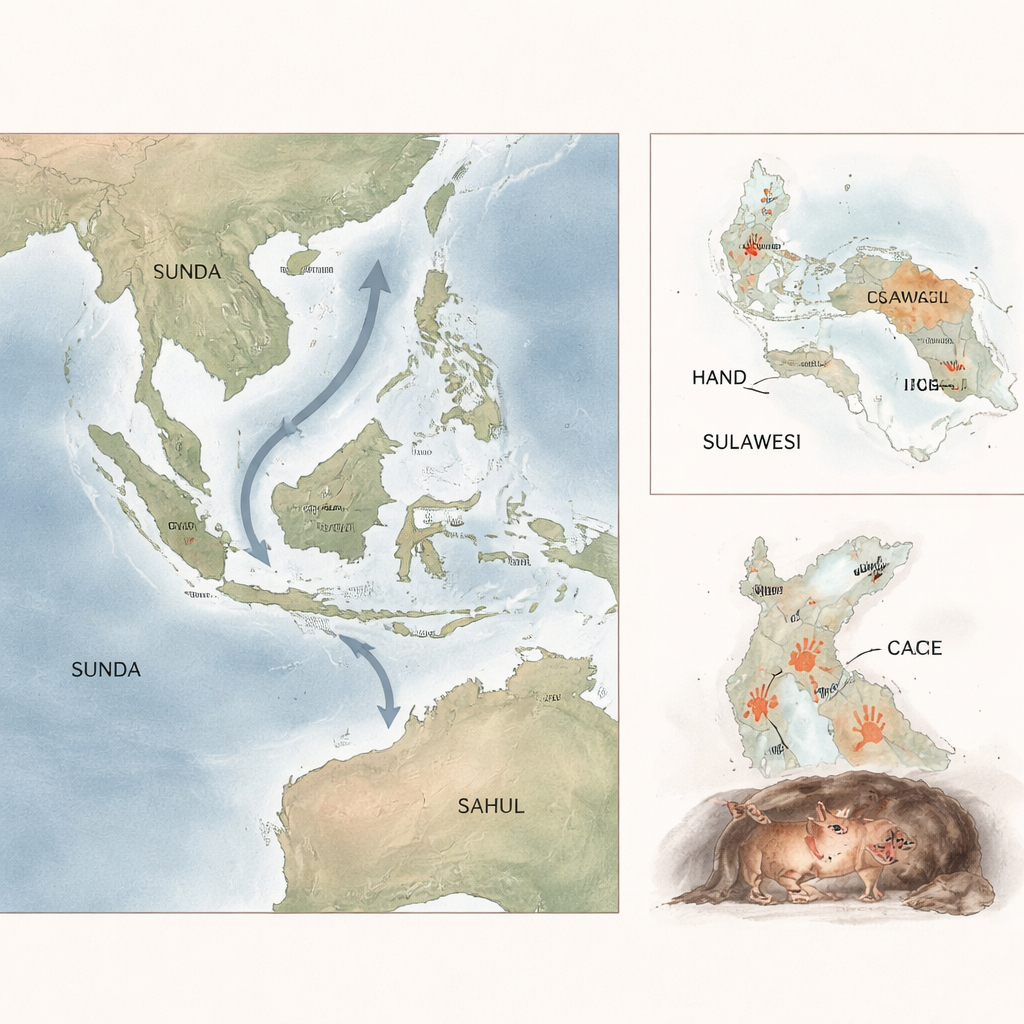
The research focuses on rock art in caves and rock shelters in Southeast Sulawesi, a rugged part of Indonesia that sits between mainland Asia and the ancient continent of Sahul (the combined landmass of Australia and New Guinea during the Ice Age). Until recently, our best early cave paintings from this region came from another part of Sulawesi and from Borneo, dating back a little over 50,000 years. The new work extends this record dramatically. Surveying 44 cave sites, the team documented hand stencils, human and animal figures, and simple geometric shapes painted on the walls. Hand stencils are made when an artist places a hand on the rock and blows or spits pigment around it, leaving a ghostly negative image.
Reading Time in Stone
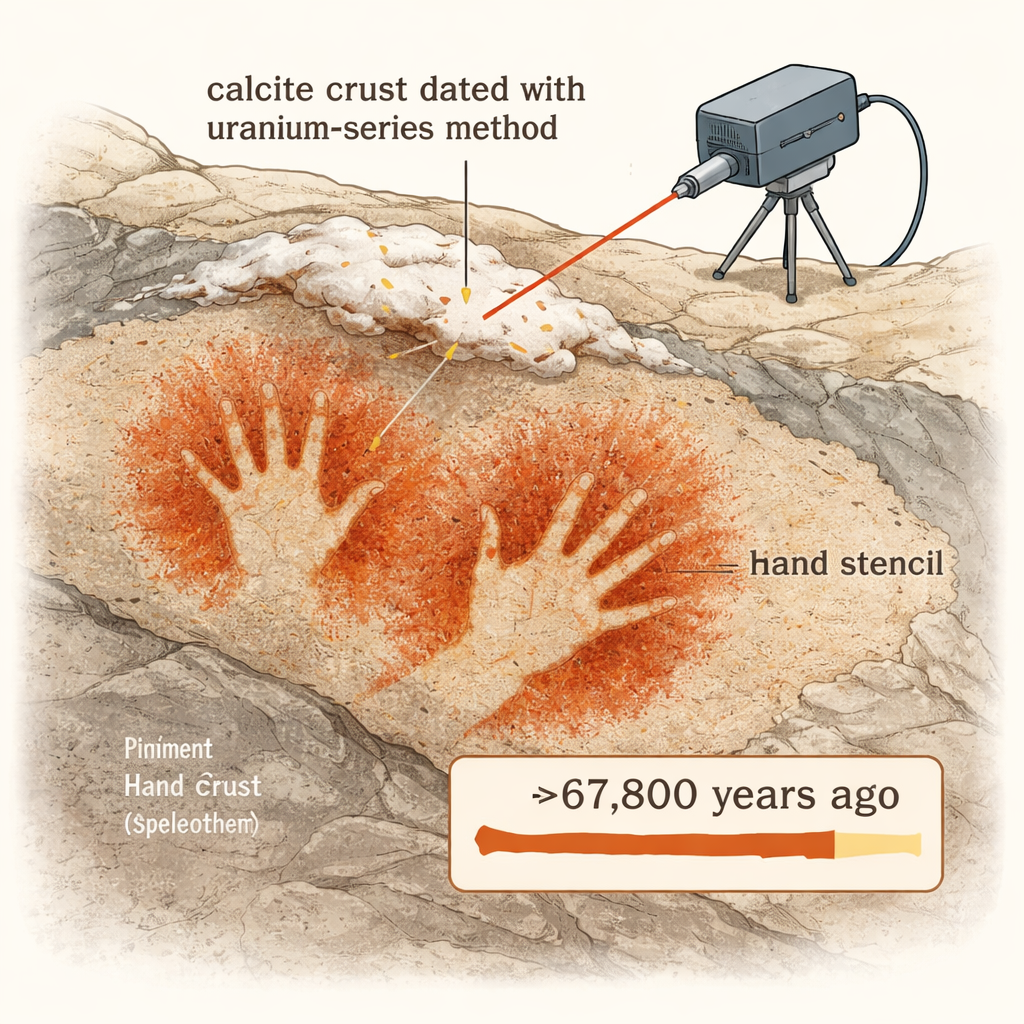
Dating such paintings is notoriously difficult, because you can’t easily test the paint itself without destroying it. Instead, the researchers took advantage of thin layers of calcite—natural mineral crusts—that had slowly formed on top of the art. Using a laser-based uranium-series technique, they measured how much uranium in the calcite had decayed into thorium. Because this decay happens at a known rate, the ratio acts like a clock, revealing when the mineral crust grew. Any painting beneath that crust must be at least as old as the crust itself, giving a firm minimum age.
The Oldest Known Cave Art by Our Species
The star of the study is a badly eroded red hand stencil in Liang Metanduno cave on Muna Island, Southeast Sulawesi. Only part of the hand survives, but a calcite growth covering it gave a minimum age of about 67,800 years. A neighboring stencil on the same panel records at least two separate painting episodes tens of thousands of years apart, one older than 60,000 years and a later one around 20,000 years. These ages beat the previous record for rock art in Sulawesi by more than 16,000 years and edge out a controversial 66,700-year-old hand stencil in Spain that some researchers attribute to Neanderthals. The Sulawesi examples almost certainly belong to our own species, Homo sapiens, in part because one stencil shows deliberately narrowed fingers, suggesting a level of playful or symbolic experimentation familiar from later human art.
Tracing the First Sea Voyages
The dating results also carry a bigger message about human migration. Archaeological finds in northern Australia show that people had reached Sahul by around 65,000 years ago. To get there from Asia, they had to cross a chain of islands known as Wallacea, undertaking repeated sea journeys that were planned rather than accidental. Models of Ice Age geography and climate have long suggested a “northern route” from Borneo through Sulawesi toward New Guinea, and a more southerly path via Java and Timor. Until now, however, there was a puzzling archaeological gap between early sites in Sumatra and Australia. The newly dated hand stencils from Southeast Sulawesi plug part of that gap and provide the earliest direct evidence of modern humans living in Wallacea along the northern route.
A Creative Legacy Carried Across the Sea
For non-specialists, the key takeaway is simple: by the time our ancestors were bold enough to sail across open water toward Australia, they were already accomplished artists. The Sulawesi hand stencils show that people carried a rich symbolic culture with them as they moved, decorating cave walls while they navigated unfamiliar coasts and islands. Far from being a sudden “creative explosion” in Ice Age Europe, the roots of human art and imagination reach back earlier and spread far wider, leaving quiet traces of red hands on the walls of tropical caves.
Citation: Oktaviana, A.A., Joannes-Boyau, R., Hakim, B. et al. Rock art from at least 67,800 years ago in Sulawesi. Nature 650, 652–656 (2026). https://doi.org/10.1038/s41586-025-09968-y
Keywords: cave art, human migration, Sulawesi, Ice Age, hand stencils