Clear Sky Science · en
Plastic landmark anchoring in zebrafish compass neurons
How a Tiny Fish Keeps Its Inner Compass Straight
Finding our way through the world depends on an internal sense of direction, a kind of brain-based compass. This study looks at how that compass works in one of nature’s simplest vertebrates: the larval zebrafish. By watching individual brain cells as the fish experience a wrap‑around virtual world, the researchers reveal how vision teaches the brain which way is “north,” and how that mapping can flexibly change with experience.
A Brain Compass in Miniature
Many animals, including humans, have “head‑direction” cells—neurons that are most active when the head points a particular way, like ticks on a compass dial. In larval zebrafish, these cells sit in a small region of the hindbrain and are arranged so that their activity forms a single moving “bump” around a ring: as the fish turns, the bump slides around, tracking heading. The team used two‑photon microscopy to record these cells while the fish were held still but allowed to move their tails, which controlled the rotation of a panoramic visual scene projected on three walls around them. This setup immersed the fish in a virtual 3D world that covered most of their upper field of view, where natural landmarks like the sun would appear. 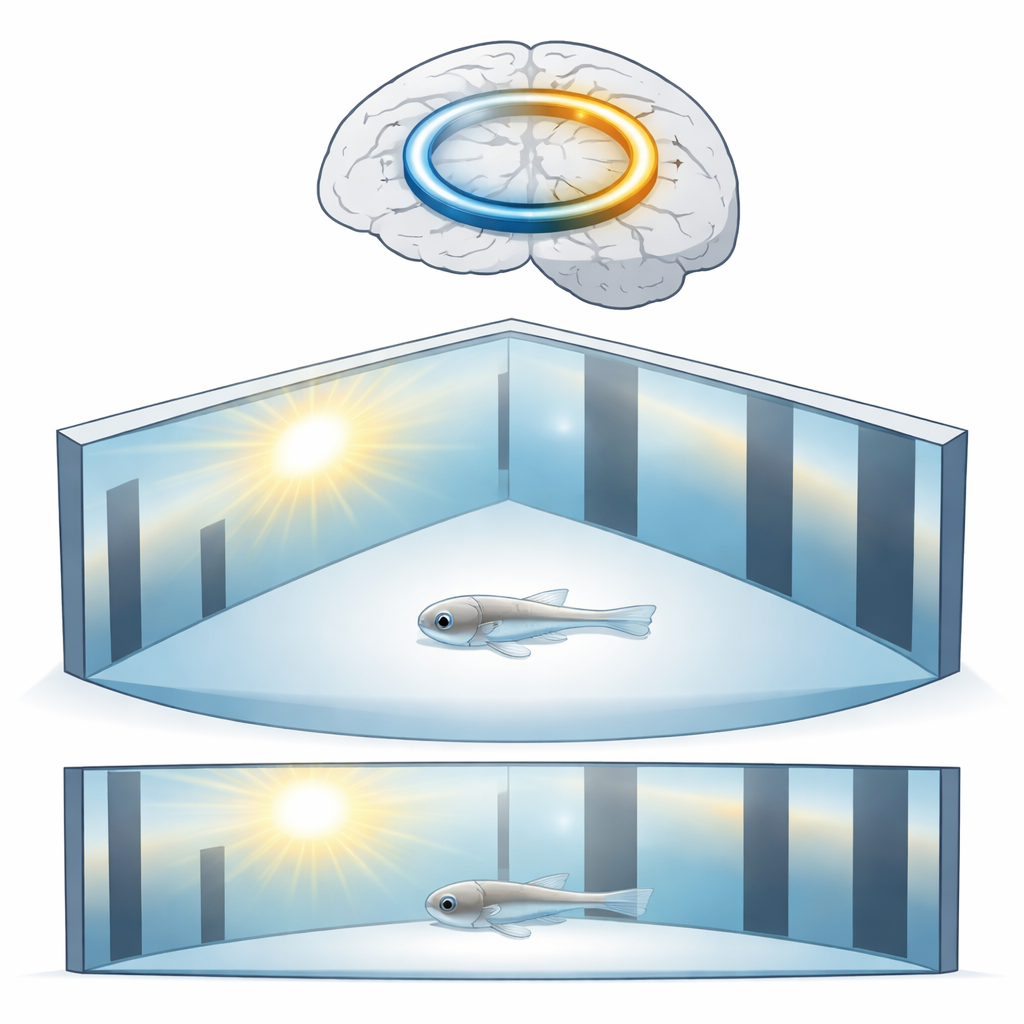
Vision Trains and Steers the Compass
When the researchers showed a scene containing a bright “sun” and dark vertical bars, the head‑direction cells reliably aligned their bump of activity with the orientation of the visual world. The same group of cells could also track other scenes, such as one with irregular “Stonehenge‑like” pillars, and they worked best when landmarks were in the upper part of the visual field, echoing how real fish rely on sky cues. By suddenly jumping the scene or replacing landmarks with a featureless rotating pattern, the team showed that the compass uses both static landmarks and the motion of the visual world (optic flow). Landmarks help pin the bump to a specific direction, while optic flow helps move it as the fish “turns,” even when those turns are only implied by moving dots on the screens.
When the World Becomes Ambiguous
To probe how flexible this mapping is, the scientists played a trick on the compass. First, they showed a single “sun” so that one particular sky position matched one particular bump position. Then they switched to a strange world with two identical suns on opposite sides of the fish. In this symmetric scene, the same pattern of visual input could mean “facing east” or “facing west.” As predicted by simple learning models, this broke the unique link between landmark and heading: after experiencing the two‑sun world, the bump no longer stayed tightly locked to a single direction even when the fish returned to a single sun. Closer inspection revealed something even more striking: during the symmetric scene, the head‑direction cells effectively “stretched” their mapping so that only 180 degrees of visual space were spread over the full 360‑degree ring of neurons, a clever way for the circuit to remain internally consistent despite an ambiguous world. 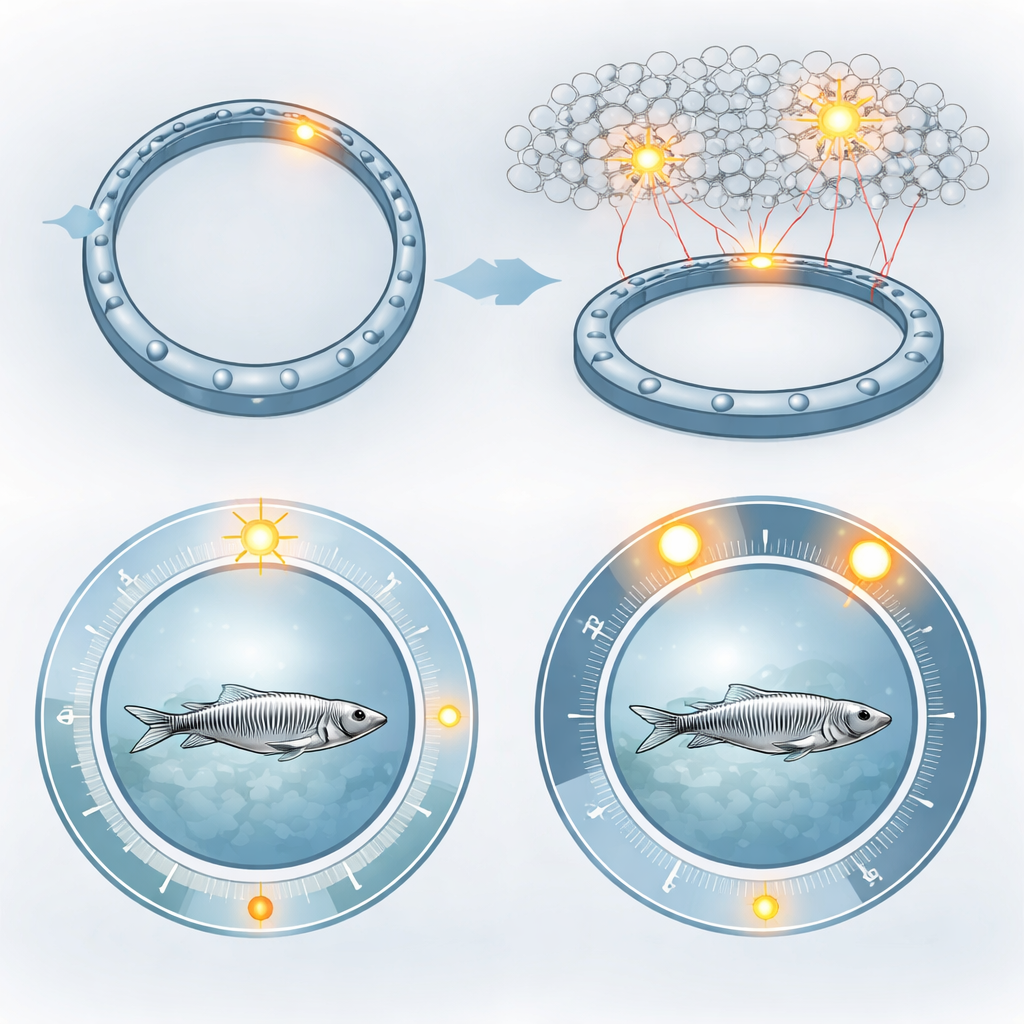
A Specialized Gateway for Landmark Information
The study also identifies a key pathway that feeds visual landmarks into the compass. A small structure called the habenula sends dense projections to a midbrain region (the interpeduncular nucleus) where head‑direction processes reside. The left habenula, in particular, contains many light‑responsive cells with local visual “pixels” that, together, encode the orientation of the scene well enough to decode it from their activity. When the researchers selectively destroyed the axon bundle from this visual habenula side, the head‑direction bump still existed and could still move with optic flow, but it no longer aligned reliably with visual landmarks. This shows that landmark anchoring and motion‑based updating use partly separate routes into the compass circuit.
Why This Matters for Brains and Navigation
To a lay reader, the key message is that even a tiny fish brain builds an internal compass that can learn from the visual world which way is which—and that learning is both powerful and fragile. The compass ring keeps track of turns on its own, but needs landmark input from the habenula to stay calibrated to the outside world. When the environment is confusing or symmetric, experience reshapes the connections so that the same visual pattern can point to more than one direction, distorting the map. These results suggest that core ideas about flexible navigation, previously worked out in insects and mammals, also apply in simple vertebrates, and that evolution has reused similar circuit tricks—ring‑like maps, plastic visual inputs, and motion cues—to solve the universal problem of knowing where you are headed.
Citation: Tanaka, R., Portugues, R. Plastic landmark anchoring in zebrafish compass neurons. Nature 650, 673–680 (2026). https://doi.org/10.1038/s41586-025-09888-x
Keywords: navigation, head direction cells, zebrafish, visual landmarks, optic flow