Clear Sky Science · en
Twisted optical fibres as photonic topological insulators
Light That Hugs the Edge
Modern communication, sensing and even future quantum technologies all rely on light travelling reliably through optical fibres. Yet tiny flaws introduced during fibre manufacture can scatter light, scramble delicate signals and limit performance. This research shows how simply twisting an optical fibre during fabrication can make light cling to the fibre’s outer rim in a way that is remarkably resistant to such imperfections, opening a route to tougher, more reliable photonic devices. 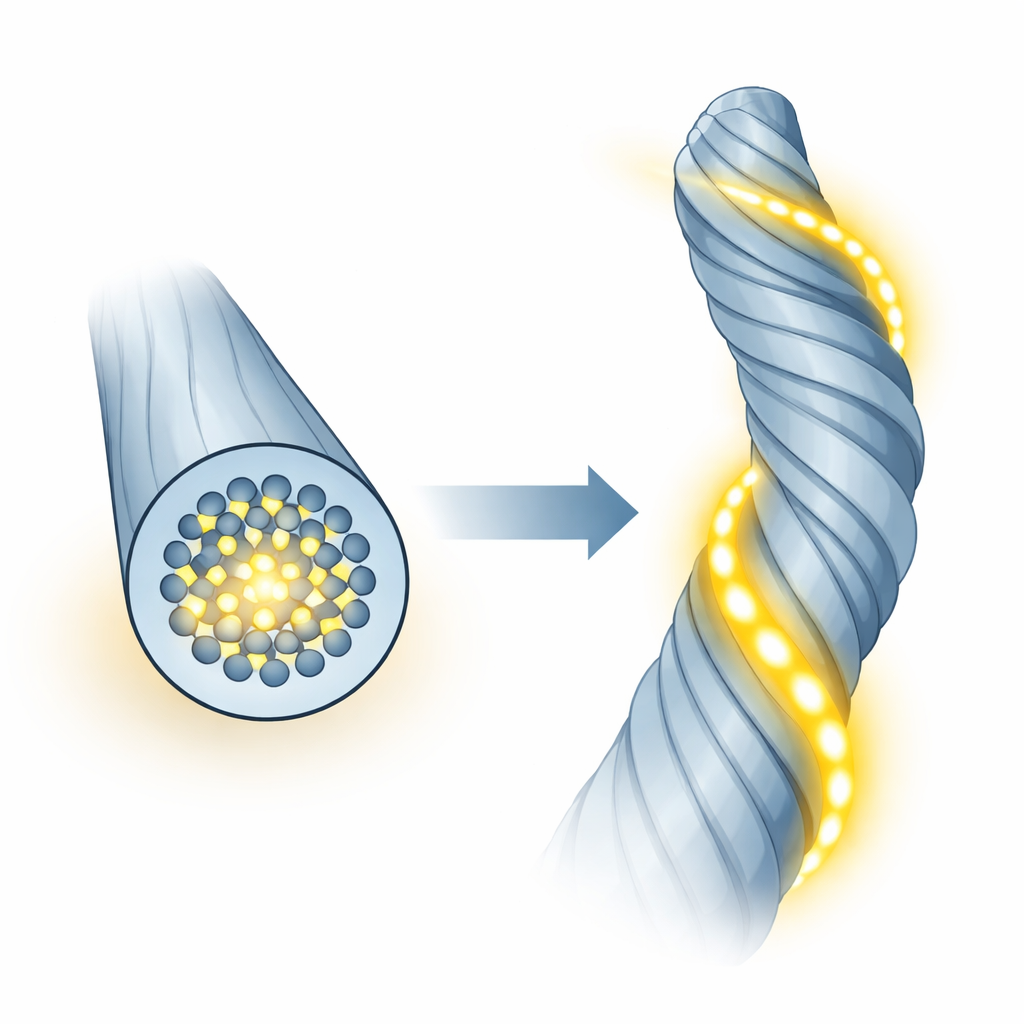
From Simple Glass Threads to Smart Pathways
Ordinary optical fibres are essentially transparent glass threads that guide light down their core by total internal reflection. The fibre in this work is more intricate: instead of a single core, it contains many tiny, germanium-doped cores arranged in a honeycomb pattern within one larger strand. Together, these closely packed cores support collective patterns of light that behave less like rays in a pipe and more like waves in a carefully engineered landscape, where the detailed arrangement of cores controls how light can move.
A Twist That Acts Like a Magnetic Field
In electronics, special materials called Chern insulators use magnetic fields and quantum mechanics to force electrical current to flow only along their edges, largely immune to bumps and defects. The authors create an optical counterpart by exploiting geometry instead of magnets. As the fibre preform is drawn and heated, they rotate it, freezing in a steady twist along the length of the fibre. In a co-rotating mathematical frame, this twist makes light feel a “pseudo-magnetic field,” similar to how rotation in physics can mimic a Coriolis or centripetal force. This breaks a symmetry between forward and backward propagation and opens up a gap between different allowed light patterns, a hallmark of Chern-type behaviour.
Finding the Just-Right Design Zone
Twisting the fibre does two conflicting things at once. On one hand, it produces the pseudo-magnetic effect that gives rise to special edge-following modes of light. On the other, it creates a gentle bowl-shaped variation in effective refractive index that tends to pull light inward and spoil the desired behaviour. Using detailed simulations and an analytical model, the team maps out how twist strength and coupling between neighbouring cores must be balanced. They identify a “Goldilocks” region where both the twist and the inter-core coupling are strong enough: here, a real-space topological marker (a Chern-like quantity computed directly from the fibre’s discrete cores) settles into clear plateau values, signalling robust edge-dominated transport.
Watching Light Run Around the Rim
To test the design, the researchers inject laser light into a single core on the perimeter of the twisted fibre and examine the output after a few centimetres of propagation. Experiments and finite-element simulations agree: instead of spreading into the interior, most of the light remains confined to a ring of outer cores and even flows around an intentionally cut-out notch in the fibre’s outline. Additional numerical work shows that these edge modes circulate in a preferred direction, and that the sense of rotation flips if either the underlying mode or the direction of the twist is reversed. Statistical tests of many different kinds of fabrication-like disorder indicate that these edge paths are far less prone to localization and frequency shifts than comparable modes in untwisted or over-twisted, topologically trivial fibres. 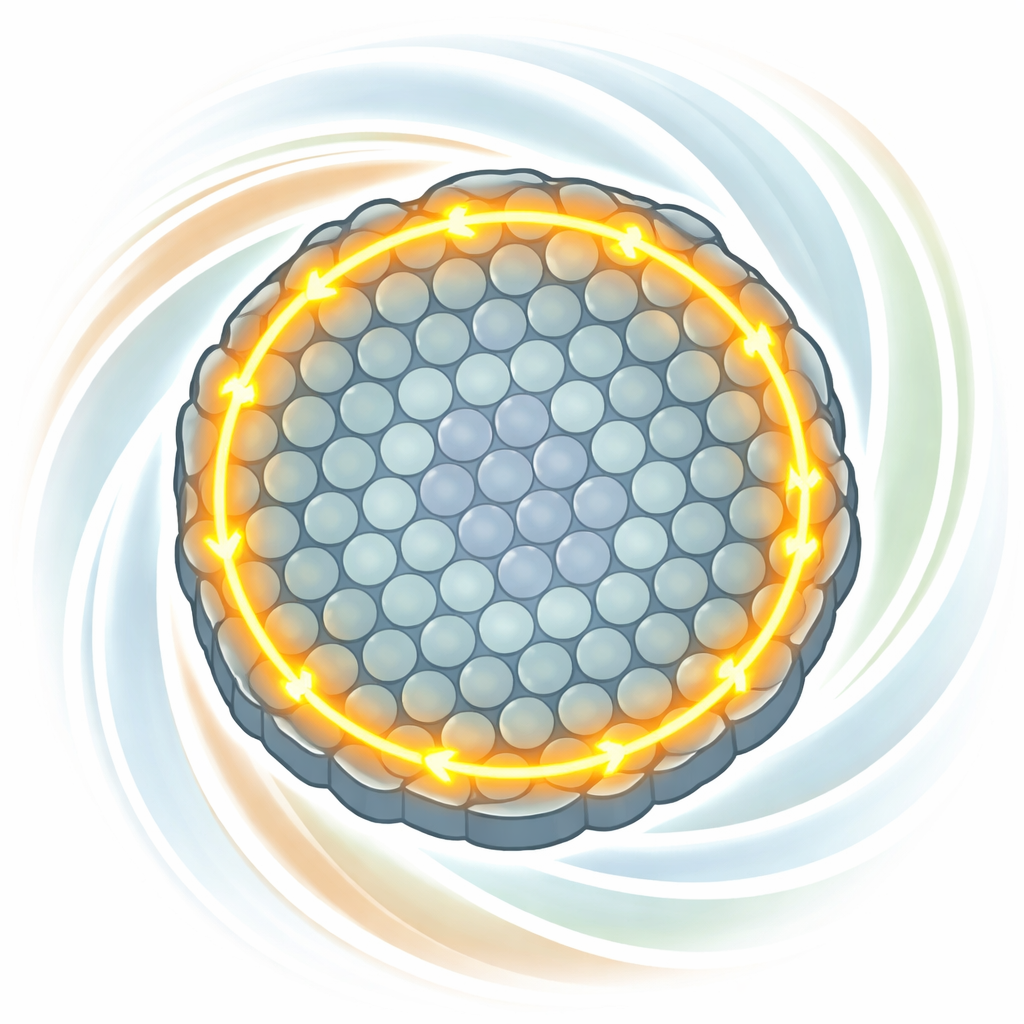
Toward Tougher Fibres for Future Technologies
In everyday terms, the authors have shown how to build a glass fibre in which light chooses a protected, one-way lane around the boundary and keeps that route even when the road is slightly damaged. By twisting a multicore fibre into this Goldilocks regime, they realize an optical analogue of a Chern insulator that is scalable using standard fibre-drawing techniques. Such topologically protected light paths could make long-distance data links more robust, help shield fragile quantum signals from noise and pave the way for new kinds of fibre lasers and sensors that harness this built-in resilience.
Citation: Roberts, N., Salter, B., Binysh, J. et al. Twisted optical fibres as photonic topological insulators. Nat. Photon. 20, 324–331 (2026). https://doi.org/10.1038/s41566-026-01848-9
Keywords: topological photonics, twisted optical fibre, Chern insulator, edge states, robust light transport