Clear Sky Science · en
Ultrafast transition from coherent to incoherent polariton nonlinearities in a hybrid 1L-WS2/plasmon structure
Light Talking to Matter at Lightning Speed
Our everyday electronics shuffle charges around relatively slowly, but when light and matter are forced to interact in extremely small spaces, their conversation can speed up to mere trillionths of a second. This study explores how a sheet of atoms and a nanostructured metal surface can work together to control light incredibly fast, revealing new ways to build ultrafast optical switches that could one day process information far beyond today’s electronics.
Building a Tiny Playground for Light
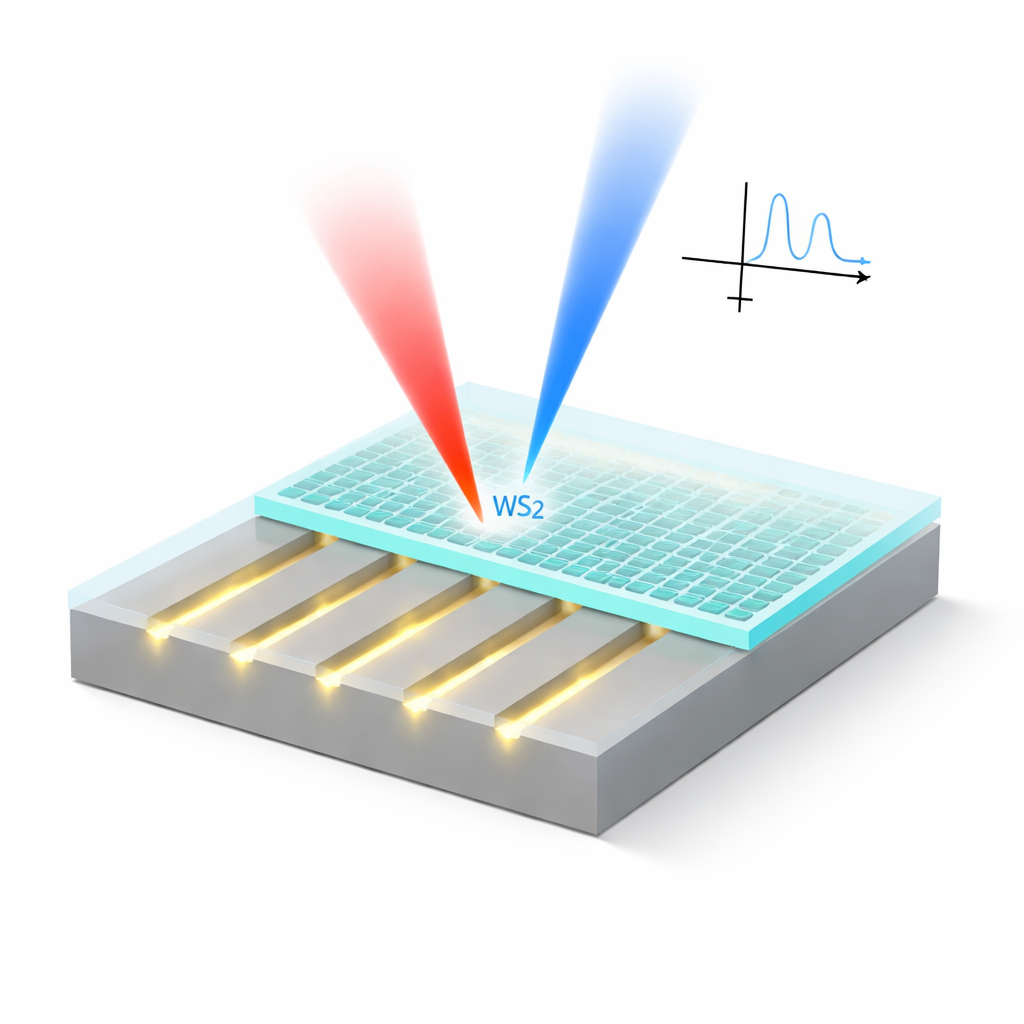
The researchers start with a special semiconductor only one atom thick, made of tungsten and sulfur (WS2). In such ultrathin materials, light can create tightly bound electron–hole pairs called excitons, which behave a bit like artificial atoms in a flat sheet. The team places this monolayer on top of a carefully engineered silver film patterned with a dense array of nanometer-scale slits. These slits act as an antenna for light, concentrating it into ripples of electric field—surface plasmons—trapped at the metal surface. When the color of these plasmons is tuned to match the excitons in WS2, the two can hybridize, forming new mixed light–matter states known as polaritons.
Turning Coupling On and Off with Polarized Light
Because the silver nanoslits respond only to light oscillating in a particular direction, the team can effectively switch the plasmonic interaction on or off just by rotating the polarization of the laser. With one polarization, the WS2 layer behaves nearly as if it were on a flat, non-structured metal, showing only weak changes in how it reflects light after being excited. With the other polarization, the plasmons strongly couple to the excitons, and the system responds much more dramatically: the nonlinear optical signal—how much the material’s response changes with intense light—jumps by more than a factor of twenty. Simply putting the monolayer on the nanoslit array transforms a nearly linear mirror into a strongly responsive optical element, even though the bare metal pattern itself has almost no nonlinear behavior.
Watching Light–Matter Hybrids Live and Die
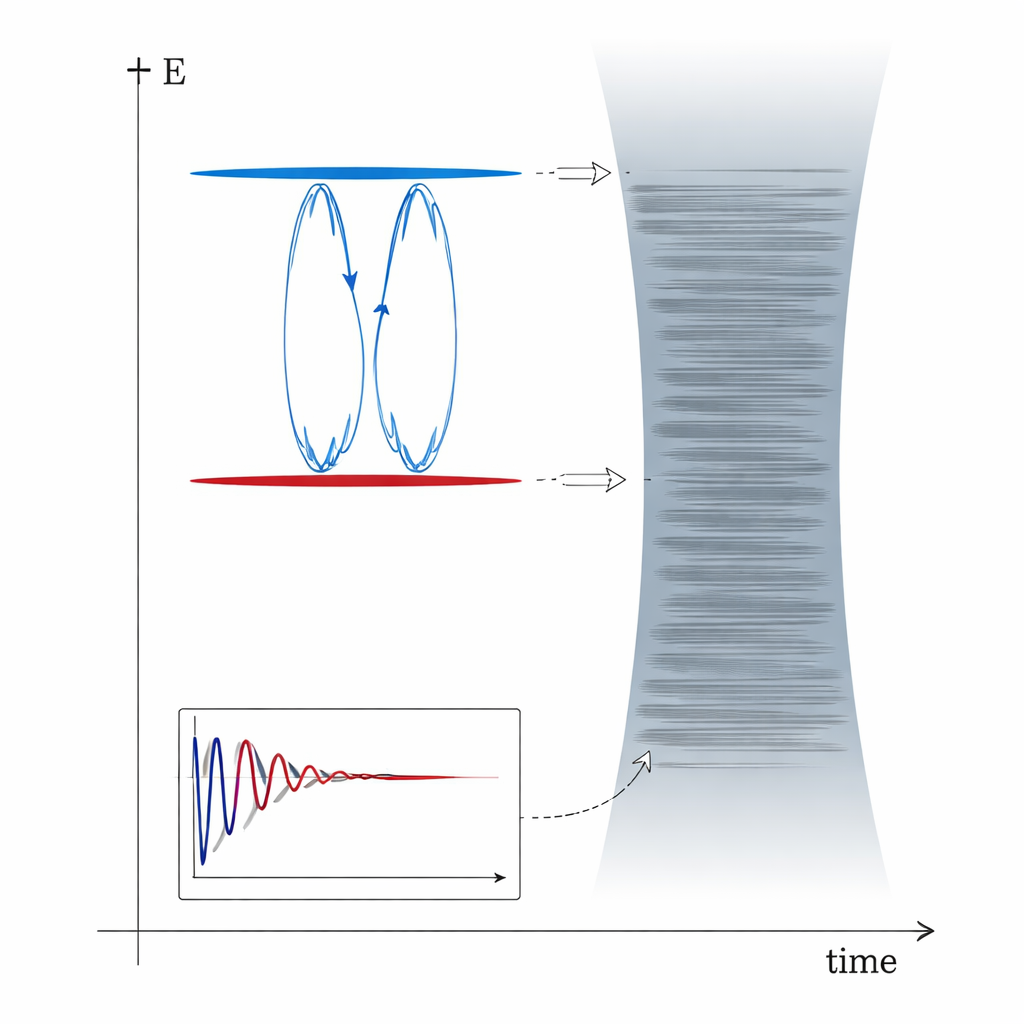
To see what happens during the first instants after excitation, the scientists use ultrafast two-dimensional electronic spectroscopy, a technique that sends a pair of ultrashort light pulses followed by a probe pulse and records how different colors of light are absorbed or emitted over time. With a time resolution of about 10 femtoseconds (one hundred-trillionth of a second), they capture “maps” showing which energies are excited and how they talk to each other. Right after the pulse, the maps reveal clear signatures of coherent polaritons: the upper and lower polariton branches beat against each other, creating oscillations that correspond to energy sloshing back and forth between light confined in the metal and excitons in the WS2 layer. These oscillations occur with a period of about 60 femtoseconds, matching the energy splitting between the polariton levels.
From Ordered Dance to Chaotic Crowd
However, this ordered dance does not last long. Within roughly 70 femtoseconds, the spectral patterns change shape, signaling a transition from well-defined, phase-locked polaritons to more disordered, “incoherent” excitations and long-lived dark states that interact weakly with light. By comparing their measurements with a simplified theoretical model, the authors show that these changes arise from two key effects. First, the strong coupling pulls in both bright excitons and more elusive “dark” excitons that are normally hard to reach with ordinary light. Second, when many excitations are present, they start blocking each other from using the same quantum states—a crowding effect known as Pauli blocking. Together, these processes redistribute energy into states that persist for tens of picoseconds, long after the initial coherence is gone.
Toward Ultrafast Light-Based Switching
In practical terms, the work demonstrates that a single atomic layer on a cleverly designed metal nanostructure can support very large and extremely fast optical nonlinearities, with reflectivity changes up to about 10% occurring in just a few tens of femtoseconds. Coherent polaritons offer a route to switching light with light on unprecedented timescales, potentially an order of magnitude faster than schemes that rely mainly on slower, dark excitations. The authors argue that by further engineering the surrounding materials to siphon off unwanted incoherent states, such hybrid structures could become the basis for ultrafast, nanoscale optical components and metasurfaces, pushing photonic information processing closer to the speed limit set by quantum mechanics itself.
Citation: Timmer, D., Gittinger, M., Quenzel, T. et al. Ultrafast transition from coherent to incoherent polariton nonlinearities in a hybrid 1L-WS2/plasmon structure. Nat. Nanotechnol. 21, 216–222 (2026). https://doi.org/10.1038/s41565-025-02054-4
Keywords: polariton, plasmonics, two-dimensional semiconductors, ultrafast spectroscopy, optical nonlinearity