Clear Sky Science · en
Prediction of eukaryotic cellular complexity in Asgard archaea using structural modelling
Ancient microbes with a hidden complexity
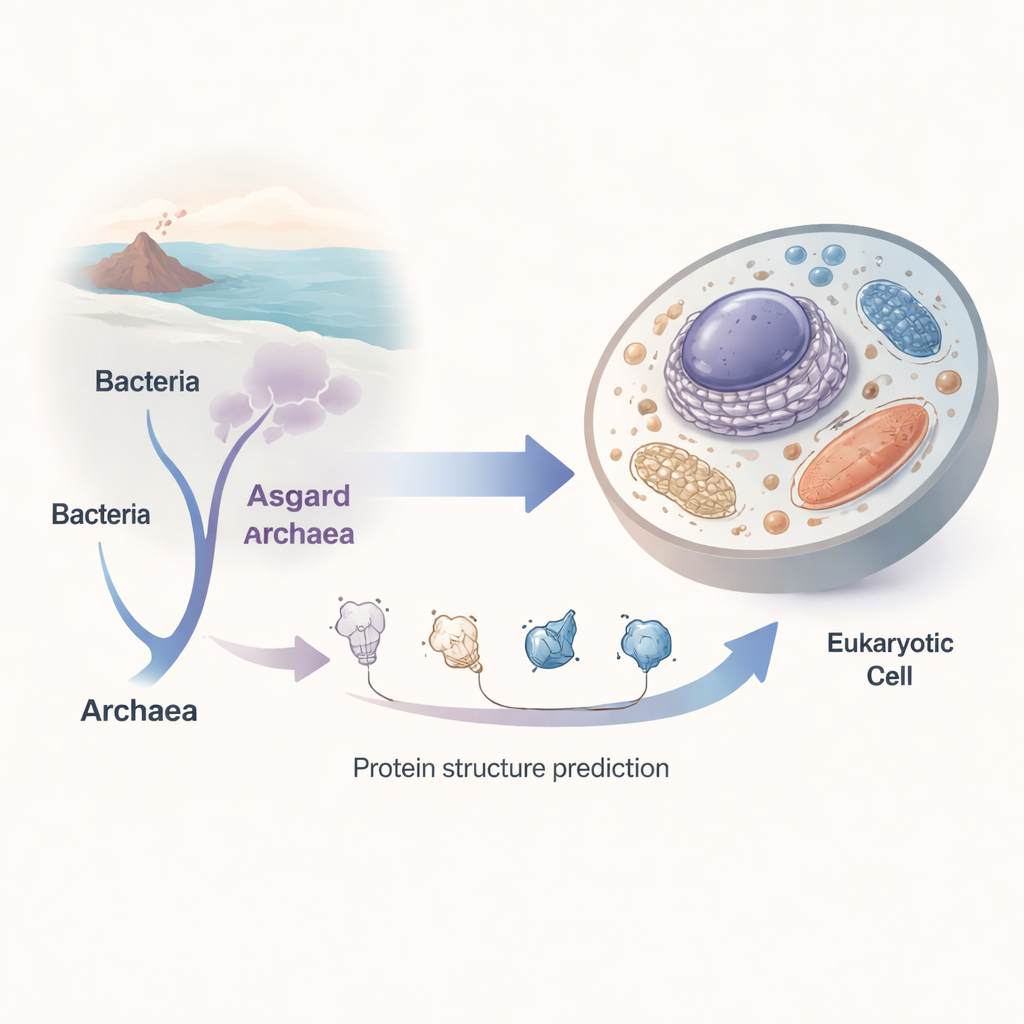
Life as we know it depends on eukaryotic cells—cells with internal compartments, such as a nucleus and mitochondria. How such intricate cells evolved from simpler microbial ancestors has long been one of biology’s deepest puzzles. This study focuses on a little-known group of archaea called Asgard and asks: do these microbes already carry the molecular building blocks needed for the complexity seen in our own cells?
Peering into the protein world of Asgard
To investigate, the researchers assembled a large genomic collection from 936 Asgard archaea, many of which are known only from DNA fragments in environmental samples. These genomes encode millions of proteins, most of them poorly understood. Instead of relying only on direct sequence similarity, which often fails over very long evolutionary times, the team predicted the three-dimensional structures of representative proteins from across this Asgard “pangenome.” Using powerful algorithms originally developed for protein folding, they generated high-confidence structural models for more than 37,000 protein families.
Seeing similarity where sequences disagree
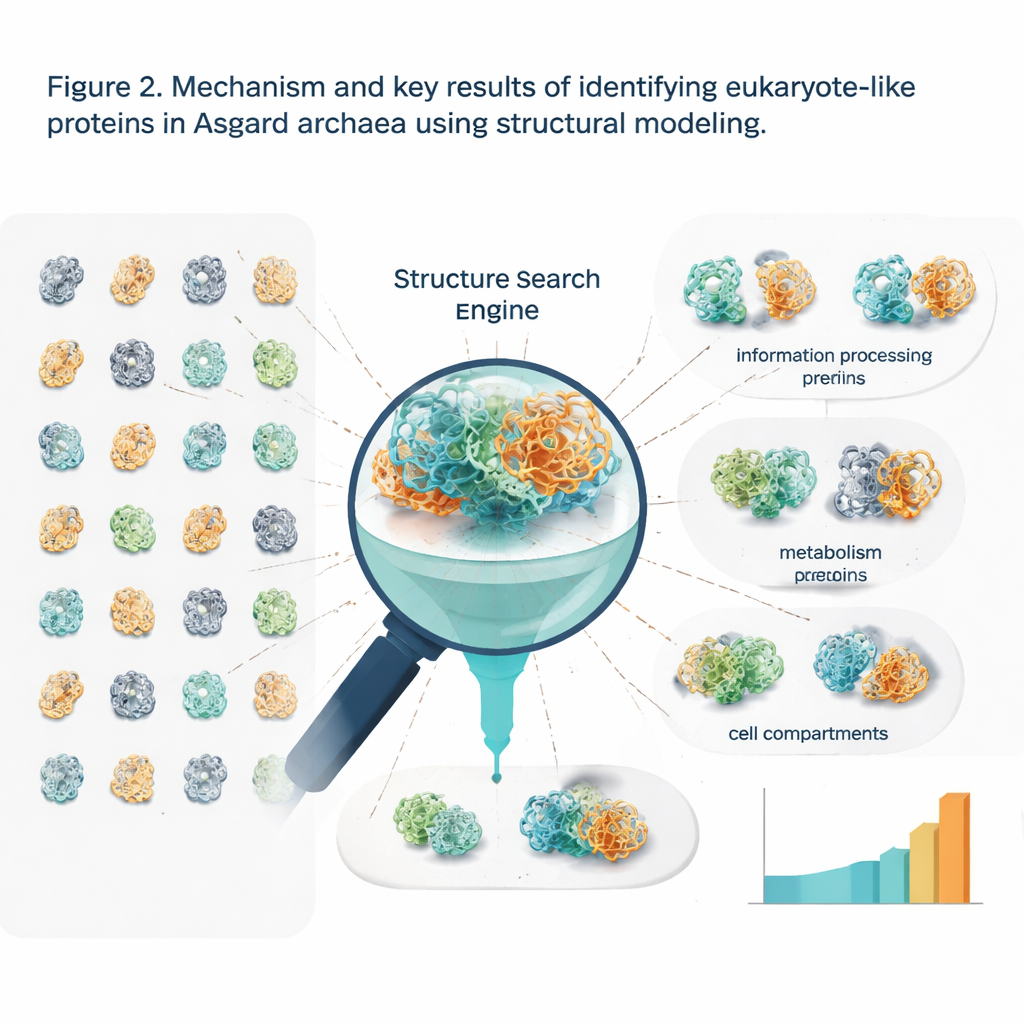
Protein sequences change rapidly over billions of years, but their overall shapes are often much more conserved. The authors exploited this by comparing the predicted Asgard protein structures against a vast database of known and predicted structures from all domains of life. They then asked, for each Asgard protein family, whether its closest structural matches were found disproportionately in eukaryotes. When such an enrichment occurred, they classified the Asgard proteins as “isomorphic eukaryotic signature proteins,” or iESPs—proteins whose shapes, rather than their sequences, strongly echo those of eukaryotic proteins linked to complex cell biology.
Tripling the set of eukaryote-like proteins
This structural approach uncovered 1,319 previously unrecognized iESPs and showed that, when grouped into related structural clusters, Asgard archaea contain 908 distinct families of proteins with strong eukaryotic affinities—more than three times the number identified by earlier sequence-based searches. Many belong to systems for information storage and processing, such as translation and ribosome biogenesis, as well as to metabolic pathways that defend against oxidative damage or handle complex molecules. This suggests that the archaeal ancestor of eukaryotes already possessed a richer, more sophisticated molecular toolkit than genomes alone had hinted.
Clues to early cellular compartments
Some of the most striking finds involve proteins tied to the internal organization of eukaryotic cells. The team identified Asgard versions of the major vault protein, which in eukaryotes assembles into huge barrel-shaped ribonucleoprotein particles implicated in transport and stress responses. They also discovered Asgard relatives of COMMD proteins from the Commander complex, which helps recycle membrane proteins in endosomes. In addition, they found Asgard-only sources for Ufm1, a ubiquitin-like modifier involved in stress signaling, and for CINP, a partner of cell-cycle kinases that has roles in DNA replication and ribosome production. These links imply that components of elaborate eukaryotic transport and control systems may trace back to Asgard ancestors.
Rewriting the story of our cellular origins
Taken together, the results paint a picture of Asgard archaea as far from simple. Their genomes encode many proteins whose shapes match those that underpin the complex organization, information handling and metabolism of eukaryotic cells. While structure alone cannot prove direct ancestry for every protein family, it reveals deep connections that sequence comparison misses. For a non-specialist, the key message is that the leap from simple microbes to complex cells was likely bridged by Asgard-like organisms already equipped with much of the molecular machinery that our own cells still rely on today.
Citation: Köstlbacher, S., van Hooff, J.J.E., Panagiotou, K. et al. Prediction of eukaryotic cellular complexity in Asgard archaea using structural modelling. Nat Microbiol 11, 747–758 (2026). https://doi.org/10.1038/s41564-026-02273-y
Keywords: Asgard archaea, eukaryotic cell evolution, protein structure modeling, cellular complexity, eukaryotic signature proteins