Clear Sky Science · en
Mild-to-wild plasticity of Earth’s upper mantle
Why rocks deep inside Earth don’t always flow smoothly
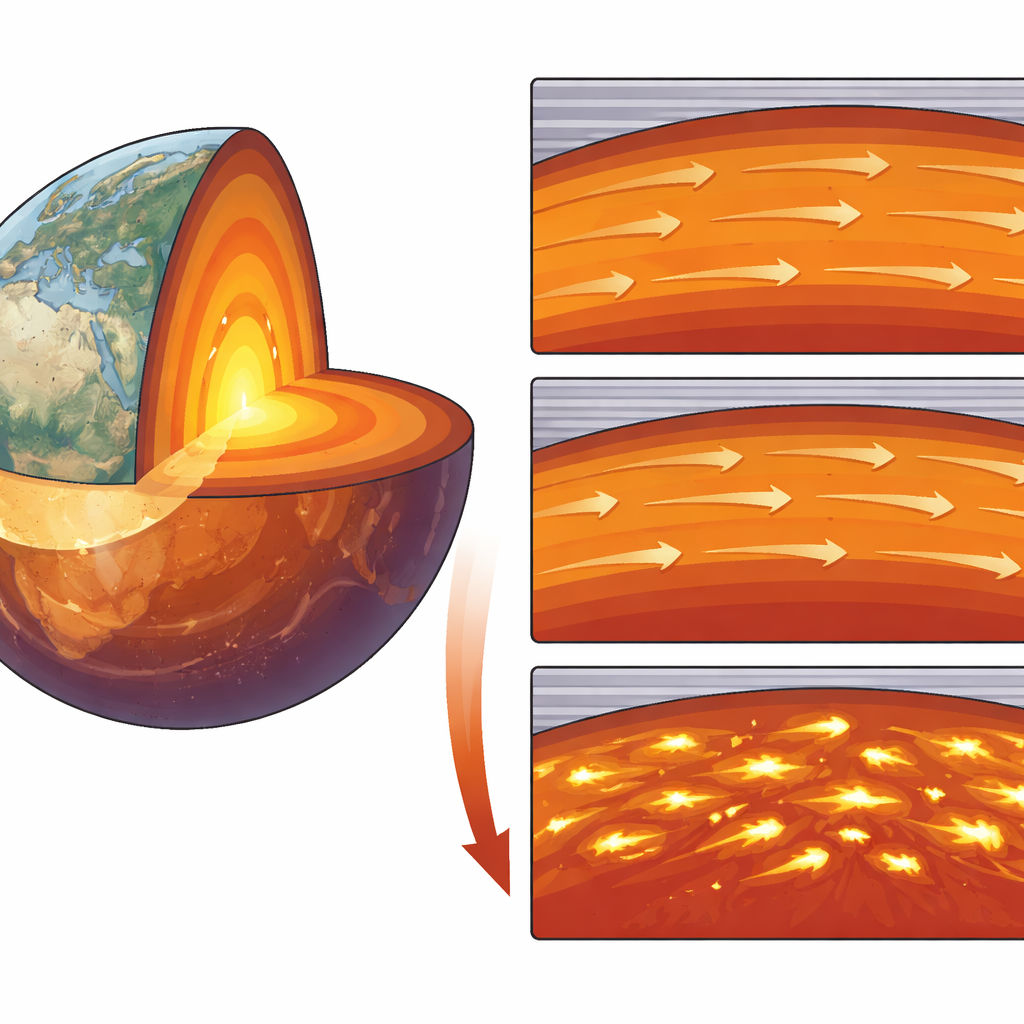
Far beneath our feet, Earth’s mantle is made of hot, solid rock that slowly creeps over millions of years, driving the motion of continents. This slow flow is usually pictured as smooth and steady, like cold honey. The paper summarized here challenges that picture. By probing tiny patches of mantle minerals in the lab, the authors reveal that even seemingly solid, slowly moving rock can deform in sudden microscopic bursts. These hidden jolts may help explain puzzling deep earthquakes and other surprising slips inside our planet.
From gentle flow to sudden jolts
For decades, geophysicists have assumed that the upper mantle deforms mainly by continuous, almost unchanging creep. Large-scale measurements of plate motions and post-earthquake relaxation show smooth, gradual movements, reinforcing this view. But work from materials science has uncovered a richer spectrum of behaviour in metals, ice and other crystals. Instead of flowing uniformly, many materials deform in fits and starts, with brief surges of internal strain called dislocation avalanches. This range, from nearly steady “mild” behaviour to highly jerky “wild” behaviour, is known as mild-to-wild plasticity. The new study asks: where does Earth’s main mantle mineral, olivine, sit on this spectrum?
Poking tiny volumes of mantle rock
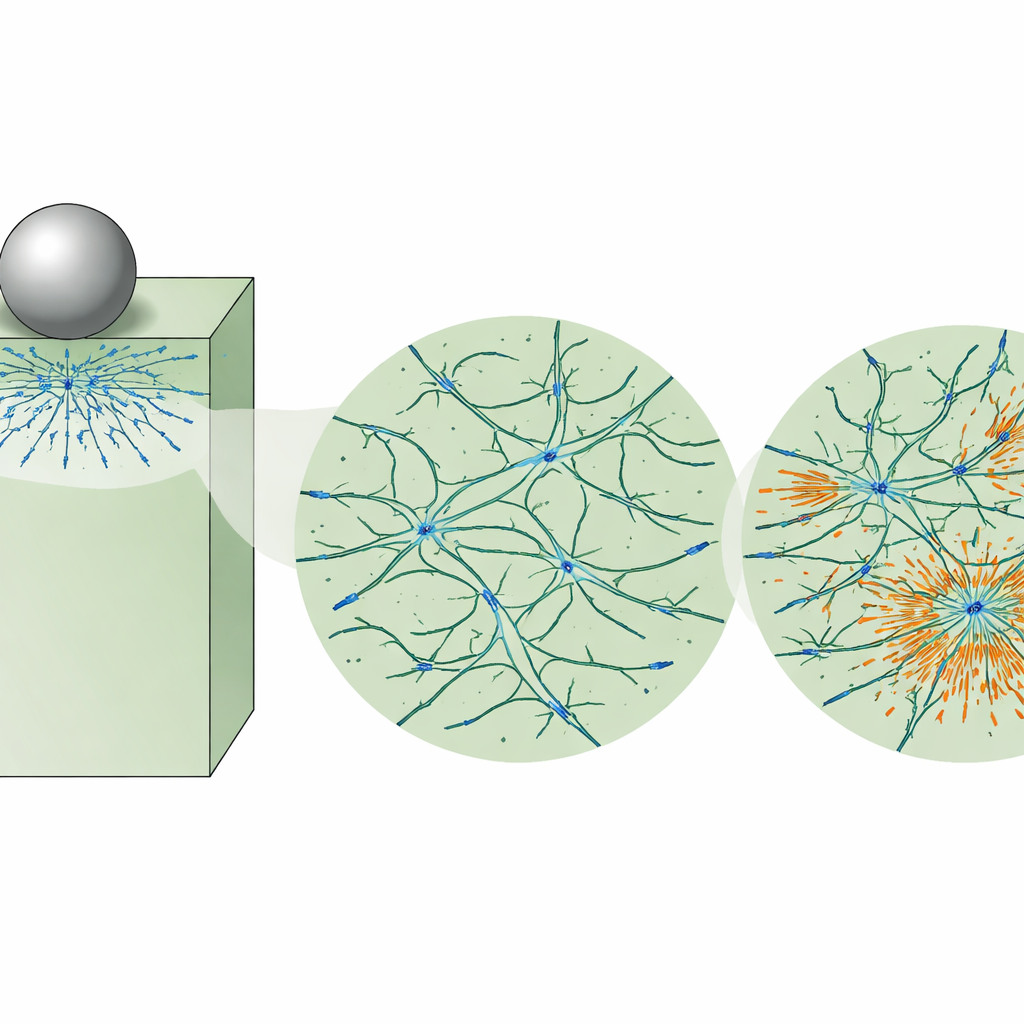
The authors revisit a set of nanoindentation experiments on single crystals of olivine. In these tests, a diamond tip with a very small, rounded end is pressed into the crystal while the instrument records how the sample pushes back and how its surface sinks. At first, the response is elastic: the crystal springs back if the load is removed. Then, a sharp “pop-in” marks the start of permanent deformation. After this, the indentation deepens as the crystal flows plastically. The team focused on this later stage to see whether the seemingly smooth plastic flow actually hides small, sudden jumps in displacement.
Detecting microscopic avalanches
By analysing hundreds of load–displacement curves, the researchers found that most tests contained many small bursts—rapid jumps in indentation depth that stood out above the background noise. These bursts were typically only a few nanometres high but occurred within individual measurement intervals, indicating very fast events. Statistical analysis showed that their sizes followed a log-normal distribution, a pattern expected when many dislocations—line-like defects inside the crystal—move in correlated avalanches rather than independently. Using methods that convert indentation data into stress–strain estimates, the authors calculated that, after the initial pop-in, about 4–12% of the total plastic strain in these experiments was carried by such bursts. Overall, olivine at room temperature behaves mostly mildly, but with a measurable “wild” component.
Scaling from the lab to Earth’s deep interior
To connect these findings to the mantle, the study uses a theoretical framework that relates wildness to two key factors: the size of the region being observed and the internal resistance to dislocation motion. When the sample is large or barriers to dislocation motion are strong, many tiny avalanches blend together into an apparently smooth signal—mild plasticity. When the region is small or resistance is weak, individual avalanches dominate—wild plasticity. Measurements and flow laws for olivine suggest that, in Earth’s cold, strong lithospheric upper mantle, resistance is high and plasticity remains mild at most scales. In contrast, in the hotter, more weakly resisting asthenosphere beneath, the same framework predicts extremely wild behaviour, with deformation at least up to the grain scale carried mainly by intermittent avalanches rather than steady creep.
Hidden bursts and Earth’s mysterious deep slips
These results imply a transition with depth: from mostly smooth, mild plasticity in the shallow upper mantle to highly intermittent, wild plasticity deeper down. To a satellite or GPS station at Earth’s surface, this deeper behaviour would still look smooth, because countless grain-scale avalanches average out over vast distances and long times. Yet, where strain rates are locally high—such as in subduction zones or ductile shear zones—bursts of dislocation motion may help trigger or amplify larger-scale instabilities, including deep earthquakes and slow-slip events. In simple terms, the study shows that Earth’s seemingly calm, creeping mantle may actually be buzzing with microscopic “rockquakes,” and that this hidden wildness could be an important missing ingredient in our understanding of how and why the solid Earth sometimes fails suddenly instead of flowing quietly.
Citation: Wallis, D., Kumamoto, K.M. & Breithaupt, T. Mild-to-wild plasticity of Earth’s upper mantle. Nat. Geosci. 19, 339–344 (2026). https://doi.org/10.1038/s41561-026-01920-7
Keywords: upper mantle, olivine, plasticity, dislocation avalanches, asthenosphere