Clear Sky Science · en
Generation of inner core anisotropy by anisotropic thermal conductivity of iron crystals
Why the Center of Earth Matters
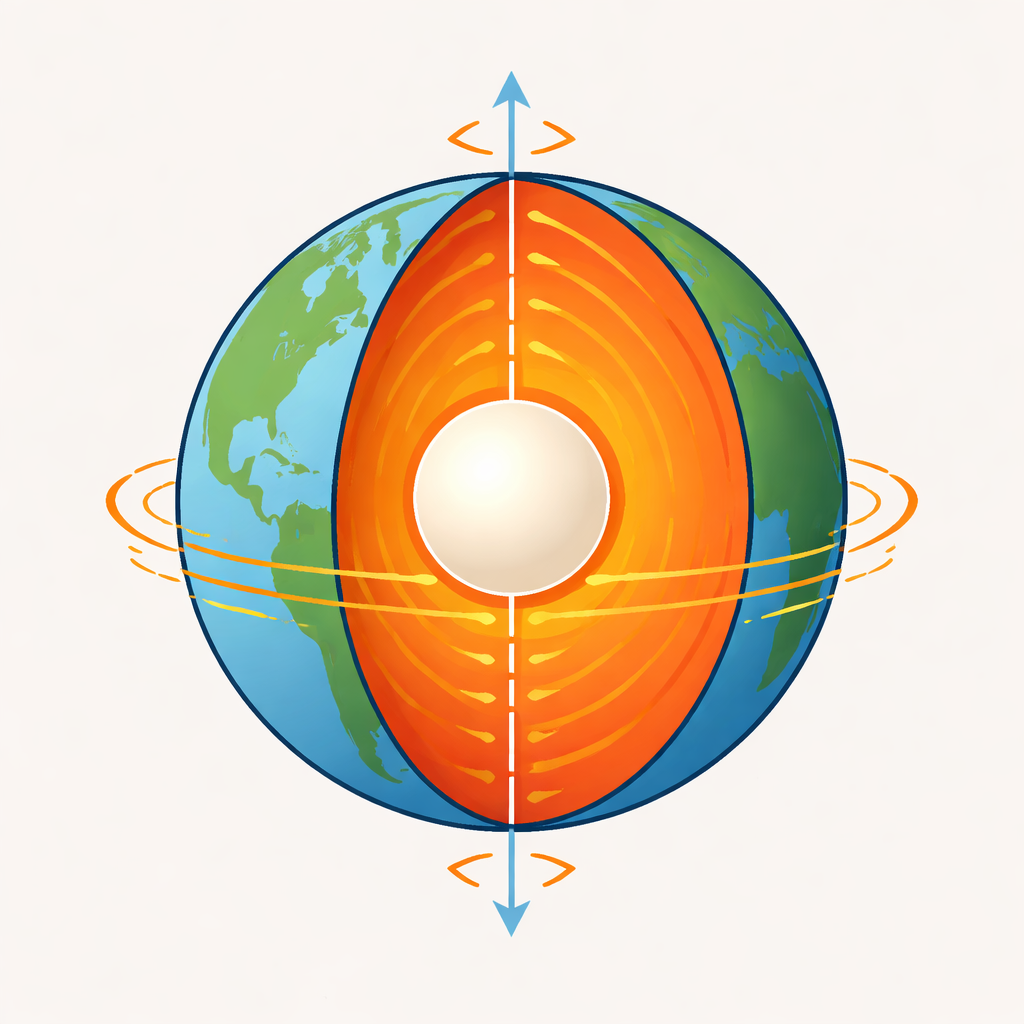
Deep beneath our feet, more than 5,000 kilometers down, lies Earth’s solid inner core—a ball of iron roughly the size of the Moon. Seismic waves from earthquakes reveal that this hidden sphere behaves strangely: waves move faster when they travel from pole to pole than when they cross the equator. This directional difference, called anisotropy, has puzzled scientists for decades. The study summarized here offers a fresh, purely internal explanation for how that pattern could arise, by focusing on the way heat moves through iron crystals at extreme pressures and temperatures.
Strange Earthquakes at the Core
Earthquakes send waves through the entire planet, and by timing how long those waves take to pass through the core, scientists can infer its internal structure. Observations show that seismic waves traveling roughly along Earth’s spin axis move faster than those traveling through the equatorial plane. The pattern is not uniform either: the western half of the inner core appears more strongly anisotropic than the eastern half. Many earlier ideas tried to explain this by appealing to forces from outside the inner core—such as uneven cooling from the mantle above or stresses from the planet’s magnetic field—but each of these explanations struggles either to generate enough deformation or to preserve the observed hemispheric contrast over long times.
Iron Crystals That Prefer a Direction
The new work asks whether the inner core might generate its own anisotropy from the inside out. The authors start from a key property of iron at core conditions: in its hexagonal crystal form, iron is not the same in every direction. It conducts heat more efficiently along one crystallographic axis (the so‑called c‑axis) than along the perpendicular directions (a‑axes), and it is also stiffer along that axis. If iron crystals within the inner core are even weakly aligned—for example, more c‑axes pointing roughly along Earth’s rotation axis—then heat will leak out of the core more easily along that direction. Over millions of years, this directional heat flow can build up subtle temperature differences inside the inner core itself.
Heat-Driven Flow at the Planet’s Heart
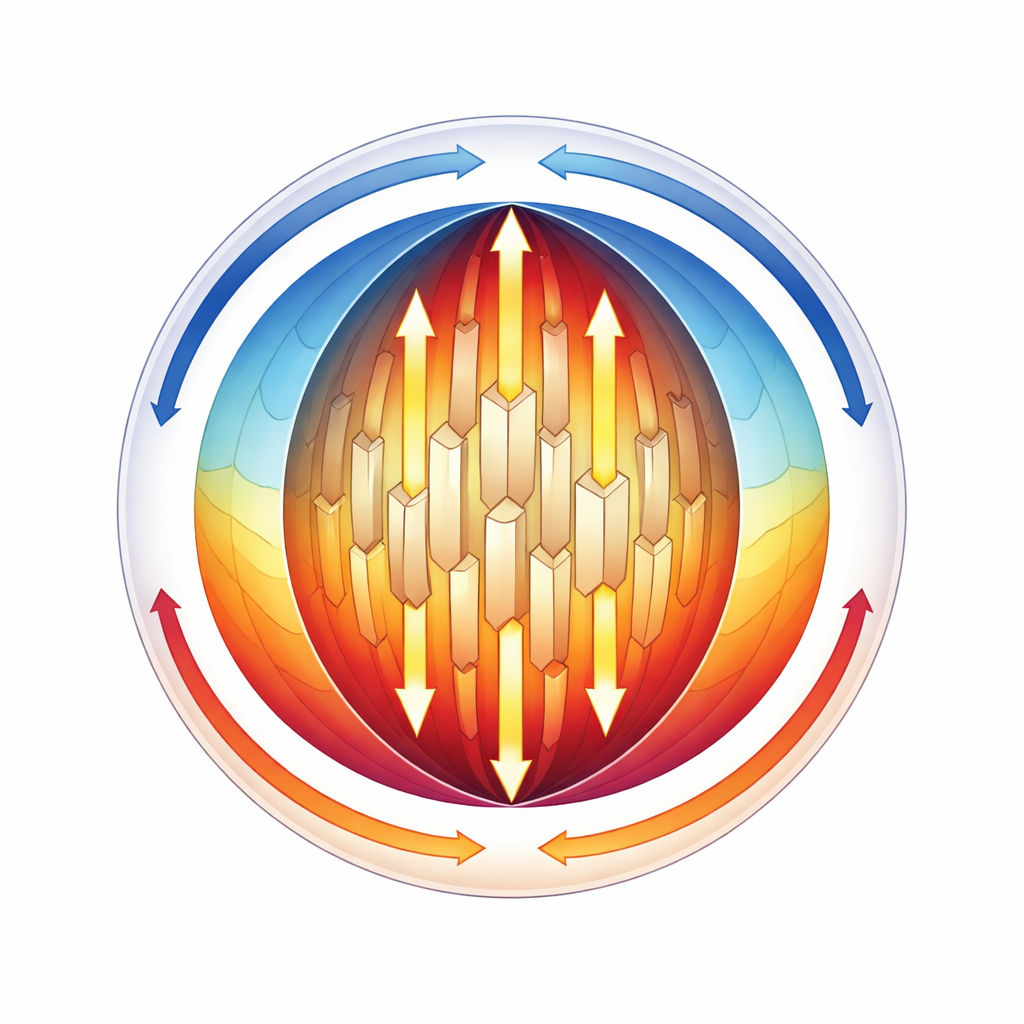
To test this idea, the researchers construct a simple model of how aligned crystals might be distributed: the alignment is strongest at the center of the inner core and decreases toward its outer boundary, echoing what seismic data suggest. They then treat the resulting anisotropic thermal conductivity as a small disturbance to an otherwise symmetric inner core and compute how the temperature field responds. Even differences of a degree or less are enough to create density contrasts: slightly warmer regions are lighter and tend to rise, while cooler regions sink. Using numerical simulations of slow, creeping flow, they find that these temperature anomalies naturally drive a distinctive circulation pattern—material converges inward around the equator and moves outward toward the poles, forming a large-scale, degree‑2 flow structure.
From Gentle Stresses to Crystal Alignment
The flows produced by this internally generated temperature pattern are extremely slow in everyday terms, but over geologic time they build up notable stresses in the solid iron—stronger than those estimated in several earlier models based on external forcing. Under such stresses, iron crystals can deform plastically along preferred slip planes, gradually rotating into alignment with the flow. Previous work has shown that a flow pattern like the one found here is especially effective at lining up crystals so that the fast seismic direction parallels Earth’s rotation axis, reproducing the main features of the observed anisotropy. The mechanism also offers a natural way to amplify an initially weak fabric: even a modest starting alignment or slight hemispheric asymmetry in crystal orientation can be strengthened as the flow focuses stress where alignment is already greatest, especially near the center of the inner core.
Asymmetry, Layering, and the Core’s History
The authors also explore how a layered temperature structure—where temperature varies with depth in a way that resists vertical motion—might damp the process. Strong stratification reduces the size of temperature anomalies and weakens the resulting flow and stresses, especially on large scales. In such cases, smaller-scale variations in crystal alignment, on the order of a few hundred kilometers, may become more important drivers of flow. They further show that if the region of strongest anisotropy is offset from the center of the inner core by a couple of hundred kilometers, then the largest stresses occur in the offset region, potentially reinforcing the observed east–west differences as the inner core slowly rotates relative to the mantle.
A Self-Organizing Inner Core
In simple terms, this study suggests that the inner core’s odd seismic behavior may arise from the way it manages its own heat. Because iron crystals conduct heat better in one direction than another, they set up tiny internal temperature imbalances that gently stir the solid iron. Those slow motions, in turn, push the crystals into a more orderly arrangement, which further sharpens the directional differences in both heat flow and seismic speed. Over hundreds of millions of years, this feedback loop can turn a faint initial pattern into the pronounced anisotropy we observe today—without requiring strong forcing from the mantle or magnetic field. The result is a picture of Earth’s center as a self-organizing system, where the microscopic physics of iron crystals helps shape the planet’s large-scale interior structure.
Citation: Das, P.P., Buffett, B. & Frost, D. Generation of inner core anisotropy by anisotropic thermal conductivity of iron crystals. Nat. Geosci. 19, 353–358 (2026). https://doi.org/10.1038/s41561-026-01916-3
Keywords: Earth inner core, seismic anisotropy, thermal conductivity, iron crystals, core dynamics