Clear Sky Science · en
Mantle heterogeneity influenced Earth’s ancient magnetic field
Why Earth’s Deep Interior Shapes Our Everyday Shield
Earth’s magnetic field quietly protects our technology, power grids and even the atmosphere from harmful solar and cosmic radiation. We usually picture it as a simple bar magnet aligned with the planet’s spin, but this new research shows that the story is more complicated—and more interesting. By combining ancient rock records with powerful computer simulations, the authors reveal that lumpy structures deep at the base of the mantle have been sculpting Earth’s magnetic field for hundreds of millions of years.
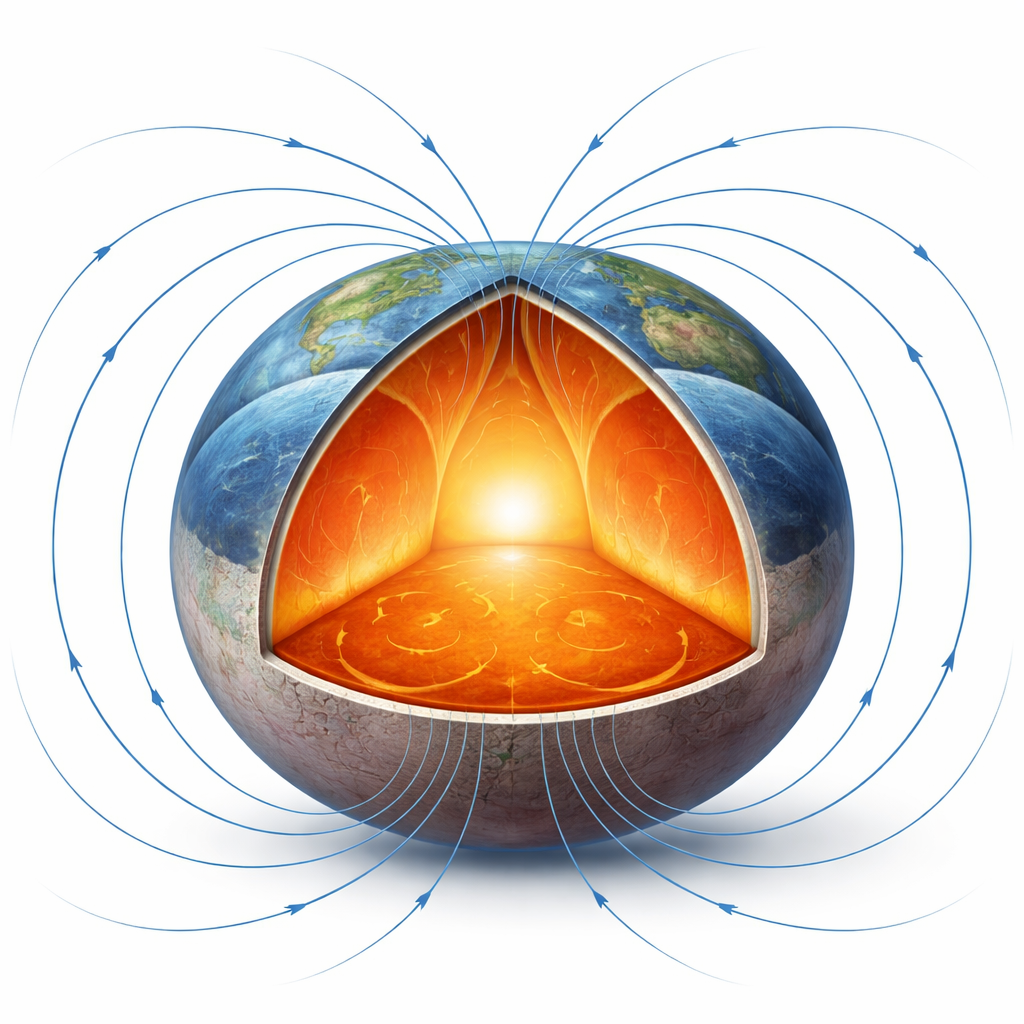
Hidden Structures at the Bottom of the Mantle
Far beneath our feet, at a depth of nearly 3,000 kilometers, lies the boundary between the solid mantle and the molten metal outer core where the magnetic field is generated. Seismic waves show that this region is anything but uniform: two giant, continent-sized zones with unusually slow seismic speeds sit roughly beneath Africa and the Pacific, separated by a ring of faster material. These slow zones are thought to be hotter than their surroundings, meaning that the heat leaking out of the core is very uneven from place to place. Because heat flow is the engine that powers the churning of liquid iron in the core, this patchiness should leave a fingerprint on the magnetic field—but detecting that fingerprint is challenging.
Reading the Magnetic Past from Rocks
When lava cools or sediments settle on the seafloor, tiny minerals inside can lock in the direction of the magnetic field at that time, creating a geological tape archive. By studying the spread in directions recorded at a given location—known as paleosecular variation—scientists can infer how stable or restless the field was over thousands to millions of years. The authors assembled and reanalyzed several large datasets spanning the last 265 million years, focusing especially on sites near the magnetic equator where the signal is most sensitive to the overall shape of the field. They also compared these rock-based records with recent global field models built from high-resolution sediment and lava data covering the past 100,000 years.
Putting Core and Mantle to the Test in Supercomputers
To see what kind of deep-Earth conditions could reproduce the rock record, the team ran suites of numerical simulations of the geodynamo—the complex flow of conducting fluid in the core that generates the field. In some simulations, the heat leaving the core was forced to be the same everywhere; in others, it varied strongly with a pattern inspired by seismic images of the lowermost mantle, with two large warm regions and cooler surroundings. They then analyzed the simulated fields in exactly the same way as the real data, measuring how much the field wandered at low latitudes and how much of the long-term average field deviated from a perfect, simple dipole.
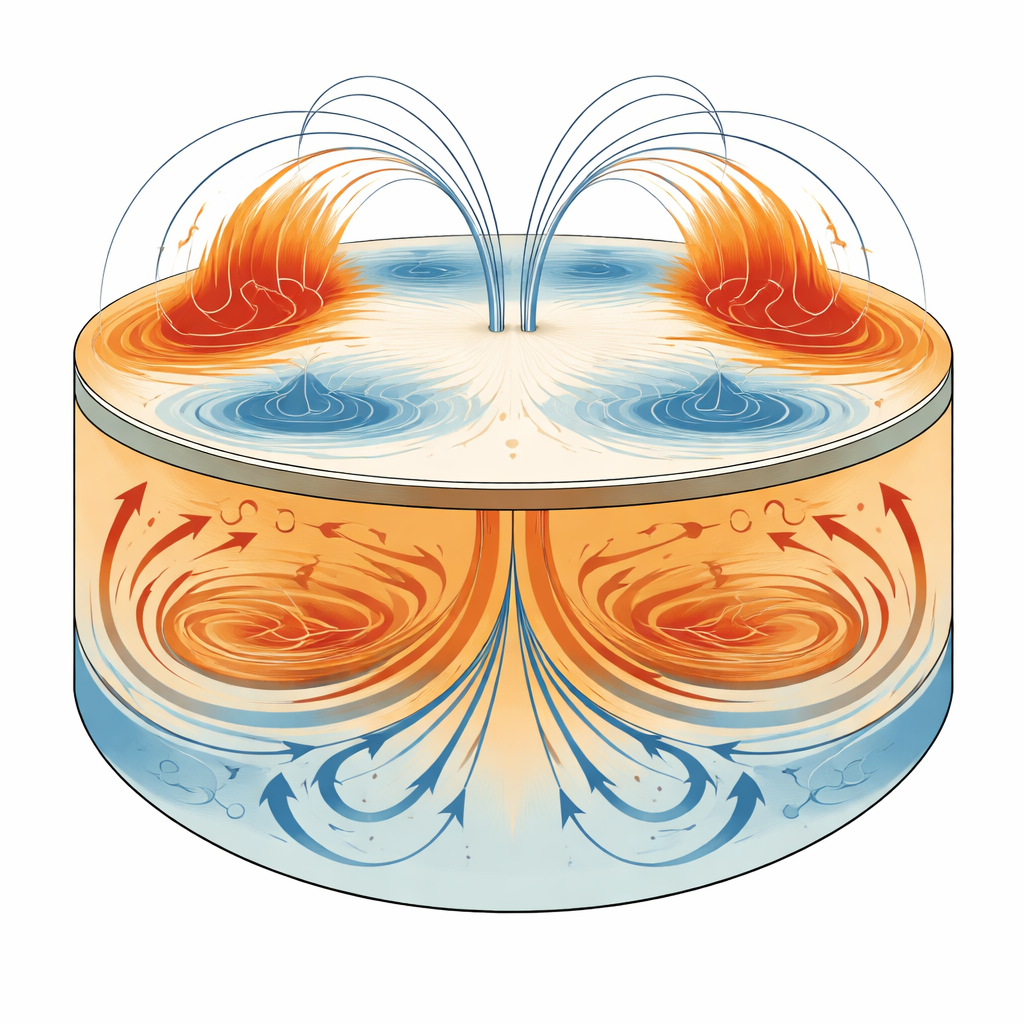
Uneven Heat Flow Leaves a Distinct Magnetic Signature
The comparison delivered a clear result. Simulations with perfectly uniform heat flow could be tuned to match some basic properties, such as the overall strength of the dipole, but they failed two key tests at the same time: they produced too little variation in direction from place to place at low latitudes, and their long-term average field remained almost perfectly symmetric around the spin axis. By contrast, simulations with strong lateral differences in heat flow naturally developed the kind of longitudinal structure seen in both recent field models and ancient rock data. They showed bands and patches in the non-dipole part of the average field and the right amount of extra directional scatter at certain longitudes, all while keeping a strong, stable dipole overall. These signatures match observations not just for the last few million years but, within uncertainty, back to at least 265 million years ago.
What This Means for Earth’s History and Maps
The study concludes that the uneven thermal pattern at the base of the mantle has been influencing Earth’s magnetic field for hundreds of millions of years. In simple terms, hot and cool patches deep below the surface help steer the flow of metal in the core, which in turn sculpts the magnetic field—adding persistent lumps and bumps on top of the main dipole. This matters for more than deep-Earth physics: paleomagnetic directions are a foundation for reconstructing where continents once were. If the time-averaged field is not perfectly dipolar and varies with longitude, some existing reconstructions could be biased by more than ten degrees. Understanding how mantle heterogeneity shapes the geodynamo therefore not only illuminates the hidden workings of Earth’s interior but also sharpens our view of the planet’s ancient geography.
Citation: Biggin, A.J., Davies, C.J., Mound, J.E. et al. Mantle heterogeneity influenced Earth’s ancient magnetic field. Nat. Geosci. 19, 345–352 (2026). https://doi.org/10.1038/s41561-025-01910-1
Keywords: Earth magnetic field, core mantle boundary, geodynamo, paleomagnetism, mantle heterogeneity