Clear Sky Science · en
Battery-electric passenger vehicles will be cost-effective across Africa well before 2040
Why this matters for everyday life
Across Africa, more people are buying motorcycles, cars and minibuses than ever before. This raises a tough question: will cleaner vehicles always be a luxury, or can they actually save money as well as cut pollution? This study shows that battery-powered vehicles charged with their own solar systems can become the cheapest option for many African drivers well before 2040—often even saving money while reducing climate-warming emissions.
A new way to think about fueling vehicles
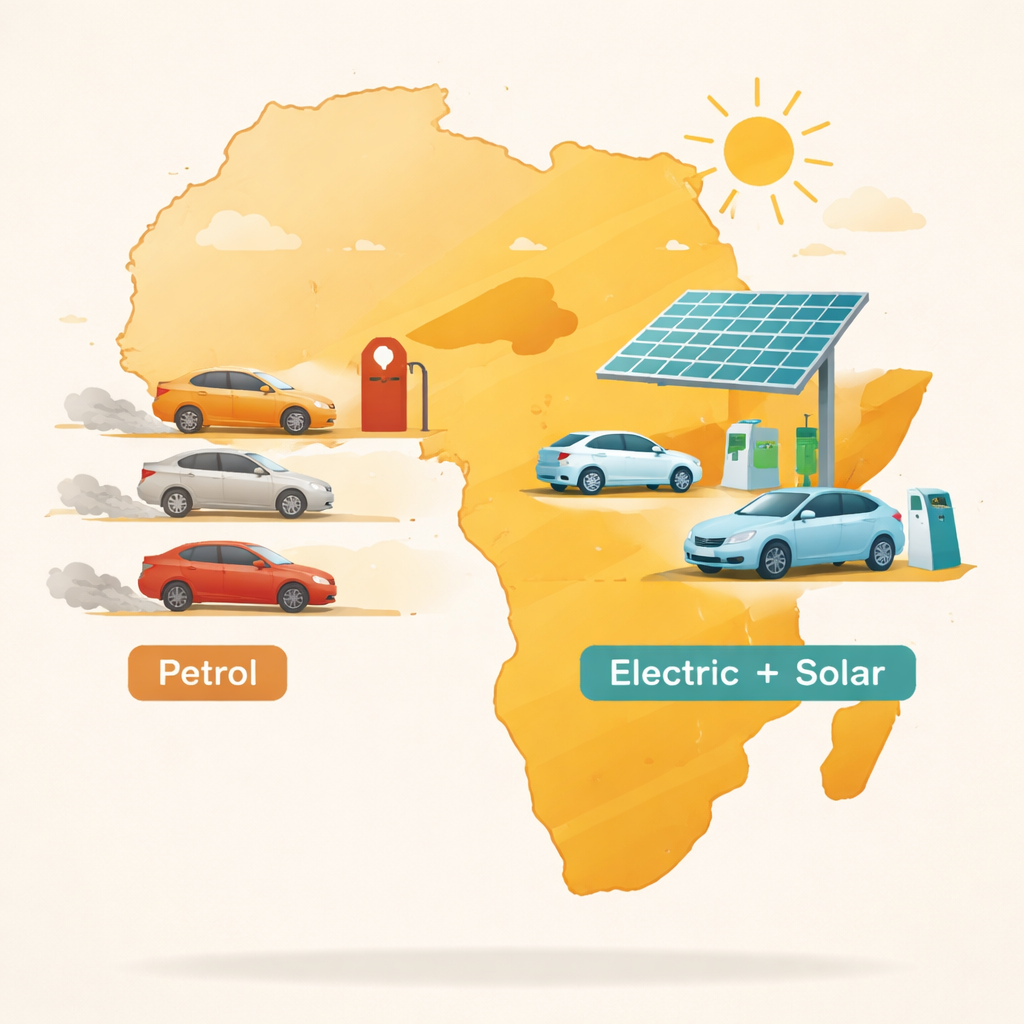
Most discussions about electric cars assume reliable power grids and low interest rates—conditions that often do not match reality in African countries. The researchers instead asked a different question: what if electric vehicles were paired with small, stand-alone solar systems designed just to charge them? These solar off-grid units use panels, a battery and an inverter to provide electricity without depending on the national grid. The team compared three options for passenger vehicles in 52 African countries: conventional engines running on fossil fuels, the same engines running on synthetic “e-fuels,” and battery-electric vehicles using dedicated solar charging.
Counting every cost over a vehicle’s life
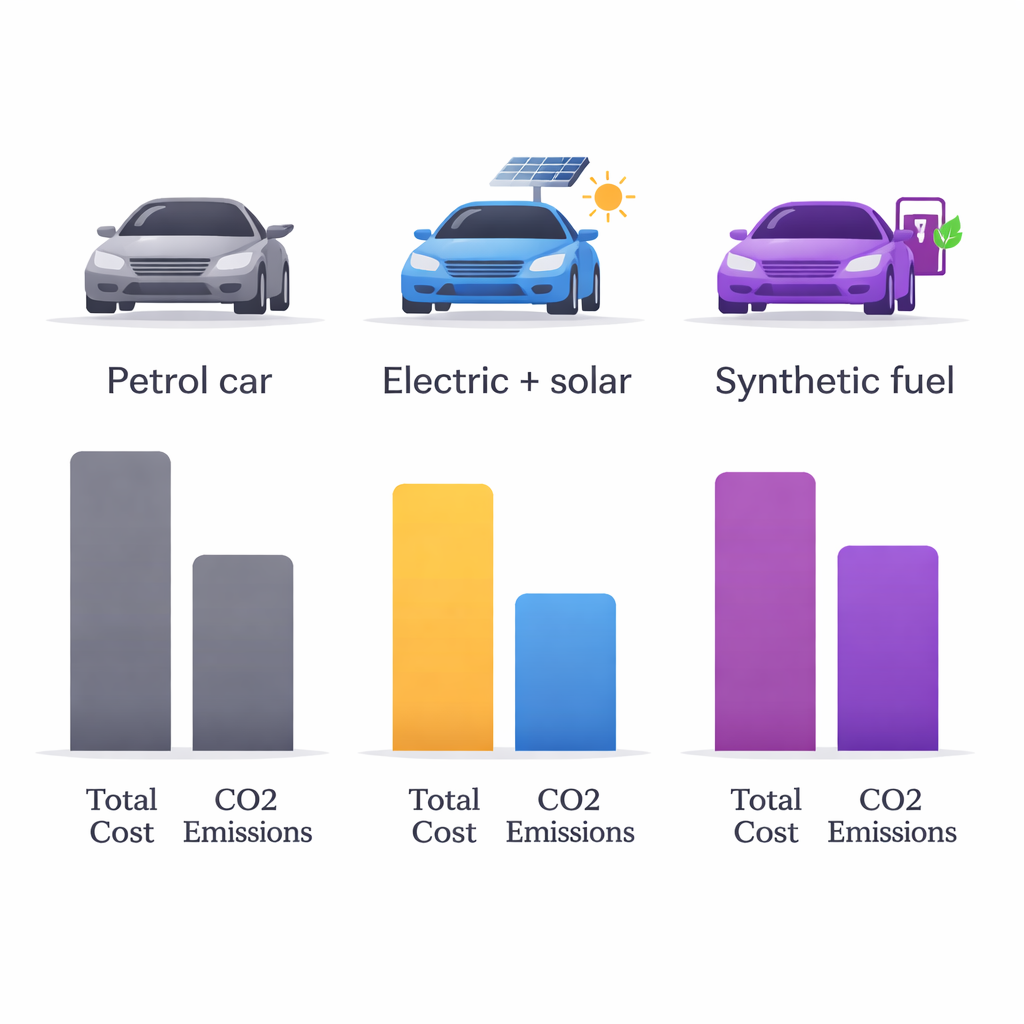
To find out which option really pays off, the study used a total cost of ownership approach. Instead of just looking at the sticker price, it added up loan costs, fuel or electricity, maintenance, insurance and the price of the solar system over the whole life of the vehicle. Advanced computer simulations captured uncertainty in driving distances, energy use and future prices. At the same time, the authors calculated the climate impact of each option, from making the vehicle and its battery to producing the fuel or electricity it uses. This allowed them to measure not only how much each kilometer costs, but also how much planet-warming pollution it creates.
Electric plus solar becomes cheaper than petrol
The results overturn a common assumption that conventional gasoline cars will dominate Africa’s roads for decades. Solar-charged electric vehicles are still more expensive in 2025, mainly because of high financing costs for new technologies. But by 2030, they are already cost-competitive with fossil-fuel cars in many countries and segments, and by 2040 they are cheaper across all passenger vehicle types—from small two-wheelers to minibuses—when policy distortions such as taxes and subsidies are stripped away. Surprisingly, the cost of solar charging is a small slice of the total bill. Once the solar system is in place, the electricity it provides is inexpensive and stable, often comparable to or cheaper than grid power, and it works even where the grid is weak or absent.
Climate benefits come as a bonus
On the emissions side, solar-charged electric vehicles perform far better than any engine-burning fuel. Even when the extra materials for batteries and solar panels are counted, lifetime greenhouse gas emissions are much lower than for gasoline vehicles. By 2040, the authors find that switching from petrol cars to electric vehicles with solar off-grid charging actually has a “negative abatement cost” in every country and vehicle type. In simpler terms, each tonne of carbon pollution avoided comes with financial savings instead of a bill. Synthetic fuels, sometimes promoted as a green drop-in replacement for petrol, never reach this point in the study: they remain more expensive than both petrol and electric options and still have sizable climate impacts.
Money, not technology, is the main hurdle
If the technology already makes sense on paper, why is the transition not happening faster? The study points to the cost of finance as the biggest obstacle. In many African economies, loans carry high interest rates, especially for newer technologies like electric vehicles. In some segments, the total interest paid over a vehicle’s life can exceed its purchase price. The authors show that lowering financing costs by several percentage points—through risk guarantees, concessional loans or pooled, cross-country investment portfolios—could move many countries to cost-saving electric mobility as soon as 2030. Other supporting policies, such as targeted import duty cuts, time-limited purchase incentives and plans to phase out the sale of new petrol vehicles, could further accelerate adoption.
What this means for the future
For ordinary drivers, the core message is simple: in the coming years, owning an electric motorcycle, car or minibus charged by the sun is likely to be cheaper than sticking with petrol, while also cleaning the air and helping to stabilize the climate. Governments and lenders now face a choice: act early to fix financing barriers and build markets for these vehicles, or wait until global cost drops make the shift inevitable later. Either way, the study suggests that Africa’s road to affordable, climate-friendly transport is paved with batteries and solar panels, not with new kinds of liquid fuel.
Citation: Noll, B., Graff, D., Schmidt, T.S. et al. Battery-electric passenger vehicles will be cost-effective across Africa well before 2040. Nat Energy 11, 284–298 (2026). https://doi.org/10.1038/s41560-025-01955-x
Keywords: electric vehicles, solar charging, Africa transport, clean mobility, vehicle costs