Clear Sky Science · en
Regulation of hydrothermal reaction kinetics with sodium sulfide for certified 10.7% efficiency Sb2(S,Se)3 solar cells
Smarter Solar Materials for a Cleaner Future
Solar panels are getting cheaper and more common, but every extra percent of efficiency still matters for cutting carbon emissions and lowering energy costs. This study focuses on a new kind of solar material made from abundant elements—antimony, sulfur and selenium—and shows how carefully tuning a watery, low‑temperature growth process can squeeze more power out of ultrathin solar cells. By understanding and guiding the chemistry inside a sealed hot water reactor, the researchers push these eco‑friendly devices to a certified efficiency of 10.7%, while also uncovering design rules that can help future tandem and building‑integrated solar technologies.
A Promising Thin, Earth‑Friendly Solar Layer
The solar material at the heart of this work, called antimony selenosulfide, is attractive because it absorbs sunlight extremely well: a layer only a few hundred nanometres thick—far thinner than a human hair—can capture most incoming light. Its color‑tuning “bandgap” can be adjusted by changing the ratio of sulfur to selenium, making it a good candidate for stacking on top of silicon in tandem solar cells that beat the efficiency limits of today’s single‑layer designs. Just as important, it can be made at relatively low temperatures from solution, using common elements rather than scarce or toxic metals. That combination of strong absorption, tunability and manufacturability has turned this material into a front‑runner for next‑generation thin solar films.
When Fast Chemistry Creates Hidden Roadblocks
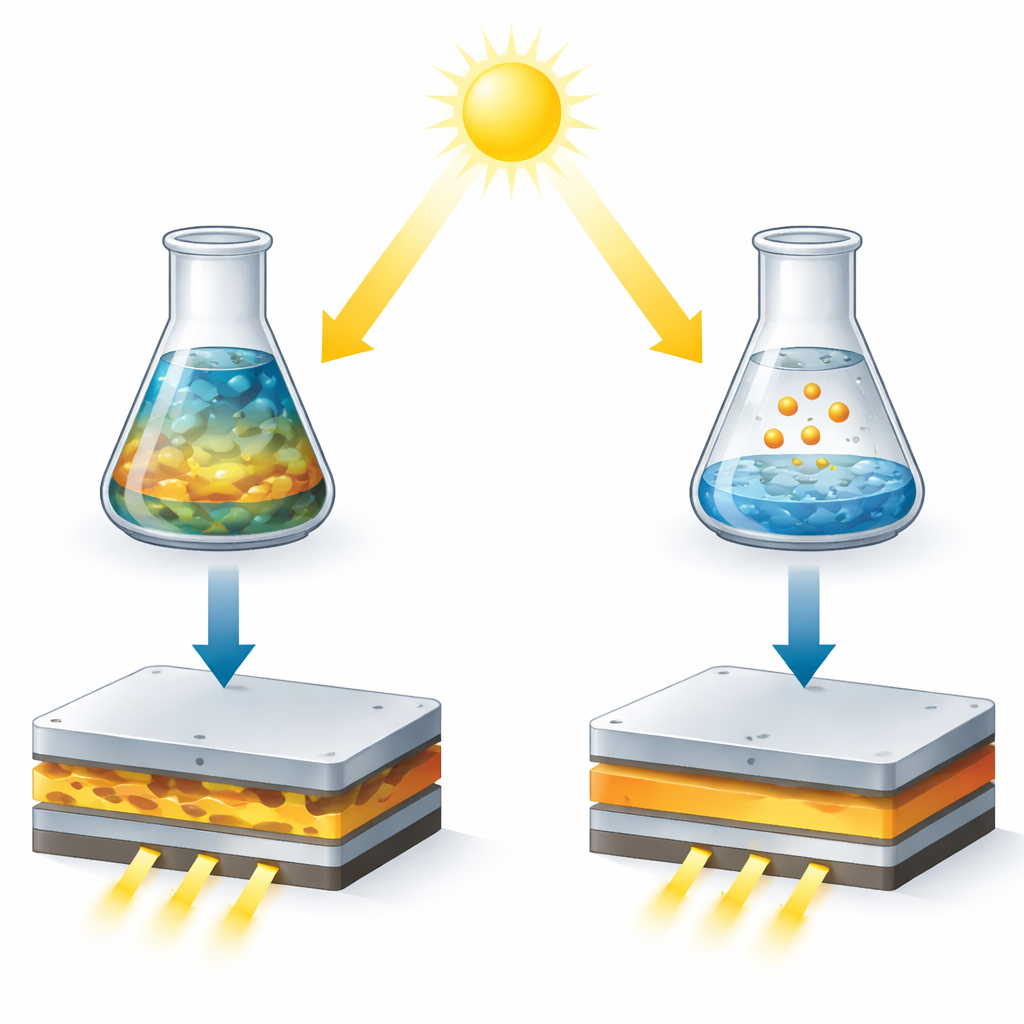
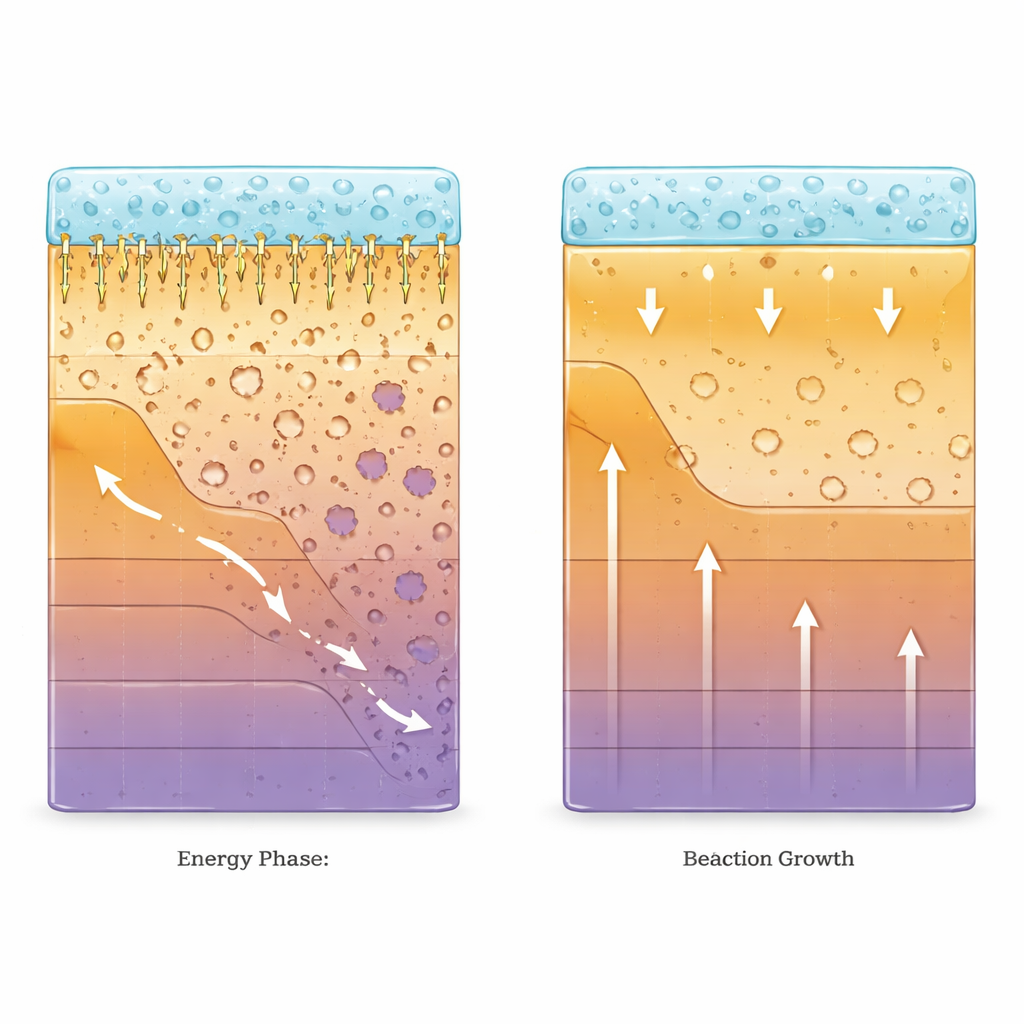
To grow these light‑absorbing films, many research groups use a hydrothermal method: glass coated with a thin “seed” layer is placed in a Teflon‑lined vessel filled with water and dissolved salts, then heated so that crystals form on the surface. Under standard conditions, the antimony source and a sulfur‑bearing salt react easily, while selenium from an added organic molecule is suddenly released in a burst. The team shows that this rush of selenium makes the bottom of the film richer in selenium and the top richer in sulfur, building in a vertical composition gradient. Microscopy images reveal voids and uneven structure near the bottom, and light‑emission maps confirm that the energy landscape inside the film tilts in an unfortunate direction, forcing electric charge carriers to climb an energy “hill” as they try to reach the outer contact.
Using a Simple Salt to Tame the Growth Process
The key innovation is the addition of a small amount of sodium sulfide to the precursor solution. This extra sulfide gently raises and stabilizes the acidity of the liquid and changes how sulfur and selenium‑containing species form and react over time. Instead of a sudden burst of selenium followed by depletion, the release becomes gradual and steady. As a result, sulfur and selenium are incorporated more evenly as the film grows, giving a nearly uniform composition from the bottom interface to the top surface. Electron microscopy and elemental mapping show that the structural voids largely disappear and the sulfur/selenium ratio becomes flat with depth. At the same time, the extra sulfide helps convert unwanted oxygen‑rich by‑products into the desired chalcogenide, cleaning up the film as it forms.
Cleaner Paths for Charges and Fewer Energy Traps
These structural and compositional improvements directly reshape how the material handles charges created by sunlight. Detailed measurements of light emission across a cross‑section of the film show that, without the additive, the energy levels bend in a way that blocks the flow of positively charged carriers (holes) toward the outer contact. With sodium sulfide, the energy bands become flat, removing this barrier so holes can move more freely. Separate defect‑spectroscopy experiments reveal that the density of deep “trap” states—linked to missing sulfur atoms and misplaced antimony atoms—is reduced by roughly two orders of magnitude. Fewer traps mean fewer non‑radiative recombination events where charges simply disappear as heat, and a higher effective carrier concentration that lowers internal resistance. Together, these changes boost both the current and the fill factor of the devices, even though a slightly thinner absorbing layer causes a small drop in voltage.
From Subtle Chemistry Tweaks to Better Solar Cells
By carefully dissecting the reaction pathways in the hydrothermal growth of antimony selenosulfide and then deliberately slowing and smoothing them with sodium sulfide, the researchers show that modest chemical tweaks can have outsized effects on solar performance. The improved films deliver a power conversion efficiency of 11.02%, with an independently certified value of 10.7%, setting a new benchmark for this class of devices. More broadly, the work demonstrates how controlling solution chemistry—rather than just device layering—can eliminate hidden gradients and defects that limit efficiency. These insights provide a roadmap for refining low‑temperature, solution‑processed solar materials, moving us closer to affordable, high‑performance thin‑film and tandem solar technologies.
Citation: Qian, C., Sun, K., Huang, J. et al. Regulation of hydrothermal reaction kinetics with sodium sulfide for certified 10.7% efficiency Sb2(S,Se)3 solar cells. Nat Energy 11, 415–424 (2026). https://doi.org/10.1038/s41560-025-01952-0
Keywords: antimony selenosulfide solar cells, hydrothermal thin films, sodium sulfide additive, defect reduction in photovoltaics, tandem solar technology