Clear Sky Science · en
Territoriality modulates the coevolution of cooperative breeding and female song in songbirds
Why bird song stories are changing
For decades, birdsong has been told as a tale of showy males serenading choosy, quiet females. But field biologists are now realizing that in many songbird species, females sing too—and not just occasionally. This study asks a deceptively simple question with big consequences: when birds live in family-style groups that help raise young together, does that change which sex sings, how songs evolve and how tightly birds defend their turf?
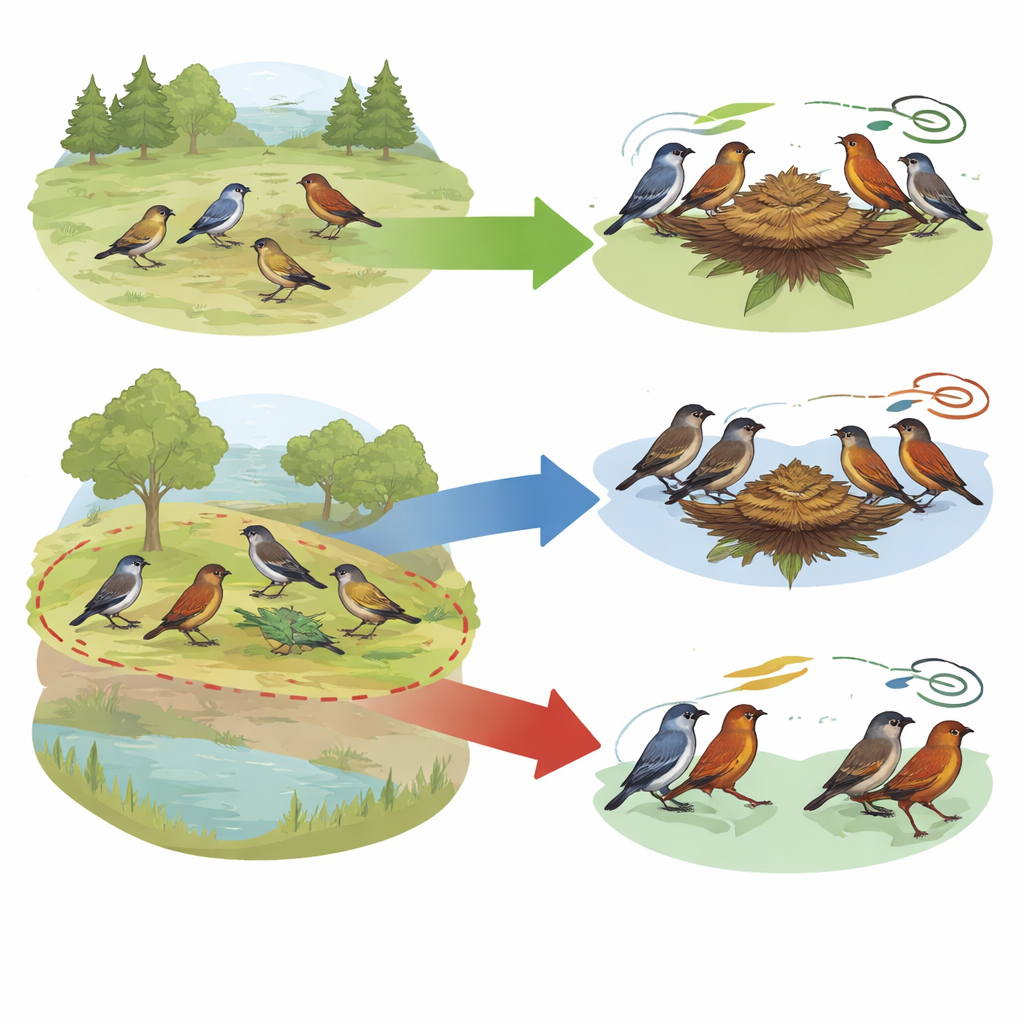
Bird families that raise chicks together
Many songbirds do more than form simple pairs. In roughly one in eight species, extra adults—often older offspring or other relatives—help parents feed and protect nestlings. This “cooperative breeding” lifestyle reshapes daily life: who competes for breeding spots, who guards food-rich areas and how long group members stay together. The authors compiled several large datasets for more than a thousand songbird species, including whether they use cooperative breeding, whether females sing, how complex male songs are and how fiercely each species defends a territory.
Tracing songs and family life on the tree of birds
Using a global family tree of songbirds, the team simulated how traits like cooperative breeding and female song were gained and lost over evolutionary time. They found a strong pattern: species with cooperative breeding and species with singing females overlap far more than expected by chance. Once female song appears in a cooperative lineage, it tends to stick around; in contrast, female song disappears more readily in species where adults do not help each other raise young. The analyses also suggest feedback in the other direction: lineages in which females already sing may be more likely to evolve cooperative care, though this signal is weaker.
Territory shape-shifts the link between song and cooperation
Territorial behavior turned out to be a crucial piece of the puzzle. Female song and cooperative breeding are both more common in species that defend territories, but that overlap alone could not explain their tight association. When the authors separated species into strongly territorial and weakly or non-territorial groups, a striking pattern emerged. In species that barely defend space, cooperative breeding and female song are each rare, yet when either does occur, they almost always occur together. In strongly territorial species, both traits are already common and their partnership is noticeable but less dramatic. This suggests that in highly contested landscapes, females may sing mainly to help defend resources, whereas in more relaxed settings, female song may have evolved for different reasons tied to group living.
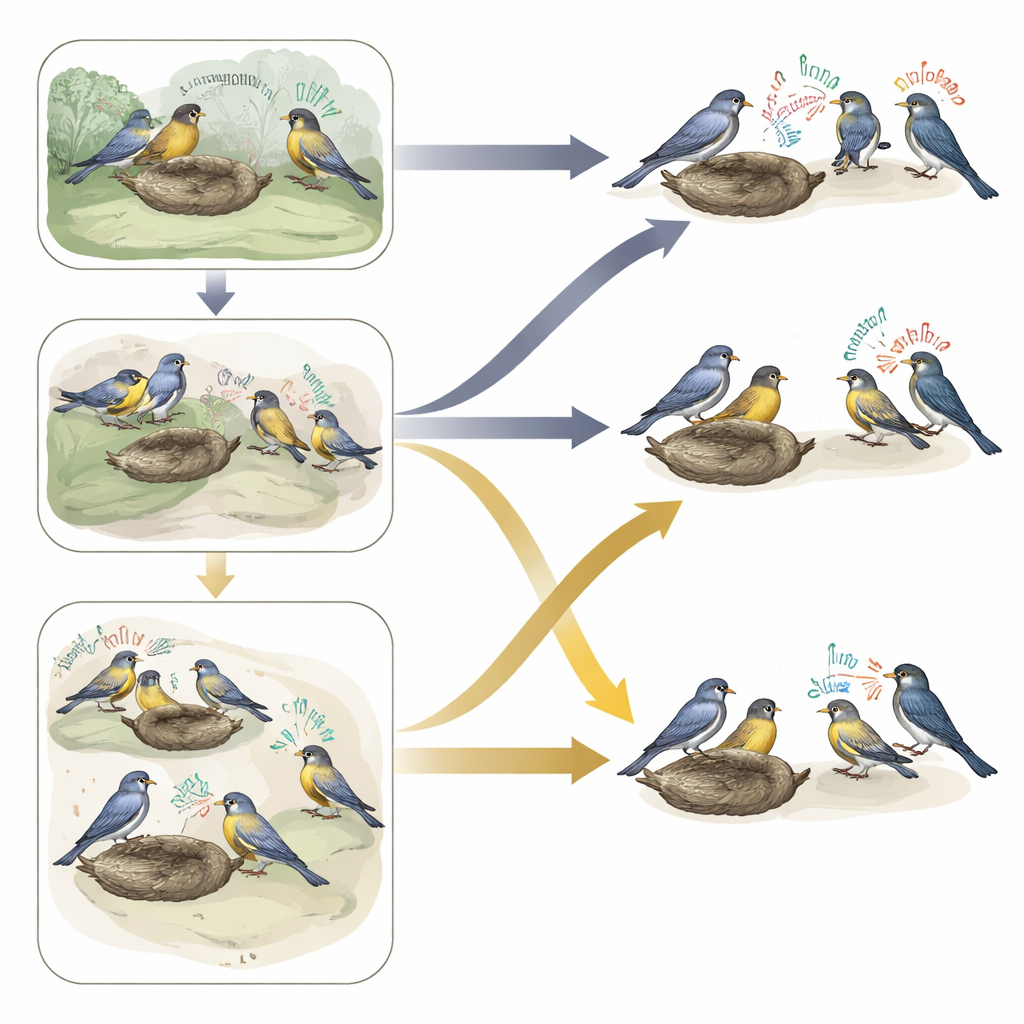
Different stories for male and female songs
Song is not just present or absent; its complexity can change too. The researchers examined the size of male song “repertoires”—how many distinct song types a species’ males typically sing—and how quickly these repertoires shift across the bird family tree. They found that male repertoires evolve more slowly in cooperative or tightly knit family systems, regardless of territorial style. By contrast, repertoire size changes fastest in species that live in simple pairs, form short-term social bonds, live in very large groups or breed in colonies—settings where competition for mates and space may be intense. This contrast hints that male and female songs respond to different pressures: male song may be tempered to avoid disrupting stable family groups, while female song is specifically favored in cooperative, kin-based systems.
Singing to keep the group together
The authors argue that female song in cooperative breeders is best understood not as a weapon in mating battles, but as social glue. In many such species, females sing in duets with mates, call to offspring after they leave the nest and use song to recognize relatives and long-term neighbors. These uses fit a picture in which song helps coordinate shared care of young, maintain bonds among helpers and reduce harmful conflict inside the group. Under this view, lineages where females already sing for coordination may be especially well prepared to transition into cooperative breeding, and once cooperation is established, selection keeps female song in place.
What this means for how we think about birdsong
This work shows that birdsong is not just a male show for romance and boundary defense. Instead, who sings—and how those songs evolve—depends strongly on social structure. Cooperative breeding and female song reinforce each other, especially in species that are less obsessed with defending territories, while stable family living slows the arms race in male song complexity. For non-specialists, the key message is that bird societies and bird songs are entwined: to understand one, we must listen to both males and females and pay attention not only to who they court or fight, but also to how they cooperate.
Citation: Snyder, K.T., Loughran-Pierce, A. & Creanza, N. Territoriality modulates the coevolution of cooperative breeding and female song in songbirds. Nat Ecol Evol 10, 536–549 (2026). https://doi.org/10.1038/s41559-026-02981-y
Keywords: cooperative breeding, female birdsong, territorial behavior, songbird sociality, vocal evolution