Clear Sky Science · en
A digital twin for real-time biodiversity forecasting with citizen science data
Listening to Nature with Your Phone
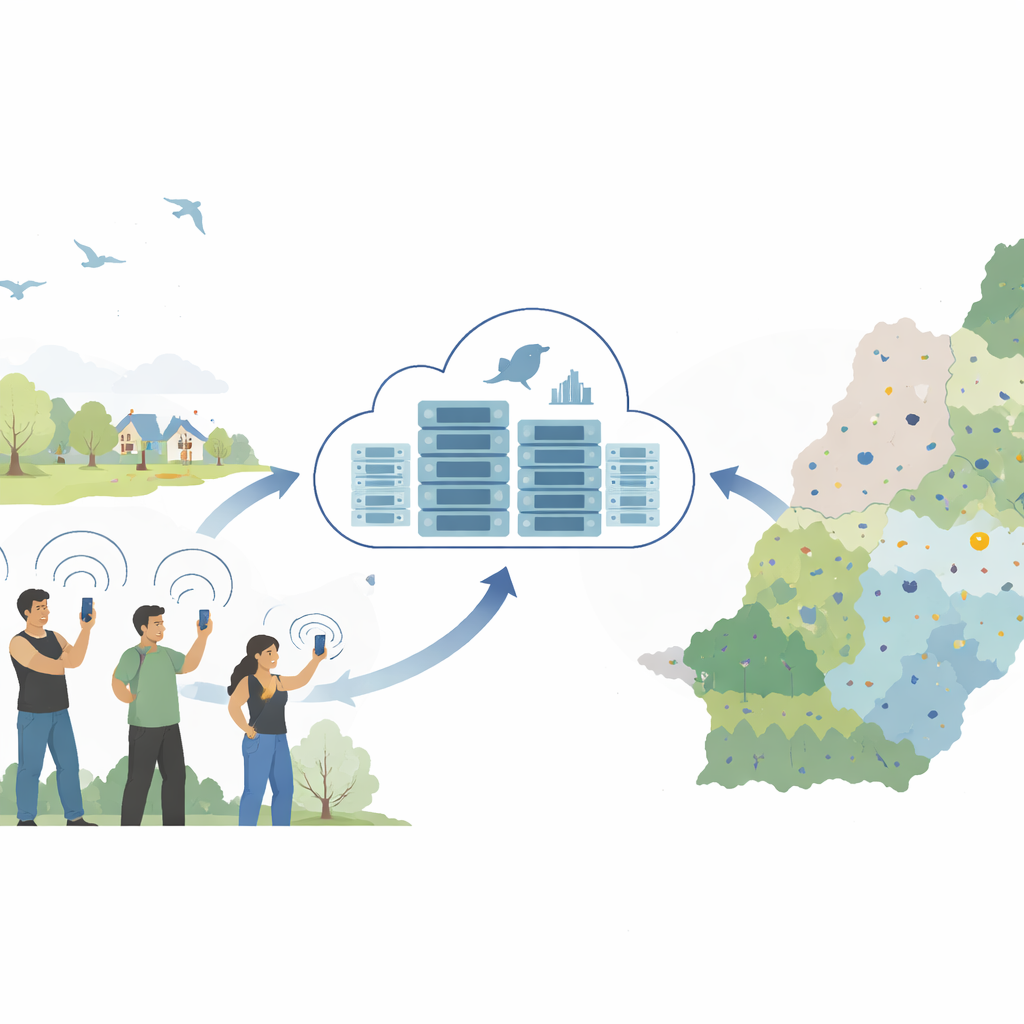
Imagine stepping outside, pressing record on your phone and, within hours, your short clip of birdsong helping scientists map where species are right now and where they are heading tomorrow. This study shows how everyday people, even those who cannot name a single bird, can still fuel a powerful forecasting system for wildlife. By turning millions of short recordings into a constantly updated "digital twin" of bird life across Finland, the researchers demonstrate a blueprint for tracking biodiversity in near real time—something conservationists have long needed but never quite achieved.
Why Watching Wildlife Is So Hard
Healthy ecosystems underpin clean air, food, climate stability and our overall wellbeing, yet we still struggle to say with confidence where many species are at any given moment. Traditional surveys by experts are careful but slow and patchy, while huge online projects where volunteers report sightings can be noisy and biased. Enthusiasts differ in their skills, people go birding mostly in pleasant places and at convenient times, and many records lack precise information on effort. As a result, even with massive databases, it is difficult to separate real changes in wildlife from quirks in how, where and when people look for it.
A Living Digital Copy of Bird Life
The team tackled this problem using the idea of a "digital twin"—a living computer model that mirrors a real system as it changes through time. In this case, the twin tracks when and where 263 bird species occur in Finland and how loudly they are singing. Each night, the model is updated with the latest data flowing in from citizens’ phones. It blends this stream with years of earlier information: expert bird counts along fixed routes, long-term records of when migrants usually arrive and depart, and continuous recordings from research stations. Together, these sources let the twin estimate three key ingredients for each species: whether it has reached a given latitude yet in the season, whether a particular spot is part of its normal range and how likely it is to be vocal there at a given time of day and year.
A Phone App that Hears for You
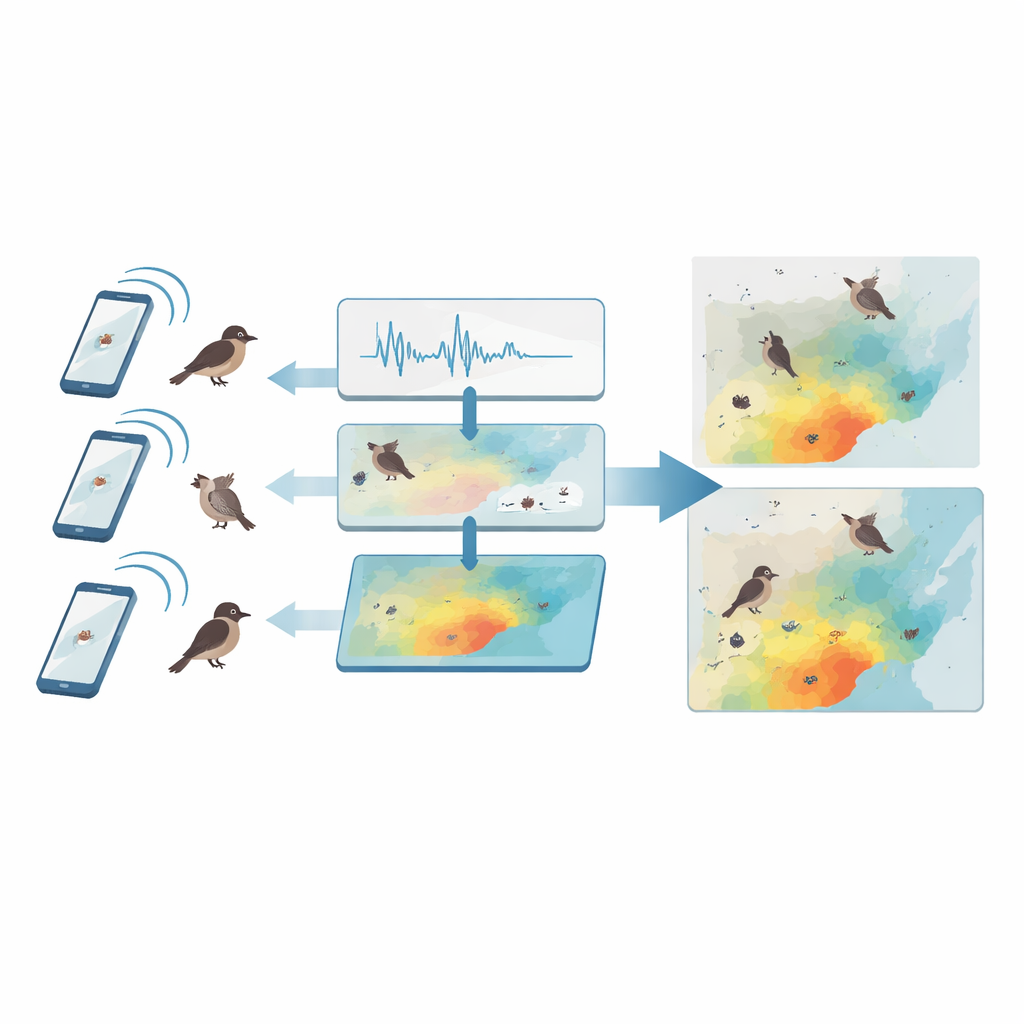
At the heart of the project is a free smartphone app, Muuttolintujen Kevät, or "Spring of Migratory Birds." Users simply record sound; they never have to identify what they hear. The app sends raw audio to a secure server, where an artificial-intelligence model—trained and fine-tuned on expert-labelled bird calls—screens for species and attaches a confidence score. To reduce common citizen-science biases, the app offers three recording modes. People can make quick direct clips, set automatic interval recordings that sample one minute every ten minutes (capturing dawn choruses without staying up) or use marked point-count spots in parks and along routes that spread sampling more evenly in space. Over just two years, more than 300,000 people—about 5% of Finland’s population—submitted over 16 million recordings, yielding 15 million high-confidence bird detections and turning the country into a vast acoustic observatory.
How the Digital Twin Learns and Improves
Each fresh batch of recordings teaches the twin something new. The system first adjusts for how likely the app is to notice a species at different times of day and year, depending on recording length and mode. It then refines its picture of migration timing, nudging its curves for arrival and departure in each year toward what the new data show while keeping them anchored to long-term averages to avoid overreacting to noise. Finally, it sharpens maps of where each species occurs by comparing predictions with nearby detections, allowing dense app data around cities and wetlands to correct older, coarser habitat maps. The result is a daily refreshed view of birds’ presence that can look very different from older models—especially for habitat specialists like reedbed warblers whose favourite spots were poorly captured by earlier surveys.
Putting Predictions to the Test
To see whether all this complexity actually pays off, the researchers ran two demanding tests. First, they asked how well the system could predict, one day ahead, which app recordings would contain a given species. For 89 common species, the updated digital twin clearly beat a model based only on past data, particularly for long-distance migrants whose timing varies from year to year. Second, they challenged the system with fully independent field surveys: expert birdwatchers conducted over a thousand short counts at strategically chosen sites, unaware of the model’s expectations. Again, the digital twin’s forecasts were more accurate than both the long-term model and a widely used global citizen-science product, despite the tiny differences in conditions that make such point-by-point predictions especially hard.
What This Means for People and the Planet
For a non-specialist, the main message is that your phone can now become part of a national early-warning network for nature. By offloading species identification to machines and carefully designing how and where people record sound, this approach turns scattered contributions from ordinary citizens into reliable, timely insight about wildlife. The gains in statistical accuracy may sound modest, but in the demanding game of forecasting which species will be where tomorrow, they represent a major leap. Scaled beyond Finland and beyond birds, similar digital twins could help track insects, frogs or entire soundscapes, shrinking the gap between environmental change and our response. In short, listening together—assisted by smart algorithms—may be one of our best tools for keeping pace with a rapidly changing living world.
Citation: Ovaskainen, O., Winter, S., Tikhonov, G. et al. A digital twin for real-time biodiversity forecasting with citizen science data. Nat Ecol Evol 10, 481–495 (2026). https://doi.org/10.1038/s41559-025-02966-3
Keywords: digital twin, citizen science, bird monitoring, biodiversity forecasting, acoustic ecology